Washington just admitted what the industry has known for a decade: the free market cannot fix a rigged game.

On February 2, 2026, the Trump administration pulled the trigger on “Project Vault,” a $12 billion strategic stockpiling initiative aimed at 13 critical minerals. For years, the U.S. watched as China executed a slow-motion strangulation of the global supply chain. Now, the federal government is attempting to build its own gravity well for the minerals that power everything from F-35s to the AI data centers currently devouring the power grid.
But if you think this is just a $12 billion check to buy some rocks, you’re missing the point. This isn’t about storage. It’s about creating a price floor in a market that has been historically allergic to stability.
For the junior mining sector, those small-cap explorers and developers that usually live or die by the whims of spot prices, Project Vault is the first real sign of a “demand signal” that isn’t dependent on a fickle consumer electronics cycle.
The $12 Billion Reality Check
Let’s be clear: $12 billion is a lot of money, but it’s also a rounding error in the context of global energy transition and defense needs. However, the way this money is being deployed is what’s shifting the landscape.
More Read

Project Vault isn’t just buying on the open market. It’s built on a public-private partnership framework designed to offer sustained offtake agreements. For a junior miner sitting on a world-class deposit in Nevada or Idaho but lacking the $500 million in CAPEX to build a mine, an offtake agreement from the U.S. government is better than gold. It’s bankable.

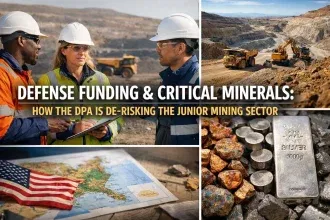
Traditionally, juniors have been hammered by the “Valley of Death”, the gap between discovery and production where funding dries up because the commodity price dropped 10% in a week. Project Vault effectively attempts to bridge that gap by signaling that the U.S. will be a buyer of last resort for processed minerals.
More Read

De-risking the “Small Guys”
The strategic calculus here isn’t subtle: Washington wants to decouple. To do that, they need more than just one or two “majors” like Rio Tinto or Freeport-McMoRan. They need a robust ecosystem of junior miners to find and develop the next generation of domestic resources.
Junior miners have long been the R&D department of the mining industry. They take the geological risks that the big guys won’t. But in the critical minerals space, specifically with minerals like antimony, gallium, and heavy rare earths, the markets are too thin and too easily manipulated by Beijing’s export controls.
By committing to a $12 billion stockpile, the administration is essentially trying to neutralize the “China Discount.” When China’s critical minerals export controls tighten, prices usually spike and then crash as demand gets destroyed or substitution happens. Project Vault provides a shock absorber.
The Processing Choke Point
There is a nasty reality lurking beneath the surface of Project Vault, though. Washington doesn’t want raw ore. They don’t have much use for unrefined dirt. They want processed, high-purity chemicals and metals.
This is where the junior mining sector faces its biggest hurdle. If a company is just digging a hole and selling raw concentrate, they’re still at the mercy of the global smelting market, which is, you guessed it, dominated by China.

We’ve seen recent moves to address this, such as USA Rare Earth consolidating control of the Round Top project, but the broader sector is still lagging. Project Vault’s governance structure currently favors downstream security. If you’re a junior miner without a clear path to a processing facility, either your own or a domestic partner’s, you’re likely to see only indirect benefits.
The stockpile might raise the tide for everyone, but it’s the companies with refining capabilities that will be invited to the table for the $12 billion feast.
Global Price Stability: Floor or Ceiling?
The most frequent question I get from operators and investors is simple: will this actually stabilize prices?
The short answer: yes, but not in the way you might think.
By acting as a “buyer of last resort,” the U.S. government creates a price floor. If the market price for lithium or cobalt drops below a certain “strategic threshold,” the Vault starts buying. This prevents mines from going into care and maintenance every time the market has a bad quarter.
But it also creates a ceiling. If prices skyrocket, the government can theoretically release portions of the stockpile to cool the market and protect domestic manufacturers. For a junior miner, this is a double-edged sword. You lose the massive “moonshot” upside of a supply squeeze, but you gain the ability to actually get a loan from a bank because your revenue projections aren’t based on a volatile fever dream.
The Geopolitical Chessboard
2026 marks the inflection point where “National Security” and “Commodity Trading” finally merged into a single department.
While the U.S. builds Project Vault, other nations are scrambling. We’re seeing a global race to lock down supply. Look at Ghana’s bauxite boom or the ongoing revenue share demands at the Oyu Tolgoi mine. Resource nationalism is the new normal.
The U.S. is betting that $12 billion is enough to convince junior miners to keep their assets in the “Western Alliance” sphere rather than selling out to the highest bidder in the East. It’s a bold bet. Ironically, the very existence of Project Vault might drive prices higher as other nations: Japan, the EU, South Korea: launch their own stockpiling programs to avoid being left out in the cold.

What Happens Next: The 2026 Outlook
The clock is already ticking. The administration has set aggressive timelines for the first round of purchases under Project Vault. For junior miners, the next 18 months will be a scramble to prove “strategic relevance.”
Here is the grim truth: not every junior miner will survive this transition. The ones who are just “lifestyle companies” or “promotion plays” will be found out. Washington is looking for tonnage, purity, and domestic security. They aren’t interested in your slick PowerPoint if you can’t show a path to production by 2028.
However, for the operators who have the geology and the permits, the game has changed. The risk profile of a junior critical mineral project in the U.S. just dropped significantly. We are seeing a shift from “high-risk exploration” to “strategic infrastructure development.”
The Bottom Line
Project Vault isn’t a bailout. It’s a buy-in.
Washington is finally putting its money where its mouth is, and the $12 billion stockpile is the first real attempt to de-risk the upstream supply chain. For junior miners, this is the most significant tailwind in a generation. But it comes with strings attached: namely, the requirement for domestic processing and a focus on the 13 minerals the Pentagon cares about most.

The tide is turning. The question for junior miners is no longer just “Is the mineral there?” but “Can you get it into the Vault?”
2026 is the year we find out who can actually deliver. The era of cheap, globalized, “just-in-time” minerals is dead. Welcome to the era of the strategic stockpile.