The mining industry loves to talk about “long-term cycles,” but the reality on the ground this week suggests we are moving at a much faster, more violent clip. As of March 14, 2026, the gap between those who have secured their supply chains and those who are still “evaluating” is becoming a canyon.

Geology is fixed. Capital is flighty. And the permit process remains a gauntlet. This week, ten entities decided they weren’t waiting for the market to settle. They moved the needle.
Here is the definitive power list for the second week of March 2026.
1. Rio Tinto (Jakob Stausholm) – The Lithium Leviathan
Rio Tinto isn’t just dipping its toes into the battery metal pool anymore; they’ve dived in headfirst with a heavy weight tied to their ankles. This week, progress reports out of the Nemaska Lithium project in Quebec and the Rincon project in Argentina show a company that has realized iron ore alone won’t carry its valuation through the 2030s.
Stausholm is playing a high-stakes game of geopolitical chess. By fast-tracking Rincon’s starter plant, Rio is signaling to the market that they can navigate the “Lithium Triangle” better than the juniors who have stalled out. They are positioning themselves as the Western alternative to Chinese processing dominance. It’s expensive. It’s risky. But in a world starving for ESG-compliant lithium, Rio is becoming the only major with the balance sheet to actually build at scale.
More Read



2. Artemis Gold (Steven Dean) – The Blackwater Execution
While other developers are complaining about inflationary pressures in British Columbia, Artemis Gold is simply building. The Blackwater project is moving toward its first gold pour with a clinical efficiency that is frankly embarrassing for some of its larger peers.
Steven Dean has managed to keep Blackwater on a tight leash, proving that the “missing middle” of mining: the mid-tier producers: is where the real value is being unlocked in 2026. They aren’t just moving dirt; they are moving the expectations of what a modern, Tier-1 jurisdiction project looks like. Their ability to manage Tier-1 environmental standards while maintaining a construction schedule is the gold standard right now.
More Read

3. Trafigura – The Arkansas Strategists
The commodity trading giant has spent the last few years evolving into a de-facto miner and refiner. This week’s focus remains on their 10-year lithium supply deal linked to the Smackover Project in Arkansas.
Trafigura isn’t just buying ore; they are securing a decade of North American sovereignty. The Trafigura Smackover lithium update highlights a critical shift: the “Middleman” is now the “Foundational Partner.” By locking in Arkansas-sourced lithium, they are bypassing the traditional shipping bottlenecks and maritime risks that have haunted the sector since 2024. The strategic calculus here isn’t subtle: if you control the flow, you control the price.
4. BMO Capital Markets – The Copper Prophets
When BMO speaks, the TSX and ASX listen. Their latest report comparing the oil-to-copper spread has become the most-read document in Vancouver boardrooms this week. The analysts are doubling down on the copper price forecast for 2026, suggesting a $13,000/t milestone is not just a bull-case scenario: it’s a structural inevitability.
The report highlights a “grim” reality for manufacturers: the structural deficit is no longer a future threat; it is a present-tense crisis. BMO’s analysis of the “Andean Thirst” and its impact on output has forced investors to look at desalination as a mining cost, not a utility cost. They’ve moved the market by simply telling the truth about how hard it is to actually get copper out of the ground.

5. Fortescue (Dino Otranto) – The Automation Vanguard
Fortescue is no longer an iron ore company. It is a technology firm that happens to own some of the most productive pits in the Pilbara. This week, their rollout of next-gen “Safety Tech” and autonomous haulage systems has set a new benchmark for operational efficiency.
Dino Otranto is hammering out a vision where the human element is moved away from the “red line” of danger and into data centers. It’s not just about safety, though that’s the headline. It’s about the throttle. Autonomous machines don’t take lunch breaks, and they don’t get tired at 3:00 AM. Fortescue is squeezing every ounce of margin out of their operations, which they’ll need as they pivot toward their ambitious green hydrogen goals.
6. First Quantum (Tristan Pascall) – The Survivalist
First Quantum is in the middle of a masterclass in balance sheet repair. This week’s news that First Quantum sold the Cayeli mine for $340M is a surgical move. Cayeli was a productive asset, but Pascall knows he needs a war chest to handle the ongoing Cobre Panama saga.
Selling a limb to save the heart is a nasty business, but it’s necessary. The market has responded with cautious optimism. By offloading non-core assets in Turkey, First Quantum is signaling that they are digging in for a long fight in Panama. They aren’t surrendering; they are consolidating.
7. Lundin Mining – The Vicuña Conquerors
Lundin Mining has been aggressively expanding its footprint in the Vicuña District, recently closing a $215M stake increase. They are essentially building a new copper province on the border of Chile and Argentina.
The Vicuña District is one of the few places left on Earth where multi-decade, high-grade copper discoveries are still happening. Lundin’s dominance here makes them a prime target for a major buyout: or the next great diversified major themselves. They are moving the needle by proving that “elephant hunting” in the Andes is still possible if you have the stomach for the altitude and the politics.

8. NexGen Energy – The Uranium Bull
As the world wakes up to the fact that “Net Zero” is impossible without nuclear, NexGen Energy has become the belle of the ball. With construction greenlit for the Rook I uranium mine in the Athabasca Basin, the timeline is finally moving from “proposed” to “producing.”
The 2026 construction window is the inflection point. Rook I isn’t just another mine; it’s a strategic asset for the entire Western nuclear fleet. As Kazakhstan’s supply remains geopolitically “complicated,” NexGen is sitting on the highest-grade uranium play on the planet. They moved this week by simply staying on schedule: a rare feat in the uranium space.
9. US Antimony / U.S. Government – The Defense Shield
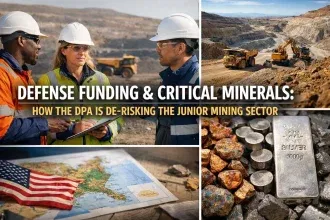
This was the week the U.S. government decided to stop talking about “mineral sovereignty” and start paying for it. The $27M injection into US Antimony is a direct shot across the bow of the China-Russia grip on the market.
Antimony is essential for everything from armor-piercing ammunition to flame retardants. By de-risking a junior miner through defense funding, the DoD is creating a new model for project finance. It’s not about the IRR; it’s about the national security interest. This move has sent ripples through the junior market: everyone is now looking for the “Antimony angle” to get a piece of that federal pie.
10. Taseko Mines – The Greenfield Winner
Starting a new copper mine in the United States is almost impossible. And yet, Taseko did it. Florence Copper is now beginning operations, marking the first greenfield copper production in the U.S. in nearly two decades.
This isn’t just a win for Taseko; it’s a proof of concept for “in-situ” copper recovery. By using a low-impact extraction method in Arizona, they’ve managed to bypass the usual “not-in-my-backyard” firestorm that kills most projects. They moved the needle this week by proving that you can actually build a mine in America if you’re smart about the technology and the community.
The Bottom Line for March 14
The theme of this week is Strategic Consolidation. Whether it’s First Quantum selling assets to focus on their core, or the U.S. government funding antimony to break a monopoly, the players on this list aren’t interested in “business as usual.”
They understand that in 2026, the industry is no longer just about digging holes. It’s about technology, geopolitics, and the brutal reality of the energy transition. The clock is ticking on the supply side, and these ten movers are the ones actually trying to wind it.