The era of the “low-hanging fruit” in mining is officially dead. As surface deposits thin out and grades decline, the industry is being forced deeper into the earth, where the margins are tighter and the risks are higher. This isn’t just a challenge of geology; it’s a challenge of economics.

On March 18, 2026, Glencore’s Raglan Mine hit a milestone at its Anuri site that marks a definitive shift in how we measure operational success. They didn’t just move more rock. They achieved a seamless integration of autonomous haulage in one of the most punishing environments on the planet.
This isn’t just a technical win for Glencore. It’s a survival blueprint for an industry currently being strangled by cost inflation and labor shortages.
The Brutal Reality of Deep-Mine Economics
Mining cost inflation isn’t a theory; it’s a daily assault on the balance sheet. All-In Sustaining Costs (AISC) have been trending upward for years, driven by energy prices, consumables, and the sheer complexity of operating at depth. When you go deep, everything gets more expensive. Ventilation requirements skyrocket. Haulage cycles get longer. The margin for human error shrinks to near zero.
In the sub-Arctic conditions of Northern Quebec, these pressures are magnified. Raglan isn’t just a mine; it’s a logistical feat. For Glencore to push the “autonomous” button at Anuri, they had to prove that the tech could handle the brutal reality of the Canadian North.
More Read

They proved it. That’s a benchmark.

Autonomous Haul Trucks: The New Mandatory
Ten years ago, autonomous haulage was a “nice-to-have” for the Tier 1 miners with deep pockets and a thirst for innovation. Today, it’s a “must-have” for any deep-mine feasibility study.
The math is simple. Human operators, while skilled, are subject to the physical limitations of the shift. They need breaks. They need shift changes. They need oxygen and cooling in environments that are increasingly hostile. Autonomous trucks don’t.
More Read


A candid, documentary-style shot of a weather-beaten autonomous haul truck parked at a staging area, showing the grit and dust of an active northern operation without the glossy sheen of marketing materials.
By implementing autonomous haulage systems (AHS), Raglan is targeting a level of utilization that manual fleets simply cannot match. We are talking about 24/7 operations with millisecond-perfect timing. No “hot changes.” No downtime between shifts. In a deep-mine scenario where the haulage ramp can be kilometers long, every second saved is a direct contribution to the bottom line.
Safety is a Margin Driver, Not a Slogan
The industry likes to talk about “Zero Harm,” but the cold reality is that safety and profitability are inextricably linked. Every safety incident is a human tragedy, yes, but it’s also a massive operational disruption. It triggers investigations, halts production, and spikes insurance premiums.
By removing the operator from the cab in the high-risk zones of the Anuri site, Glencore has effectively removed the most vulnerable variable in the safety equation. Mine safety isn’t just about better hard hats anymore; it’s about removing people from the line of fire entirely.
When you look at the AISC trends for 2026, the operations that are successfully controlling their costs are the ones that have minimized their risk profile through automation. It’s a cleaner, more predictable way to run a business.
The Social License and the Tech Evolution
One of the most significant aspects of the Raglan milestone is the context of its partnership with the Inuit communities. Technology is often viewed as a threat to local employment, but Raglan has reframed it as an evolution.
This isn’t just about replacing a driver with a computer. It’s about shifting the workforce into higher-value roles: tech monitoring, remote operations, and systems maintenance. It’s a move toward a more sustainable, high-tech career path for the local community. This is critical for maintaining the social license to operate in sensitive regions.
The industry is watching. If Glencore can make this work in the Arctic, the “it won’t work here” excuse from other operators officially dies.
AISC Trends and the 2026 Outlook
As we move further into 2026, the gap between the “automated” and the “manual” is going to widen. We are seeing a divergence in the market where high-margin operations are defined by their digital maturity.
Consider the shift we’ve seen in other jurisdictions. For instance, Orla’s underground shift has highlighted how high-margin operations are being built on a foundation of technical efficiency. Raglan is the same story, just on a larger, more rugged scale.
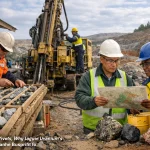
![[IMAGE] Mining professionals in safety gear review site plans and pose in an open-pit mine](https://cdn.marblism.com/vZNLHL60ddU.webp)
The investment required for autonomous fleets is substantial, sure. But the ROI is found in the consistency of the data. When every truck moves at the same speed, takes the same line, and consumes the same amount of fuel, the mine becomes a factory. And factories are much easier to optimize than chaotic, manual pits.
Why This is the New Benchmark
What makes the Anuri milestone at Raglan the new benchmark?
- Environmental Resilience: The tech held up in sub-zero, high-latitude conditions.
- Productivity Gains: The shift from batch-style haulage to a continuous, autonomous flow.
- Predictability: The ability to forecast output with a precision that was previously impossible.
The industry cannot ignore these results. As we see global silver production growth and the push for critical minerals, the pressure to produce “more for less” is relentless.
The Integration Challenge
It hasn’t been a walk in the park. Integrating autonomous systems into an existing mine like Raglan requires a total overhaul of the communication infrastructure. You need high-speed, low-latency connectivity miles underground. You need a data center that can handle the telemetry from a dozen trucks simultaneously.
This is where many companies fail. They buy the trucks but forget the “brain.” Glencore’s success here suggests they’ve solved the connectivity puzzle in one of the toughest spots on Earth.

A documentary-style photo of a technician in a dusty, dimly lit server room at a mine site, focusing on the tangled cables and glowing LEDs that power the “brain” of an autonomous operation.
Beyond the Trucks: A System-Wide Shift
Autonomous haulage is just the tip of the spear. Once you have a reliable, automated haulage loop, the rest of the mine starts to follow. Automated loading, remote-controlled blasting, and AI-driven ore sorting are the next logical steps.
We are seeing similar trends in other sectors, such as the uranium ISR technology that is revolutionizing fuel production through low-impact, high-tech methods. The common thread? Technology is being used to bypass the physical and economic constraints of traditional mining.
The Investor Perspective
For investors, the Raglan milestone is a signal. In an era of volatile commodity prices, the winners are the ones who can protect their margins against inflation. If a company isn’t talking about its automation roadmap in 2026, they aren’t just behind the curve: they are a risk.
Glencore is signaling that they are ready for the long game. They are turning Raglan into a laboratory for the future of deep mining.
Summary: Adapt or Fade
The milestone at Anuri isn’t just a headline in a mining trade journal. It’s a warning shot. The days of “business as usual” are over.
Autonomous haulage is no longer a futuristic dream. It is a present-day necessity for any operation that intends to stay competitive in an environment of rising costs and declining grades. Glencore has set the bar. Now, the rest of the industry has to figure out how to clear it.
The strategic calculus here isn’t subtle: automate the routine, protect the people, and let the machines handle the grit. That’s the only way forward.