Silicon Valley spent billions on Large Language Models that hallucinate recipes and write mediocre poetry. Meanwhile, in the high deserts of the Utah Copper Belt, a different kind of intelligence is doing something actually useful: moving millions of tons of earth and refining critical minerals without a human hand on the controls. This is Physical AI. It isn’t a digital assistant; it’s an industrial overhaul.

Mariana Minerals is currently proving that the traditional mining model: dependent on a dwindling pool of skilled labor and high-grade geologic luck: is obsolete. Their Utah Copper One project isn’t just a mine; it’s the debut of MarianaOS, an autonomy-first operating system designed to manage everything from the excavator bucket to the final copper cathode.
The goal? A seamless 50,000 tonnes per year of high-purity copper. The method? Agentic workflows that treat mining as a robotics problem rather than a civil engineering one.
The Labor Crisis Is a Wall, Not a Speed Bump
The mining industry likes to talk about “labor shortages” as if it’s a seasonal flu that will pass once the right recruitment campaign kicks in. It won’t. The data is grim. By 2026, the industry faces a structural deficit of skilled operators that no amount of sign-on bonuses can fix. The workforce is aging out, and the next generation isn’t interested in living in remote camps.

More Read

Mariana Minerals isn’t trying to win the recruiting war. They’re side-stepping it entirely. By deploying MarianaOS, the company is shifting the labor burden from “operators” to “agents.” In the Utah Copper Belt, this means the heavy machinery doesn’t just follow a GPS path; it perceives its environment, adjusts for rock density, and communicates with the processing plant in real-time.

This isn’t just remote-controlled trucking. That’s old news. This is agentic autonomy: where the machine makes tactical decisions on-site to optimize the flow. It’s the difference between a puppet and an athlete.
MarianaOS: The Brain of the Utah Copper One
At the heart of the Utah operation is MarianaOS. Think of it as a “digital twin” that actually has the power to pull the levers. Most digital twins in the industry are glorified dashboards: they show you what’s breaking but don’t do anything about it. MarianaOS is different. It is an “autonomy-first” system, meaning human intervention is the exception, not the rule.
More Read
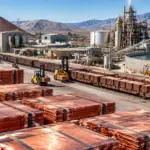
The system uses a suite of proprietary sensors and computer vision to turn the “messy” reality of an open-pit mine into structured data. For the Utah Copper One project, this translates to a massive reduction in operational volatility.
Key Technical Pillars of MarianaOS:
- Predictive Geologic Mapping: Continuous updates to the block model based on real-time sensor data from the drill bits.
- Dynamic Load Balancing: Agentic trucks that don’t just wait in line but re-route based on the crushing circuit’s current throughput.
- Chemical Feedback Loops: The refinery talks to the pit. If the ore grade fluctuates, the refinery adjusts its reagent mix automatically.
This level of integration is necessary because the global copper industry faces a $2.1 trillion investment gap to meet demand by 2050. You can’t bridge that gap with 20th-century processes.
The Hybrid Feedstock Strategy: Geologic Meets Scrap
One of the most radical aspects of the Mariana Minerals play in Utah is their approach to feedstock. Traditional mines are “pure-play”: they dig holes and process what they find. Utah Copper One is designed as a hybrid facility.
The plant is built to integrate both virgin geologic ore and scrap copper feedstock. This is a logistical nightmare for a traditional refinery. Virgin ore has a predictable chemical profile; scrap is a chaotic mix of alloys and contaminants.

MarianaOS solves this through Physical AI. The system monitors the “mix” in the refinery in real-time, using AI-driven sorting and chemical analysis to balance the feed. This allows Mariana to throttle up scrap intake when ore grades dip or when the market price of secondary copper is favorable.
This hybrid model targets an output of 50,000 tonnes per year. To put that in perspective, that’s enough copper to power roughly 500,000 electric vehicles annually. It’s a “circular” mining model that actually scales, unlike the small-scale “black mass” experiments we see elsewhere. For context on how the industry is pivoting toward this type of circularity, one only needs to look at the $1.1B black mass pivot being led by Trafigura.
Solving the Efficiency Trap
Mining has historically been a game of “bigger is better.” Bigger trucks, bigger pits, bigger capex. But the “Copper Titan” era of $7.5B expansions, like Freeport-McMoRan’s bid at El Abra, is only half the story. The other half is efficiency at the mid-tier level.
Mariana Minerals is targeting the “Goldilocks” zone: large enough to matter for the domestic supply chain, but smart enough to avoid the crushing overhead of traditional mega-projects. By using Physical AI, they reduce the “energy tax” of mining.
Traditional hauling is incredibly inefficient. Trucks burn diesel while idling, wait for shovels, and travel sub-optimal routes. In Utah, MarianaOS minimizes these “dead moments.” The result is a lower carbon intensity per tonne of copper produced. It’s not about being “green” for the sake of PR; it’s about being lean because diesel is expensive and waste is a margin-killer.

Suggested caption: Advanced AI-driven haulage systems at Utah Copper One optimize fuel consumption and cycle times.
The Geopolitical Calculus: Utah vs. The World
The location isn’t an accident. The Utah Copper Belt is one of the most prolific mineralized zones in North America. But in 2026, being “prolific” isn’t enough. You have to be “permissible.”
With the U.S. government aggressively funding domestic mineral security, Mariana Minerals is positioned as a “safe” bet. They aren’t dealing with the sovereign risk of South America or the infrastructure hurdles of the Greenlandic mining industry. Utah offers a stable regulatory environment, but it comes with high costs.
The only way to make U.S. copper competitive with low-cost overseas operations is through technology. You can’t out-pay the labor in developing nations, but you can out-automate them. MarianaOS is essentially a hedge against the high cost of doing business in America.
The Agentic Workflow: Beyond Automation
Let’s be clear: “Automation” is a script. “Agentic workflows” are a strategy.
In a traditional automated mine, if a truck encounters an unexpected boulder in its path, it stops. It waits for a human to clear the code. In an agentic mine powered by MarianaOS, the truck’s Physical AI evaluates the obstacle. It checks its sensors, communicates with the drone-survey layer, and decides whether to navigate around it or signal a specialized “cleaner” agent to move it.
This happens in seconds. No radio calls. No downtime.
This level of self-correction is what will allow Mariana to hit that 50,000-tonne mark. Mining is a series of interruptions. The company that manages those interruptions most efficiently wins.

2026: The Inflection Point
The Utah Copper One project is currently in its final commissioning phase for the MarianaOS integration. This isn’t a pilot program; it’s the full-scale deployment.
The industry is watching. If Mariana can prove that Physical AI can handle the variability of both geologic and scrap feedstock at scale, the valuation of traditional “dumb” mines will start to look very different. Investors are already looking for more tech-heavy plays, as seen in the recent Rio Tinto acquisition of Arcadium Lithium.
The strategic calculus here isn’t subtle: The world needs more copper, we have fewer people to dig it up, and the earth isn’t giving up its secrets any easier. You can either keep throwing more money at old problems, or you can change the operating system.
Mariana Minerals has chosen the latter. In the Utah Copper Belt, the “shiny AI revolution” is finally getting its hands dirty.