By Penny Laneford

The mining industry enters the second quarter of 2026 facing a landscape defined by aggressive capital mobilization and a fundamental shift in how critical minerals are secured. As global supply chains decouple and the energy transition accelerates, the demand for timely, high-accuracy intelligence has never been higher. To meet this demand, Skillings Mining Review has launched Operation 100K: a dedicated content engine designed to provide 14 daily updates, ranging from high-stakes M&A “hard news” to deep-dive technical analyses.
As of March 31, 2026, the sector is reacting to massive state-level interventions in Canada and a $5 billion commitment from BHP to secure copper dominance in Chile. These developments reflect a broader trend where operational efficiency and geopolitical alignment are now the primary drivers of project valuation.
Strategic Capital: Canada’s $12.1 Billion Critical Minerals Surge
In a move that has recalibrated expectations for North American supply chain resilience, the Canadian government has secured 30 new critical minerals partnerships. These agreements represent $12.1 billion in committed capital, specifically targeting mining projects that alleviate Western dependence on volatile foreign markets.
The influx of capital is not merely a subsidy program; it is a strategic de-risking mechanism for junior miners. Historically, junior projects have struggled with the “valley of death”: the gap between discovery and production. By fostering these partnerships, Canada is ensuring that the exploration breakthroughs seen in late 2025 transition into active production by 2027. This mirrors the momentum discussed at PDAC 2025, which served as a catalyst for this new era of global collaboration.
More Read



Copper Expansion: BHP’s $5 Billion Bet on Escondida
In Chile, BHP has confirmed a $5 billion upgrade at its Escondida mine, the world’s largest copper producer. The objective is to maintain a massive production profile of 460,000 tons per day. This expansion comes at a critical time as the industry grapples with a widening copper deficit in 2026, largely driven by refining bottlenecks rather than just mine-level extraction limits.
The Escondida upgrade focuses on leaching technologies and infrastructure improvements to handle lower-grade ores: a challenge facing many mature mines globally. For investors, the BHP move signals a long-term bullish outlook on copper, despite short-term price volatility. The ability to maintain high output at Escondida is seen as a benchmark for the industry’s ability to meet the requirements of the global electrification movement.
More Read
Uranium and the Nuclear Renaissance
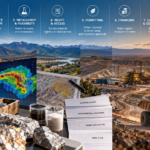
The energy-mining nexus is perhaps most visible in the uranium sector. Uranium Energy Corp (UEC) recently received regulatory approval for expanded in-situ recovery (ISR) production at Christensen Ranch in Wyoming. Furthermore, the Nuclear Regulatory Commission (NRC) has approved a U.S.-based conversion facility, a vital link in the domestic fuel cycle.
This surge in uranium production is inextricably linked to the rise of Small Modular Reactors (SMRs). As the mining industry seeks decarbonized power solutions for remote sites, SMRs are emerging as the next power play, offering a stable, carbon-free baseload that renewables alone cannot provide.
Table: Projected 2026 Output for Key Critical Minerals
| Mineral | 2026 Est. Global Output (MT) | YoY Growth (%) | Primary Driver |
|---|---|---|---|
| Copper | 23.5M | +3.2% | Escondida expansion / DRC output |
| Uranium | 62,000 (U₃O₈) | +8.5% | Wyoming ISR / Kazakhstan restarts |
| Lithium | 1.1M (LCE) | +12.0% | Rio Tinto/Arcadium integration |
| Tungsten | 95,000 | +4.1% | IMA Project / New exploration |
Exploration Breakthroughs: The IMA Project
In the realm of exploration, American Tungsten has reported significant mineralization at its IMA Project. Drilling results indicate high-grade intervals, including 17 feet at 1.28% WO₃. Tungsten is often overlooked in the “battery metal” hype, yet it remains indispensable for industrial applications, including the manufacturing of the very mining equipment used to extract other critical minerals.
These discoveries are vital because the U.S. remains heavily reliant on imports for tungsten and cobalt. Current data shows the U.S. is 100% import-dependent for cobalt, a vulnerability that has prompted new calls for domestic mining support and international partnerships.

Automation and Digitalization: The Operational Edge
The March 2026 Global Mining Review highlights that the “digital mine” is no longer a future concept but a current operational requirement. Key focus areas for the first half of 2026 include:
- Autonomous Haulage Implementation: Reducing human risk in deep-pit environments and optimizing fuel consumption.
- Custom Haul Truck Solutions: Designing fleets specifically for the unique topography of high-altitude mines, such as those in the Vicuña District.
- Digital Blasting Solutions: Using AI to predict fragmentation patterns, which directly reduces the energy required for crushing and grinding.
- Particle Size Distribution (PSD): Implementing sensing technology to provide real-time data from mine-to-mill, ensuring processing plants operate at peak efficiency.
The integration of these technologies is a core theme in our industry transformation coverage, where data-driven sensing is proving to be as valuable as the ore itself.
Operation 100K: A Strategy for Informed Decision-Making
To keep pace with these rapid shifts, Skillings Mining Review has implemented the Operation 100K strategy. This initiative ensures that the professional mining community receives a consistent stream of 14 pieces of content daily.
The workflow is structured to mirror the needs of decision-makers:
- 00:05 – 02:00 ET: A burst of 4 hard news stories covering overnight M&A, regulatory shifts in Asia and Australia, and urgent commodity price movements.
- 02:00 – 23:59 ET: 10 deep-dive analysis posts, published every 90 minutes. These focus on ESG trends, workforce outlooks, and technical breakdowns of new mining technologies.
This cadence is designed to sustain a benchmark of high-quality engagement, targeting over 945 daily views and 577 active users who rely on skillings.net for their operational and investment intelligence.

Conclusion: The Road Ahead
As we navigate the complexities of 2026, the mining industry is shedding its reputation for slow adaptation. From the $12.1 billion in Canadian critical mineral partnerships to the automation of the world’s largest copper mines, the sector is moving at a tech-industry pace.
Operation 100K is our commitment to capturing this momentum. By providing a mix of immediate news and profound analysis, we ensure that operators, geologists, and investors are never more than 90 minutes away from the latest essential insight. The intersection of policy, technology, and capital is where the future of mining is being written, and Skillings is the primary record of that evolution.