By Salini Krishnan

The 2025-2026 winter season has solidified a troubling trend for Arctic and sub-Arctic operations: the “infrastructure trap” is no longer a theoretical risk, but a line-item reality on the balance sheet. For decades, the northern mining sector: particularly in Canada’s Northwest Territories and Nunavut: has relied on the seasonal reliability of “frozen” infrastructure. As the current operational window for the Tibbitt to Contwoyto Winter Road (TCWR) closes weeks earlier than historical averages, the industry is facing a fundamental redrawing of the cost curve.
The vulnerability of these operations stems from a dependence on sub-zero temperatures to provide the structural integrity required for heavy-haul logistics. When the ice thins and the permafrost softens, the bridge between the mine site and the global market effectively disappears. This analysis explores how shortening winter windows are forcing a pivot from seasonal ice roads to permanent, high-CapEx alternatives, and what this means for the valuation of northern assets in 2026 and beyond.
The Shrinking Window of the Tibbitt to Contwoyto Winter Road (TCWR)
The TCWR is arguably the most critical piece of seasonal infrastructure in the global mining industry. Serving major diamond mines and emerging critical mineral projects, this 400-kilometer lifeline: of which 85% is over frozen lakes: traditionally allowed for the transport of over 8,000 loads of fuel, explosives, and heavy equipment annually.
Historically, the road opened in late January and remained operational through the end of March. However, data from the last three seasons indicates a tightening pincer movement: later freeze-ups in January and earlier thaws in March. In 2026, the peak-load window has contracted to a mere 45 days, down from a 65-to-70-day historical average.
More Read

This contraction creates a “logistics squeeze.” Mining operators must now move the same volume of goods in 30% less time. This requires more trucks, more drivers, and more sophisticated dispatching systems, all of which drive up the cost per tonne. When the ice fails to reach the required thickness for heavy loads, the “trap” snaps shut, forcing companies to pivot to air freight: a move that can increase transport costs by 400% to 1,000% depending on the weight and urgency of the cargo.

The Permafrost Paradox: When Ground Becomes Liquid
The challenge isn’t just on the ice; it’s on the land bridges and the mine sites themselves. Permafrost: ground that remains frozen for two or more consecutive years: serves as the foundation for airfields, tailings facilities, and haul roads. As mean annual temperatures rise, the “active layer” of the soil (the part that thaws and refreezes) is deepening.
This degradation leads to thermokarst: land subsidence that turns solid roads into mud-filled quagmires. For infrastructure engineers, the cost of maintaining a gravel road on degrading permafrost is significantly higher than on stable ground. It requires constant grading, the use of expensive geotextiles, and in some cases, the installation of thermosyphons: heat pipes designed to keep the ground frozen artificially.
More Read


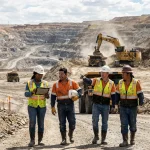
Infrastructure engineers inspecting a permafrost-affected gravel road in the Arctic, highlighting the structural instability caused by rising mean temperatures.
The long-term cost implications are staggering. A 2025 study on northern logistics suggests that for every 1°C increase in local temperature, the maintenance cost for northern all-weather roads increases by approximately 15%. For a remote mine, this isn’t just an operational nuisance; it is a threat to the life-of-mine (LOM) economic viability.
The Great Pivot: From Ice to Gravel and Air
As the reliability of winter roads falters, operators are being forced to consider two expensive alternatives: permanent gravel roads or year-round air bridges.
1. The All-Weather Road CapEx Hurdle
Building an all-weather road in the North is an immense undertaking. Estimates for the proposed “Slave Geological Province” corridor suggest costs exceeding $1 million per kilometer. While a permanent road eliminates the seasonal uncertainty, it requires a massive upfront capital investment that many junior and mid-tier explorers cannot bear. Furthermore, permanent roads bring increased environmental scrutiny and longer permitting timelines, which we have covered extensively in our Skillings Mining Review March 2025 issue.
2. The OpEx Burden of Air Logistics
When the road fails, the skies are the only option. However, moving bulk commodities or heavy fuel via air is a margin-killer. To mitigate this, some operators are investing in larger, more efficient landing strips capable of handling Boeing 737 or Hercules-class aircraft. While this improves reliability, the operational cost remains a significant drag on the project’s Net Present Value (NPV).

Strategic Adaptation: SMRs and the Energy Nexus
One of the most promising avenues for escaping the infrastructure trap lies in decoupling the mine from its reliance on massive seasonal fuel shipments. Fuel for power generation typically accounts for a significant portion of the total tonnage hauled over winter roads.
As explored in our analysis of the Nuclear Renaissance and SMRs, Small Modular Reactors offer a way to generate reliable, carbon-free power on-site for 10 to 20 years without the need for an annual fuel convoy. By reducing the logistics burden by 40% or more, SMRs could be the key to making northern projects resilient to climate-driven transportation disruptions.
Redrawing the Cost Curve: Investor Implications
For investors, the infrastructure trap necessitates a more rigorous approach to due diligence. Traditional cost curves often fail to account for the “volatility premium” of northern logistics. A project that appears low-cost on paper during a “good” winter can quickly become a cash-flow drain during a “bad” one.
We are seeing a shift in how these assets are valued:
- Infrastructure-Adjusted NPV: Analysts are increasingly applying higher discount rates to projects that are 100% dependent on seasonal ice roads.
- Inventory Carrying Costs: To guard against short winter windows, companies are holding larger inventories of critical spares and fuel. This ties up capital and increases the risk of loss, further weighing on valuations.
- The “Brownfield” Advantage: Projects located near existing permanent infrastructure or those that have already secured all-weather access are trading at a significant premium compared to their more remote counterparts.
The vulnerability is not unique to the Arctic. We have seen similar cascading cost pressures in other regions; for instance, flooding in 2022 increased unit costs by 22% for major Australian thermal coal miners. The lesson for 2026 is that climate change is not just an environmental metric: it is a primary driver of operational risk.
2026 Outlook: A New Operating Paradigm
As we look toward the 2027 season, the northern mining industry is at a crossroads. The era of cheap, reliable ice roads is ending. The “infrastructure trap” will likely lead to a period of consolidation, where only those projects with high enough margins to support permanent infrastructure or those that can innovate their way out of the logistics bottleneck will survive.
Government intervention will be critical. The Canadian federal government and territorial authorities are under pressure to co-fund “Northern Corridors” that serve both mining interests and local communities. These public-private partnerships (PPPs) may be the only way to unlock the vast critical mineral potential of the North without bankrupting the operators.
In the meantime, the industry must adapt to a shorter, warmer, and more expensive reality. The redrawing of the cost curve is well underway, and those who fail to account for the thinning ice will find themselves trapped by it.
Data Summary: Northern Logistics Shift (Est. 2026)
| Metric | Historical Average (1990-2010) | 2025-2026 Season (Observed) | Impact on Unit Cost |
|---|---|---|---|
| Winter Road Duration | 68 Days | 45 Days | +25% Logistics Cost |
| Fuel Tonnage (Truck) | $0.15 / Litre-km | $0.28 / Litre-km | Increased Hired Haulage |
| Air Freight Dependency | < 2% of Annual Supply | 12-15% of Annual Supply | Significant Margin Compression |
| Infrastructure Maintenance | Baseline | +18% (Thermosyphons/Grading) | Long-term CapEx Growth |
For more on the evolving logistics of global mining, see our recent deep dive into the copper refining bottlenecks of 2026.