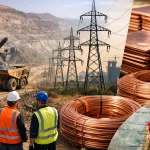
The global economy is currently sleepwalking into a supply wall.

For years, analysts have warned about a looming copper crunch, but 2026 is the year the math finally becomes impossible to ignore. We aren’t just looking at a minor market tightening; we are witnessing a structural decoupling of supply and demand that threatens to throttle the energy transition and the AI revolution in one fell swoop.
The numbers coming out of the major desks are staggering. J.P. Morgan is projecting a refined copper shortfall of 330,000 tons for 2026. That is the largest gap the market has seen in years. Some estimates, looking at the wider “800kt supply gap” scenarios, suggest even more dire straits if project delays continue at their current pace.
Copper deficit 2026: why everyone is talking about this 800kt supply gap and you should too isn’t just a catchy headline. It is a fundamental shift in how industrial procurement and commodity investment will function for the next decade.
The AI and EV Stranglehold: Inelastic Demand
The primary reason the 2026 deficit is different from previous cycles is the sheer volume of “non-negotiable” demand. In the past, high prices would eventually lead to substitution or a slowdown in construction. But you can’t build a massive AI data center with aluminum wiring and expect it to function at scale.
More Read

Consider the scale: a single major AI data center requires between 40,000 and 50,000 tons of copper. Per facility. That is not a typo. As Big Tech races to build out the physical infrastructure for generative AI, they are effectively competing with the automotive sector, where electric vehicles consume three to four times more copper than traditional internal combustion engines.


China, which currently consumes about 60% of the world’s refined copper, isn’t slowing down either. Their power infrastructure is projected to account for over 60% of their demand increase through 2030. When you stack the “shiny AI revolution” on top of the global “green” grid modernization, you get a demand profile that is remarkably inelastic.
More Read

They’re all competing. They’re all pulling from the same dwindling pot. And the pot is nearly empty.
Why the Supply Side Can’t Just “Turn It On”
The uncomfortable truth is that you cannot disrupt geology. Even with copper prices hitting record highs: averaging well over $12,000/mt and peaking at $13,300/mt earlier this year: new supply cannot be “willed” into existence.
There are three brutal realities keeping supply in a stranglehold:
- Declining Ore Quality: The average ore grade globally has fallen below 0.6%. This is half the level we saw 25 years ago. This means miners have to move twice as much rock to get the same amount of copper, driving up energy costs and environmental footprints.
- The Lead-Time Trap: It takes seven to ten years: minimum: to bring a new discovery into production. The discovery rates for new Tier-1 deposits have fallen 70% since the 1990s. We are currently living off the investment decisions made in 2012.
- Water Scarcity: This is the silent killer of 2026 production. Approximately 40% of copper production regions, particularly in Chile and Peru, face critical freshwater shortages. Without water, you can’t process ore. It’s that simple.
The situation in the Atacama Desert is particularly grim. Water scarcity in the Atacama: the real threat to 2026 production is no longer a fringe ESG concern; it is a direct threat to quarterly guidance for the world’s largest miners.

The M&A Mirage: Moving Chairs on the Titanic
As the deficit looms, we’ve seen a frantic rush toward M&A. From Eldorado’s $2.8 billion move for Foran to Rio Tinto’s aggressive copper maneuvering, the industry is trying to buy its way out of the problem.
But here is the kicker: M&A does not create a single new pound of copper.
Buying an existing mine just changes who gets the dividends. It doesn’t fix the fact that the mine is still subject to the same declining grades and permit delays. Some companies, like BHP, have realized this. They are shunning the “M&A mania” in favor of optimizing their own sector-leading pipelines.
The luxury of discipline: why BHP is shunning M&A mania for its sector-leading copper pipeline represents a more sober approach. They know that the only real solution is technical optimization and long-term project development, not just shuffling balance sheets.
The industry needs over $210 billion in new investment by 2035 to meet demand. We’ve only seen about $76 billion deployed over the last six years. The gap is not just in metal: it’s in capital.
Price Forecast 2026: The New Normal
What does this mean for the ticker?
For anyone holding long positions, the outlook is historically bullish. J.P. Morgan expects copper to average $12,075/mt for the full year 2026. However, there is a “bear case” where high prices finally force some demand destruction in lower-margin sectors like consumer electronics or certain construction segments.
Copper forecast 2026: prices, supply risks, and what comes next suggests that the volatility will be as significant as the price level itself. In a market where global inventories have dwindled to below three weeks of consumption, any minor disruption: a strike in Peru, a power outage in Zambia: can send prices vertical in a matter of hours.

Securing high-quality copper in 2026 is no longer just a matter of price: it’s a matter of project uptime. If you are an OEM (Original Equipment Manufacturer) and you haven’t secured your 2026-2028 supply through off-take agreements or direct equity stakes, you are playing a very dangerous game.
The Technology-First Solution
If we can’t find more copper, we have to get better at getting it out of the ground. This is where the “insider” view gets interesting. The industry is finally moving toward a technology-first approach.
Autonomous haulage, which we’ve analyzed extensively, is no longer a gimmick; it’s a requirement for managing the lower-grade, deeper mines of the future. Autonomous haulage: lessons from the first 1,000 hours of operation shows that the efficiency gains are the only thing keeping some aging pits profitable at current cost-of-capital rates.
Why M&A mania won’t solve the copper supply crisis: the case for a technology-first mining sector argues that the real winners of 2026 won’t be the companies with the biggest balance sheets, but those with the best processing technology.
A Stark Assessment
2026 marks the inflection point where the digital and green ambitions of the West finally collide with the physical realities of the Earth’s crust.
We are looking at a market where inventory buffers are gone, demand is fixed by massive capital commitments in AI and energy, and supply is hampered by decades of underinvestment and geological fatigue.
The strategic calculus here isn’t subtle: we are entering an era of “Copper Scarcity” that will redefine global trade and industrial policy. If you aren’t talking about the 2026 deficit yet, you’re already behind.
For more in-depth data and the latest updates on the copper market, visit skillings.net. You can also track specific regulatory changes and exploration breakthroughs through our news-sitemap or deep-dive into regional specifics via our local-sitemap.
The clock isn’t just ticking; it’s already run out. Welcome to the 2026 reality.