By Salini Krishnan

The full implementation of Mali’s revised mining code has fundamentally restructured the investment landscape for West African gold, resulting in a 23% decline in national gold output and a significant reallocation of capital among frontier operators. As the military-led government seeks to increase the mining sector’s contribution to GDP to 20%, the transition from the 2019 regulatory framework to the 2023 code has forced major producers into a series of high-stakes negotiations, settlements, and operational restructurings.
The regulatory shift, which was finalized in late 2023 but saw its most profound operational impacts throughout 2025 and into early 2026, grants the Malian state a mandatory 10% stake in all new and existing projects, with the option to acquire an additional 20% within the first two years of production. When combined with a 5% stake reserved for local private investors, the total potential domestic ownership now stands at 35%. This move marks a sharp departure from previous incentives designed to attract foreign direct investment into the Sahelian gold belt.
The New Revenue Reality: 35% State and Local Ownership
For frontier gold operations, the primary challenge lies in the mechanics of the state’s equity participation. Under the new code, the initial 10% stake is “free-carried,” meaning the government does not contribute to the capital costs of exploration or development. The subsequent 20% option represents a significant shift in the internal rate of return (IRR) calculations for junior and mid-tier miners who rely on high-margin frontier projects to offset regional geopolitical risks.
Beyond equity, the code has eliminated tax exemptions that were previously standard during the operational phase of a mine’s lifecycle. These exemptions, which the Malian Ministry of Mines estimates were worth approximately 60 billion CFA francs ($100 million USD) annually, provided a buffer for companies operating in remote, infrastructure-poor regions. Their removal has effectively increased the operational cost base for every ounce of gold produced in the country.
More Read


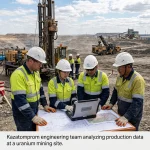
Caption: Mining professionals review site plans in an open-pit environment as regulatory changes in West Africa reshape global exploration strategies.

Production Declines and the “Frontier” Risk Premium
The immediate fallout of the code’s implementation was a sharp contraction in output. Mali’s gold production fell to 51 metric tons in the twelve months following the adoption of the new rules, down from nearly 66 metric tons previously. Analysts attribute this 23% drop to a combination of suspended expansion projects and a “wait-and-see” approach adopted by exploration-stage companies.
Frontier operators: those targeting less-developed or high-risk geographic areas: now face a heightened risk premium. Lenders and private equity firms have increased their return requirements for Malian projects to account for the potential 30% state dilution and the lack of fiscal stability clauses that once protected long-term investments. This has led to a noticeable capital reallocation, with some firms shifting focus to neighboring jurisdictions such as Côte d’Ivoire or Guinea, despite Mali’s superior geological endowment.
More Read

| Feature | 2019 Mining Code | 2023/2026 Mining Code |
|---|---|---|
| Mandatory State Stake | 10% | 10% |
| Optional State Stake | 10% | 20% |
| Local Private Stake | 5% (Optional) | 5% (Mandatory/Reserved) |
| Total Potential Domestic Share | 25% | 35% |
| Tax Exemptions | Standard during operations | Eliminated |
| Revenue to Local Communities | Limited | Mandatory Development Fund |
Corporate Responses: From Arbitration to Adoption
The industry’s reaction has been polarized, characterized by both legal resistance and pragmatic settlement. Barrick Gold, which operates the Loulo-Gounkoto complex: one of the largest gold mining operations in the world: initially sought formal arbitration through the World Bank’s International Centre for Settlement of Investment Disputes (ICSID). However, a landmark settlement was reached in late 2025, where Barrick agreed to the new code’s terms in exchange for a 10-year permit extension and guaranteed operational control.
In contrast, other majors like Endeavour Mining and smaller producers such as Faboula and Bagama Mining moved more quickly to sign agreements. These operators have integrated the new ownership structures into their long-term planning, viewing the 35% state/local participation as the “cost of doing business” in a country that remains Africa’s third-largest gold producer. These agreements, while representing a small fraction of total capacity, provide a blueprint for how frontier operations may survive under the new regime.

Caption: A comparative map of West African gold production centers illustrating the shift in investment toward more stable regulatory jurisdictions.
Regional Implications for Frontier Exploration
The implementation of the Malian code is being closely watched by other resource-rich nations in the Economic Community of West African States (ECOWAS). There is a growing trend of “resource nationalism” across the continent, where governments seek a larger share of mineral wealth to fund social programs and infrastructure.
In Mali, the government has directed $33 million through the Local Mining Development Fund to communities surrounding mine sites. While this increases the social license to operate, it also adds another layer of administrative complexity for frontier projects. Operators must now navigate not only federal tax and equity requirements but also localized spending mandates that were previously handled through voluntary Corporate Social Responsibility (CSR) programs.
The exploration sector has been the hardest hit. According to data from Skillings Mining Intelligence, new drilling permits in Mali saw a 40% decline in the first half of 2026 compared to the same period in 2023. Junior miners, who often act as the “scouts” for the industry, are finding it difficult to raise capital for projects where the government can claim a third of the upside once the project reaches commerciality.
Technical Adaptation and Infrastructure Integration
Despite the regulatory headwinds, technical innovation continues to drive efficiency at established Malian sites. Modern mineral processing plants are being modularized to allow for quicker deployment and lower initial capital expenditure, a strategy used to mitigate the risk of state dilution.

Caption: Advanced modular mineral processing facilities are becoming the preferred choice for frontier operators looking to optimize capital efficiency under new equity rules.
Companies are also investing in solar-hybrid power solutions to reduce the “all-in sustaining cost” (AISC). With the elimination of tax breaks on fuel and equipment, the drive toward energy independence is no longer just an ESG goal: it is a financial necessity. This shift mirrors broader trends in the industry, such as the Vicuña consolidation, where operational scale and energy efficiency are used to offset geopolitical and regulatory pressures.
The 2026 Outlook for Mali Gold
The Malian government’s goal of making mining contribute 15-20% of the national GDP remains ambitious. To reach this, the Ministry of Mines is targeting an additional 500 billion CFA francs ($820 million) in annual revenue from the sector. Whether this can be achieved without further stifling production remains the critical question for the remainder of 2026.
For frontier gold operations, the path forward involves a more collaborative approach with the state. The era of the “enclave” mine: where foreign companies operate with minimal local interference and high tax protection: has ended in Mali. Investors are now looking for projects that can demonstrate viability even with a 35% domestic ownership stake and a higher tax burden.
As noted in recent analysis regarding U.S. funding for critical minerals, the global competition for resources is intensifying. In Mali, the competition is no longer just about who can find the gold, but who can navigate the most complex regulatory environment in West Africa.

Caption: Geologists continue to assess core samples at frontier sites, though exploration financing remains under pressure due to increased state participation.
Summary of Impact on Stakeholders
- Frontier Operators: Must account for a 30% state stake and 5% local stake in all financial modeling, leading to higher AISC and lower NPVs.
- Investors: Increasing focus on jurisdictions with existing stability agreements or those that have already navigated the settlement process with the Malian government.
- Malian Government: Poised to capture a larger share of the country’s mineral wealth but faces the risk of long-term production stagnation if exploration does not recover.
- Local Communities: Set to receive increased direct funding through the Local Mining Development Fund, provided transparency in fund distribution is maintained.
The implementation of the new mining code in Mali represents a pivot point for the West African mining sector. It balances the government’s need for immediate revenue with the industry’s need for long-term fiscal stability: a balance that will be tested as gold prices fluctuate throughout 2026.
Market Snapshot: Mali Gold Sector
- 2025 Production: 51 Metric Tons
- State Equity Cap: 30%
- Local Private Cap: 5%
- Est. Revenue Increase for State: $820 Million USD
- Key Players: Barrick Gold, Endeavour Mining, B2Gold
For more updates on global mining regulations and market trends, visit Skillings Mining Review.