2026 Lithium Power Map : Early Access Open ($59) | Get the latest sector data and secure your copy here: https://skillings.short.gy/LithiumPreSale

By Salini Krishnan
The uranium market has officially crossed a Rubicon. For the better part of a decade, $100 per pound was viewed as a distant, almost mythical psychological barrier. Today, as we navigate the second quarter of 2026, it has become something far more permanent: a structural floor.
The transition from a cyclical commodity subject to the whims of spot-market volatility to a duration-led regime is no longer a forecast: it is the current reality. Market participants are waking up to a stark realization: the “easy” uranium is gone, and the gap between what the world needs and what the world produces is widening into a 40-million-pound annual chasm.
The 40 Million Pound Hole: 2026 Outlook
To understand why $100 is the new baseline, we have to look at the math. By the end of 2026, the structural deficit is projected to hit approximately 40 million pounds per year. Global demand, fueled by a massive pivot back to nuclear energy and the insatiable power hunger of AI-driven data centers, is estimated to exceed 195 million pounds. Meanwhile, primary production is struggling to keep pace, hovering between 155 and 160 million pounds.
More Read

This isn’t a temporary glitch in the supply chain. In previous cycles, utilities could bridge the gap by tapping into secondary supplies: government stockpiles, enrichment underfeeding, and recycled fuel. However, those buffers have essentially collapsed. Utility inventories have plummeted by nearly 40% since 2012. What remains is largely “working capital”: fuel already committed to the reactor core or the cooling pond: not liquid inventory that can be dumped onto the market to cool prices.


Why Higher Prices Won’t Fix Supply Quickly
In a typical commodity market, a sustained price of $100 would trigger a flood of new supply. Uranium is different. The lead time for a greenfield uranium project, from initial discovery to the first drum of yellowcake, is now estimated at 10 to 20 years. Even brownfield restarts face significant hurdles.
More Read

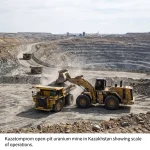
We are seeing this play out in real-time with the industry’s titans. Kazatomprom, the world’s largest producer, has repeatedly signaled that it cannot meet its previous production targets. The bottleneck isn’t just about the ore in the ground; it’s about the “plumbing” of the industry. A global shortage of sulphuric acid: essential for the in-situ recovery (ISR) process: has handcuffed production in Kazakhstan.
Similarly, Cameco has navigated a series of operational hurdles at its flagship McArthur River and Cigar Lake operations. While these assets remain the gold standard of the industry, they are operating in an environment where “nameplate capacity” is often a theoretical maximum rather than a daily reality. Historically, the industry has seen actual output fall roughly 30% below nameplate capacity due to technical constraints and processing bottlenecks.
The “Silicon-Nuclear” Nexus
One of the most significant drivers of the $100 floor is the emergence of a new class of uranium buyers: Big Tech. In 2025 and early 2026, we saw a fundamental shift as companies like Microsoft, Amazon, and Google began exploring direct power purchase agreements (PPAs) with nuclear operators.
The logic is simple. Artificial Intelligence requires “always-on” baseload power. Wind and solar are part of the mix, but they cannot provide the 24/7 reliability required for massive server farms. Nuclear is the only carbon-free solution that fits the bill. This has created a “floor under the floor,” as tech giants with trillion-dollar balance sheets prioritize energy security over price sensitivity. They aren’t looking for the cheapest pound of uranium; they are looking for the most certain pound.
Strategic Moves in the Basin
As the majors struggle with constraints, the focus has shifted to strategic acquisitions and junior developers in tier-one jurisdictions. We recently saw Vanguard Mining secure a strategic foothold in the Athabasca Basin with the Quark Uranium acquisition. This move highlights the premium being placed on North American assets that can bypass the geopolitical risks associated with Central Asian or Russian supply.

Furthermore, the market is closely watching established players for their next moves. For instance, Paladin Energy’s upcoming 2027 decision on Patterson Lake South is already being factored into long-term supply models. Investors are no longer asking if these projects are needed; they are asking how quickly they can be permitted and built.
Geopolitical Fragmentation and the “Western Premium”
The uranium market is no longer a single global pool. It has fragmented into two distinct spheres: the Western-aligned market and the Eastern-aligned market. With the U.S. and its allies moving to ban or heavily restrict Russian nuclear fuel imports, Western utilities are competing for a limited slice of global production.
Only about one-third of global uranium production is currently “freely accessible” to Western markets without significant geopolitical or logistical risk. This fragmentation sustains a price premium. When a utility in the U.S. or France looks at their fuel needs for 2028 or 2030, they aren’t looking at the global average price: they are looking at the price of “secure” uranium.

The New Equilibrium: What Investors Should Watch
As we look toward the second half of 2026, the “structural deficit” is the primary lens through which all market activity should be viewed. The $100 floor is supported by three pillars:
- Exhausted Secondary Supply: The buffer is gone, leaving utilities exposed to spot market volatility.
- Operational Friction: The “Big Two” (Kazatomprom and Cameco) are facing genuine technical and logistical limits to growth.
- Inelastic Demand: Nuclear restarts in Japan, life extensions in the U.S. and Europe, and the rise of SMRs (Small Modular Reactors) have made demand more rigid than ever before.
For operators and investors, the “weekly power list” of movers and shakers is increasingly dominated by those who control the physical pounds or the permits to get them out of the ground. For more on the players shaping this week’s market, see our latest Weekly Power List.
Final Thoughts: Beyond the Cycle
The uranium market is notorious for its boom-and-bust history, but the current setup feels fundamentally different. In the past, high prices were the cure for high prices: they incentivized enough supply to crash the market. But in 2026, the barriers to entry (permitting, ESG requirements, and technical complexity) are so high that supply cannot respond with its traditional speed.
We are in a duration regime. The $100 floor isn’t just a number on a screen; it’s a reflection of a world that has finally realized it cannot meet its climate or technology goals without a massive, sustained investment in nuclear fuel.
2026 Lithium Power Map : Early Access Open ($59) | Get the latest sector data and secure your copy here: https://skillings.short.gy/LithiumPreSale