2026 Lithium Power Map : Early Access Open ($59) | Get the latest sector data and secure your copy here: https://skillings.short.gy/LithiumPreSale

As the global nuclear renaissance moves from policy white papers into actual grid-scale demand, the world is looking at Kazakhstan with an intensity rarely seen in the commodities market. As of – April 15th, 2026, the question for uranium investors is no longer just about demand, but whether the world’s largest producer, NAC Kazatomprom JSC, can: or even wants to: bridge the widening structural supply gap.
The 2026 guidance from Kazatomprom suggests a complex balancing act. While the company has forecasted a 9% year-over-year increase in actual production, it has simultaneously slashed its nominal production capacity targets. This “value over volume” strategy, coupled with persistent operational bottlenecks, indicates that the uranium market’s “heavy hitter” is not coming to the rescue with a flood of cheap yellowcake. Instead, the industry is seeing a disciplined, market-centric approach that may keep the spot price floor significantly higher than many analysts predicted just two years ago.
The Production Paradox: 9% Growth vs. 10% Capacity Cuts
At first glance, Kazatomprom’s 2026 outlook presents a statistical riddle. The company recently revised its production targets, aiming for an output of 27,500 to 29,000 tonnes of uranium (tU) on a 100% basis. This represents roughly 71.5 to 75.4 million pounds of $U_3O_8$. For those tracking the year-over-year metrics, this is nearly a 9% jump from 2025 levels.
However, the company simultaneously announced a 10% reduction in its nominal production capacity: the “theoretical” maximum it intended to hit before reality set in. This reduction, from approximately 32,777 tU to 29,697 tU, represents about 5% of the world’s total primary uranium supply.
More Read

By pulling back the curtain on its capacity, Kazatomprom is signaling that the era of “overproduction at any cost” is over. The company is leaning into its “downflex opportunity,” exercising a 20% deviation from subsoil use agreements to maintain inventory and honor high-value contracts rather than dumping material into a volatile spot market.

Sulphuric Acid: The Achilles’ Heel of Kazakh Mining
The primary constraint on Kazatomprom’s ability to “save the day” isn’t a lack of uranium in the ground; it’s a lack of the chemical key required to get it out. Kazakhstan utilizes In-Situ Leaching (ISL), a process that is highly cost-efficient but relies heavily on the steady supply of sulphuric acid.
By mid-2026, the sulphuric acid shortage in Central Asia has transitioned from a temporary glitch to a systemic risk. Despite efforts to build new domestic acid plants, the ramp-up has been slower than expected. Supply chain disruptions have made importing the acid from neighboring markets both expensive and logistically fraught.
More Read


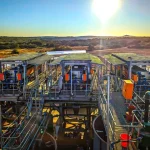
Caption: Advanced modular processing units are essential as the industry shifts toward more efficient but resource-intensive extraction methods.
“The sulphuric acid situation is the ultimate bottleneck,” says one industry analyst. “You can have the best grade in the world, but if you can’t leach it, it stays in the sand. Kazatomprom is being realistic: they aren’t going to promise production they can’t physically acidize.”
Geopolitical Friction and the Logistics of Neutrality
Kazakhstan’s geographic position has always been its greatest asset and its most significant liability. Positioned between Russia and China, Kazatomprom must navigate a geopolitical minefield to deliver its product to Western utilities.
While the Trans-Caspian International Transport Route (TITR) has been touted as a way to bypass Russian territory, the logistics remain cumbersome and expensive. Shipping uranium through the Port of Poti in Georgia involves multiple hand-offs and higher insurance premiums. Meanwhile, China continues to exert “soft power” by securing long-term supply through joint ventures, such as the Budenovskoye project.
For Western investors, the risk remains that a significant portion of Kazatomprom’s 9% production increase is already “spoken for” by Eastern buyers, leaving the Western spot market to fight over a thinning slice of the pie. This dynamic is a key driver in the uranium outlook for other major players like Paladin Energy and the junior explorers in the Athabasca Basin.
Sales Strategy: Why “Tight” is the New Normal
Despite the production increase, Kazatomprom’s sales guidance for 2026 remains remarkably tight, projected at 50.7 to 53.3 million pounds. This gap between production (71.5M – 75.4M lbs) and sales suggests the company is aggressively rebuilding its internal inventories.
During the bear market of the 2010s, Kazatomprom (and the rest of the industry) liquidated stocks to survive. Now, the world’s top producer is playing the long game. By withholding sales, they are effectively tightening the market themselves. This strategy is a primary reason why we are seeing a shift in the mining economics and strategy across the sector: producers are no longer price-takers; they are price-makers.
Market Snapshot: 2026 Uranium Fundamentals
| Metric | 2025 Actual (Estimated) | 2026 Guidance (Kazatomprom) | Change |
|---|---|---|---|
| Production (100% Basis) | ~26,000 tU | 27,500 – 29,000 tU | +9% |
| Sales Volume | 46.5 Million lbs | 50.7 – 53.3 Million lbs | +10% |
| Revenue Guidance | 1.80 Trillion Tenge | 2.20 – 2.30 Trillion Tenge | +25% |
| Capacity Target | 32,777 tU | 29,697 tU | -10% |
Implications for Global Spot Prices
What does this mean for the person watching the ticker? The combination of Kazatomprom’s capacity cuts and its focus on inventory rebuilding suggests that the supply gap is here to stay.
While the “Kazatomprom 9% increase” headlines might initially seem bearish for prices, the underlying data shows a producer that is struggling with cost inflation and chemical shortages. Furthermore, with the U.S. Steel future at a crossroads and the broader industrial sector facing energy-intensity challenges, the demand for reliable nuclear baseload power is only climbing.
If Kazatomprom cannot: or chooses not to: fill the void, the focus shifts to North American projects. Companies like Vanguard Mining, which recently secured a strategic foothold in the Athabasca Basin, are becoming increasingly critical to Western energy security.
The Investor Magnet: Why This Matters Now
Kazatomprom’s 2026 outlook serves as a “canary in the coal mine” for the broader commodities sector. It highlights that even the most dominant players are susceptible to the global battery revolution and the associated scramble for critical minerals. As utilities realize that “The Big K” isn’t going to bail them out with limitless supply, the scramble for long-term contracts is likely to intensify.

Caption: Industry professionals are increasingly focused on strategic supply chains as geopolitical tensions reshape mineral trade.
Final Thoughts: A Disciplined Giant
Kazatomprom’s strategy for 2026 is a masterclass in market discipline. By recognizing its operational limits: namely sulphuric acid and logistics: and choosing to prioritize value over sheer volume, the company is ensuring its long-term profitability at the expense of short-term market relief.
For the mining industry, this is a signal that the “easy” uranium is gone. Whether it’s the 7 strategies for the mining sector to thrive or the push for new deep-sea mining technology, the theme for 2026 is clear: supply is hard, and it’s getting harder.
2026 Lithium Power Map : Early Access Open ($59) | Get the latest sector data and secure your copy here: https://skillings.short.gy/LithiumPreSale