2026 Lithium Power Map : Early Access Open ($59) | Get the latest sector data and secure your copy here: https://skillings.short.gy/LithiumPreSale

By Salini Krishnan
The convergence of artificial intelligence and industrial power infrastructure: now widely termed the “AI-Energy Nexus”: has fundamentally rewritten the playbook for the global mining sector. As of April 2026, the demand for high-performance computing (HPC) has collided with a strained global electrical grid, turning former cryptocurrency miners into data center titans and traditional mineral extractors into strategic energy partners.
In this week’s Deep-Dive mandate, we rank the top 10 innovators bridging the gap between sub-surface extraction and silicon-based intelligence. These are the companies moving beyond the “extraction-only” model to secure the future of the AI grid.
1. KoBold Metals: The AI-Driven Prospector
KoBold Metals continues to dominate the exploration space by applying machine learning to find the very minerals that power AI. Often referred to as the “Google of mining,” KoBold’s proprietary TerraShed platform has become the industry standard for reducing exploration risk in “blind” deposits. Their focus on high-grade copper and nickel is essential for the electrical conductivity required by massive GPU clusters.
More Read



2. Core Scientific: The Infrastructure Pivot
Since its landmark $9 billion acquisition and restructuring involving CoreWeave in late 2025, Core Scientific has transitioned from a pure-play Bitcoin miner into a premier provider of high-density power capacity. By repurposing its 1.3-gigawatt power pipeline for AI hosting, the company has solved the primary bottleneck for tech giants: speed-to-market for energized rack space.
3. TerraPower: Mining’s Nuclear Savior
Bill Gates’ TerraPower is no longer just a laboratory concept. As of early 2026, the company’s Small Modular Reactor (SMR) designs are being integrated directly into remote mining sites and data center hubs. By providing 24/7 carbon-free baseload power, TerraPower allows the AI grid to expand into regions where traditional grid connections are nonexistent or prohibitively expensive.
More Read

4. IREN (formerly Iris Energy): The Microsoft Ally
IREN’s strategic pivot toward high-performance computing was solidified by its multi-year agreement with Microsoft. Operating out of British Columbia and Texas, IREN has successfully bridged the gap between renewable energy harvesting and AI data processing. Their deployment of NVIDIA GB300 GPU clusters has made them a blueprint for how mining companies can monetize their power interconnects.
5. BHP and Rio Tinto: The Copper Majors
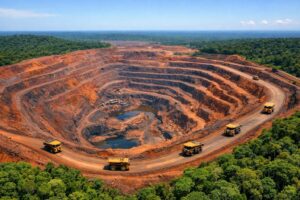
You can’t have an AI grid without copper: lots of it. The “Copper Majors” remain the bedrock of the nexus. BHP and Rio Tinto have invested heavily in autonomous hauling and AI-driven sorting to maximize throughput. Their ability to deliver the massive volumes of “red metal” needed for grid upgrades and data center cooling systems makes them indispensable, if traditional, innovators.

6. Lundin Mining: The Vicuña Powerhouse
Lundin Mining has rapidly ascended the ranks thanks to its aggressive expansion in the Vicuña District. As detailed in our report on strategic footholds, Lundin’s focus on large-scale copper-gold porphyries in South America provides the raw materials necessary for the next generation of power transmission. Their $215 million stake increase in key projects highlights their long-term commitment to the energy transition.
7. Hut 8: The Data Architect
Hut 8 has moved beyond the volatility of hash rates to embrace long-term, 15-year data center hosting agreements. By leveraging its existing industrial-grade electrical infrastructure, Hut 8 provides the physical “home” for AI models. Their strategy focuses on “vertical integration,” managing everything from the energy source to the server rack.
8. Northern Data: The HPC Specialist
With its subsidiary Peak Mining now fully integrated into its AI data center operations, Northern Data has emerged as a leader in European high-performance computing. Their divestment from pure Bitcoin mining assets in late 2025 allowed them to reinvest in liquid-cooled data centers specifically designed for the thermal demands of AI training.
9. Tether: The Renewable Maverick
Tether’s expansion into Uruguay and El Salvador’s renewable energy sectors has created a decentralized power model. By investing in geothermal and hydro-powered mining facilities, Tether is demonstrating that the “AI-Energy Nexus” can be both carbon-neutral and sovereign, providing a hedge against centralized grid failures.
10. Bit Digital: The Diversified Operator
Bit Digital, through its WhiteFiber unit, has secured a significant niche in the AI hosting market. Their diversified approach: maintaining a presence in both digital asset mining and high-end cloud computing: allows them to flex their power usage based on real-time market profitability, a key feature of the modern smart grid.
Executive Perspective: A Note from Charles Pitts, CEO
“Look, we’ve been talking about the ‘AI-Energy Nexus’ for years, but 2026 is where the rubber finally hits the road. For the guys in the pits, it’s not just about digging dirt anymore; it’s about being a power broker. If you’ve got a gigawatt of power and a copper pipe, you’re basically a tech company now. The companies on this list figured out that the grid is the ultimate commodity. We’re seeing a total blur between ‘mining’ and ‘infrastructure,’ and frankly, that’s where the real money is moving.”
Market Snapshot: The AI-Energy Nexus
| Company | Primary Asset | 2026 Focus | Grid Contribution |
|---|---|---|---|
| KoBold Metals | Data/Algorithms | Copper/Nickel Exploration | Mineral Security |
| TerraPower | SMR Technology | Nuclear Deployment | Baseload Reliability |
| Lundin Mining | Copper (Vicuña) | Production Ramp-up | Raw Material Supply |
| Core Scientific | 1.3GW Pipeline | AI Data Centers | Infrastructure Capacity |
Why the AI Grid Depends on Mining
The demand for AI is projected to increase global data center power consumption by 160% by 2030. This surge requires a two-pronged approach from the mining industry:
- Critical Minerals: Increased extraction of copper, lithium, and rare earths for the hardware and transmission lines.
- Power Arbitrage: The conversion of mining sites into data centers to utilize existing high-voltage connections.
As the Global Battery Revolution continues to evolve, the ability to store and dispatch power at these sites will become the next frontier. We are already seeing companies like Vanguard Mining securing uranium assets to feed the SMRs that will eventually power these AI hubs.

The Geopolitical Angle
The race for AI supremacy is inextricably linked to mineral sovereignty. Nations that control the supply chain for high-performance computing: from the cobalt in the batteries to the copper in the grid: will dictate the pace of technological progress. This is why we see such a heavy emphasis on strategic minerals in Japan and defense-funded mining initiatives in North America.
2026 Lithium Power Map
The transition to an AI-powered world isn’t just about silicon; it’s about the lithium that stabilizes the grid. Our latest landscape report, Lithium 2026: The Margin Gravity Report, provides an exhaustive look at the projects, players, and price forecasts defining the next decade.

Get Early Access to the 2026 Lithium Power Map for $59: https://skillings.short.gy/LithiumPreSale