2026 Lithium Power Map : Early Access Open ($59) | Get the latest sector data and secure your copy here: https://skillings.short.gy/LithiumPreSale

By Salini Krishnan
As the global energy transition accelerates into the second half of the decade, the gap between copper supply and demand has reached a critical juncture. In 2026, the industry is no longer just talking about the “looming” deficit; it is living it. With electric vehicle (EV) production scaling and renewable energy infrastructure requiring record amounts of the red metal, mining operators are under immense pressure to squeeze every possible gram of concentrate out of existing operations.
However, the challenge is not just finding new deposits: which can take over a decade to permit and develop: but optimizing the aging, energy-intensive infrastructure already in place. This is where artificial intelligence (AI) is moving from the experimental phase into the operational core. Specifically, ABB’s GMD (Gearless Mill Drive) Copilot is emerging as a primary tool in the fight against production bottlenecks, offering a blueprint for how AI-powered mill optimization can bridge the gap in the global copper supply.
The Grinding Bottleneck and the Copper Deficit
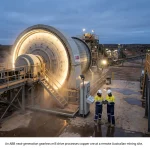
In any hard-rock mining operation, the grinding circuit is the heart of the mill. It is also the most significant bottleneck. Gearless Mill Drives are the powerhouse behind these massive rotating cylinders that crush ore into fine particles for mineral extraction. When a GMD goes down, production stops. In the context of a global copper deficit, an hour of unplanned downtime can cost an operator anywhere from $50,000 to $200,000.
More Read

By April 2026, the industry has realized that simply building bigger mills is not the answer. The focus has shifted toward “intelligence” as a way to enhance throughput. ABB’s GMD Copilot, a generative AI-powered digital assistant, is designed to solve the two biggest headaches in the mill: complexity and knowledge loss.

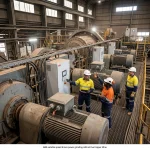
As experienced mill operators retire, they take decades of “feel” for the machinery with them. The AI assistant bridges this gap by providing real-time technical support, troubleshooting, and optimization strategies using natural language processing. Instead of scouring thousand-page manuals during a crisis, operators can simply ask the Copilot for the most efficient parameters to handle a specific ore hardness.

More Read

Performance Metrics: The 4% Edge
While AI often sounds like a buzzword, the data coming out of copper operations in early 2026 is concrete. ABB has reported that its GMD systems, when properly optimized through digital platforms, deliver efficiency improvements of up to 4% over conventional grinding systems. In a market starved for supply, a 4% increase in throughput across a major site like Codelco’s operations in Chile is equivalent to adding thousands of tonnes of copper to the market without breaking new ground.
The impact of GMD Copilot specifically focuses on operational uptime:
- 30% Faster Troubleshooting: By integrating with the GMD Connect cloud platform, the AI can diagnose faults in minutes rather than hours.
- 18% Reduction in Unplanned Downtime: Field data from Chilean copper mines indicates that predictive maintenance prompts and real-time AI guidance prevent the catastrophic failures that previously halted production for days.
- Enhanced Resource Allocation: Maintenance teams can move from reactive “firefighting” to proactive servicing, which is essential as sites become more complex and integrated.
This level of optimization is closely tied to mine electrification trends, where the goal is to slash operational costs while maximizing mineral recovery.
Case Study: Chile’s Frontline in the Copper War
Chile remains the epicenter of global copper production, and it is also the primary testing ground for ABB’s AI technology. Under long-term service agreements (LTSAs), companies like Codelco are utilizing GMD systems to support a combined production of approximately 400,000 metric tons per annum.
The mountainous terrain and high-altitude environments of the Andes make equipment maintenance notoriously difficult. At sites like those in the Vicuña District, where major copper projects are increasingly relying on high-tech solutions to remain viable, the GMD Copilot acts as a remote expert. It allows a junior technician on-site to access the collective intelligence of ABB’s global engineering team through an intuitive interface.

Decarbonization and the AI Intersection
It isn’t just about more copper; it’s about “greener” copper. The grinding process is one of the most energy-intensive stages of mining. By using AI to maintain the mill at its “sweet spot”: the perfect balance of speed, torque, and ore load: operators can significantly reduce energy waste.
Reduced emissions and improved energy efficiency are no longer optional “nice-to-haves.” As we move through 2026, carbon taxes and “green copper” premiums are becoming standard. ABB’s GMD Copilot helps operators hit these sustainability targets by ensuring the machinery runs at peak thermodynamic and electrical efficiency. This is a critical component for companies looking to maintain their social license to operate in regions sensitive to environmental impact, much like the discussions surrounding rare earth elements and national security.
Operational Data: 2026 GMD Impact Analysis
To understand the scale of the impact, consider the following data points derived from 2026 industry benchmarks:
| Metric | Traditional GMD Operation | GMD Copilot Optimized | Improvement |
|---|---|---|---|
| Mean Time to Repair (MTTR) | 6.2 Hours | 4.3 Hours | ~30% Reduction |
| Annual Unplanned Downtime | 142 Hours | 116 Hours | ~18% Reduction |
| Energy Consumption per Tonne | 100% (Baseline) | 96.5% | 3.5% Savings |
| Throughput (Cu Concentrate) | 100% (Baseline) | 104.1% | 4.1% Increase |
Data based on ABB field reports and 2026 mining efficiency projections.
The Human Element: Preserving “Institutional Memory”
One of the most overlooked aspects of the global copper deficit is the human capital deficit. The mining workforce is aging, and the technical expertise required to manage a Gearless Mill Drive is rare. GMD Copilot serves as an “institutional memory” bank. It logs every fault, every solution, and every adjustment made by seasoned engineers.
When a new operator logs on in 2026, they aren’t starting from scratch. They are standing on the shoulders of an AI that has analyzed thousands of hours of mill data. This democratization of expertise is what will allow the industry to scale production rapidly enough to meet the 2030 climate goals.

2026 Outlook: The Industrialization of AI
As we look toward the remainder of 2026 and into 2027, the “pilot phase” of AI in mining is officially over. We are now in the era of industrialization. Tools like ABB’s GMD Copilot are being integrated into broader mine-to-port digital twins, where the mill is no longer an isolated asset but a dynamic part of a global supply chain.
The global copper deficit is a structural problem that requires a multi-faceted solution. While exploration and new mine development are essential, the “hidden mine” of efficiency is the fastest way to bring new supply to the market. By capturing that 4% efficiency gain and slashing downtime by 18%, AI is effectively creating “new” copper without the environmental footprint of a new open pit.
For more updates on the technologies shaping the 2026 mining landscape, visit Skillings.net or check out our latest analysis on the Weekly Power List.
2026 Lithium Power Map : Early Access Open ($59) | Get the latest sector data and secure your copy here: https://skillings.short.gy/LithiumPreSale