2026 Lithium Power Map : Early Access Open ($59) | Get the latest sector data and secure your copy here: https://skillings.short.gy/LithiumPreSale

By Salini Krishnan
The global race to secure copper supplies has reached a critical technological inflection point. As of April 15th, 2026, the industry is grappling with a projected structural deficit that threatens to derail the pace of the global energy transition. In response, ABB has announced the successful deployment of its next-generation grinding solutions at a major copper operation in Western Australia, a move designed to squeeze higher recovery rates from increasingly complex and lower-grade ores.
This deployment comes at a time when the “easy copper” has largely been mined. Producers are now forced to process massive volumes of harder rock to maintain output levels, making comminution: the process of crushing and grinding: the most energy-intensive and cost-heavy segment of the mining value chain. By integrating advanced Gearless Mill Drives (GMDs) with real-time digital optimization, ABB aims to provide a blueprint for how the industry can bridge the supply gap through efficiency rather than just new discoveries.
The Grinding Bottleneck and the Global Deficit
The copper market in 2026 is defined by a widening chasm between decarbonization-driven demand and a stagnant supply pipeline. Copper is the “metal of electrification,” essential for everything from electric vehicle (EV) motors to high-voltage transmission lines. However, the mining industry faces a “grade decline” crisis. Average copper grades globally have fallen from approximately 1.0% two decades ago to near 0.5% today.
More Read

To produce the same amount of refined copper, mines must now move and process twice as much rock. This puts an immense strain on grinding circuits. Traditional grinding technology often operates at a fixed speed, leading to inefficiencies when ore hardness varies: a common occurrence in aging Australian pits.

ABB’s next-gen solution addresses this by utilizing variable-speed drive technology. This allows operators to adjust the mill’s speed in real-time based on the specific characteristics of the ore feed. In Australia, where energy costs remain a significant operational headwind, the ability to optimize power draw while maximizing throughput is no longer a luxury: it is a requirement for survival.

More Read

Technical Deep-Dive: Gearless Mill Drives and Recovery Rates
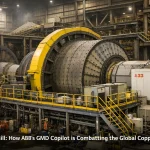
At the heart of the Australian deployment is the ABB GMD, a technology that eliminates the need for a gearbox by wrapping the motor around the mill itself. While GMDs are not entirely new, the “Next-Gen” iteration deployed this month includes a suite of digital enhancements under the ABB Ability™ MineOptimize framework.
- Dynamic Feed Control: Using AI-driven sensors, the system detects changes in ore mineralogy before it enters the SAG (Semi-Autogenous Grinding) mill. The drive system automatically adjusts torque and speed to ensure the optimal “grind size” is achieved.
- Increased Recovery Rates: Recovery is the percentage of metal successfully extracted from the ore. In many copper operations, over-grinding or under-grinding leads to significant losses in the flotation stage. ABB’s new system has demonstrated a 1.5% to 2.2% increase in recovery rates in pilot phases. In a 100,000-tonne-per-annum operation, a 2% recovery boost equates to an additional 2,000 tonnes of copper: worth roughly $20 million at current market prices: without moving a single extra ton of earth.
- Predictive Maintenance (Digital Twins): The Australian deployment utilizes a “digital twin” of the grinding circuit. This allows site engineers to simulate various operational scenarios and predict component fatigue before a failure occurs. In a sector where an unplanned mill shutdown can cost upwards of $200,000 per hour, the financial implications of predictive maintenance are profound.
This focus on efficiency mirrors shifts seen in other commodities, such as the efficiency over scale pivot in the Atacama, where technology is being used to maximize existing resources.
Why Australia is the Testing Ground
Australia remains a tier-one mining jurisdiction, but its copper sector faces unique challenges. Many of the country’s most productive assets, such as those in the Gawler Craton or the Mt Isa Inlier, are dealing with increasing depth and harder rock types.
The Australian government’s focus on “Critical Minerals” has also spurred investment into technologies that reduce the carbon footprint of extraction. Because grinding accounts for up to 40% of a mine’s total energy consumption, the electrification and optimization of these circuits are central to meeting Net Zero targets.
ABB’s deployment is also strategically timed with the broader global battery revolution, which is driving an insatiable appetite for the copper used in battery foils and charging infrastructure. By proving this technology in the harsh, high-cost environment of the Australian outback, ABB is positioning its grinding solutions for a global rollout across the Andean copper belt and Central Africa.
Strategic Implications for Investors and Operators
For mining operators, the message is clear: the era of “brute force” mining is ending. As ore grades continue to slide, the difference between a profitable mine and a stranded asset will lie in the processing plant.
Investors are increasingly scrutinizing the “intensity” of production: both in terms of energy and capital. Technology that increases recovery rates directly improves the Net Present Value (NPV) of a project by extending the life of the mine and lowering the unit cost of production.
We are seeing a similar trend in other sectors, such as the strategic foothold in the Athabasca Basin, where the quality of the resource must be matched by the sophistication of the extraction method. In the copper space, ABB’s breakthrough suggests that the industry may be able to offset part of the global deficit through technological “hidden supply”: copper that was previously lost to tailings because of inefficient grinding.

Looking Ahead: The 2026-2030 Copper Outlook
The deployment of next-gen grinding solutions in Australia is a vital piece of the puzzle, but it is not a silver bullet. The market still requires massive greenfield investment. However, the success of these technologies provides a bridge. If the global mining fleet can improve recovery rates by even a modest 3-5% through digital optimization and advanced drives, it would effectively add several “Tier One” mines to the global supply map without the 10-15 year lead time required for new discoveries.
As we move further into 2026, keep a close eye on how other majors respond. We may see an acceleration of “brownfield” tech upgrades as companies like BHP, Rio Tinto, and Freeport-McMoRan look to squeeze every possible pound of copper from their existing footprints.
For more on how technology is reshaping the supply chain for critical minerals, including our latest analysis on the Vicuña District copper expansion, visit our latest market reports.
2026 Lithium Power Map: Early Access Open ($59)
The copper deficit is only half the story. The lithium landscape is shifting even faster. Secure your copy of the Lithium 2026: The Margin Gravity Report today to get the latest sector data and infrastructure maps.
Get access here: https://skillings.short.gy/LithiumPreSale