2026 Lithium Power Map : Early Access Open ($59) | Get the latest sector data and secure your copy here: https://skillings.short.gy/LithiumPreSale

By Salini Krishnan
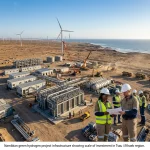
The global race to decarbonize heavy industry reached a pivotal milestone this month in the Namib Desert. The SuSteelAG consortium, led by Germany’s Federal Institute for Materials Research and Testing (BAM), has successfully completed the first industrial-scale pilot of hydrogen-based iron ore reduction at the Oshivela site in Namibia.
By converting 80 tonnes of lower-grade Australian iron ore into high-quality direct reduced iron (DRI) using only green hydrogen, the project has provided a technical blueprint for a climate-neutral steel value chain. This breakthrough effectively proves that the “green steel” revolution does not need to be restricted to premium-grade ores, which are increasingly scarce and expensive.
The Oshivela Milestone: Technical Specifications
The campaign utilized a specialized hydrogen rotary kiln developed and operated by project partner HyIron Green Technologies. Unlike traditional blast furnaces that rely on coking coal and emit vast quantities of CO2, the Oshivela facility uses 100% green hydrogen: produced via electrolysis powered by Namibia’s abundant solar and wind resources: as the reducing agent.
More Read

During the pilot, the consortium achieved a consistent processing throughput of approximately 5 tonnes per hour. The feed material consisted of 80 tonnes of untreated Australian iron ore supplied by Fortescue. Notably, this ore possessed an iron content of approximately 56%, a grade typically considered “lower-grade” in the context of traditional direct reduction processes, which usually require 65% Fe or higher.


The successful conversion of this material into refined iron under climate-neutral conditions marks a shift in the economic feasibility of green metallurgy. For operators and investors, the results suggest that the geographic and geological constraints that previously hampered green steel initiatives may be loosening.
More Read
Decoupling from Premium Ores
For years, the primary critique of hydrogen-based DRI was its dependency on “DR-grade” pellets: high-purity ores that represent only a small fraction of global iron production. If green steel required only the best ore, the transition would be bottlenecked by supply shortages.
The SuSteelAG results challenge this narrative. Christian Adam, a lead researcher at BAM, noted that the project demonstrates that “green steel production need not be constrained by the limited availability of premium ores.” By successfully processing 56% Fe content ore, the consortium has opened the door for a much wider range of global mining operations to participate in the green transition.
This development is particularly relevant as mining companies grapple with declining ore grades across traditional hubs. Technologies that can upgrade lower-quality deposits into “green iron” on-site are becoming essential. As noted in recent reports on eco-friendly mining technology, the integration of renewable energy directly into the processing phase is the next logical step for the industry.
The Tri-Continental Value Chain: Australia, Namibia, and Germany
The SuSteelAG (Sustainable Steel from Australia and Germany) consortium represents a unique geopolitical partnership designed to optimize the strengths of three different regions:
- Australia: Providing the raw mineral resources and mining expertise.
- Namibia: Serving as the processing hub due to its world-class renewable energy potential and strategic coastal location.
- Germany: Supplying the advanced engineering, research coordination, and the ultimate industrial demand for the finished product.
This “frontier region” approach leverages Namibia’s status as a burgeoning green hydrogen hub. The Oshivela site is positioned to take advantage of some of the lowest-cost renewable energy production in the world, which is a prerequisite for making hydrogen-based reduction competitive with coal-based methods.
The project is supported by approximately €4.5 million in funding from the German Federal Ministry of Research, Technology and Space (BMBF) under the 7th Energy Research Programme. Additional support for the kiln technology was provided by the German Federal Ministry for Economic Affairs and Climate Action.
From the Desert to the Factory Floor
The 80 tonnes of refined iron produced in Namibia are not staying in the desert. The material is currently being prepared for shipment to Germany, where it will undergo rigorous testing by Salzgitter Mannesmann Forschung GmbH.
Engineers in Germany will investigate how this green iron can be integrated into existing industrial steel production lines. The goal is to produce high-specification steel for the automotive and construction sectors, sectors that are under intense pressure to lower their Scope 3 emissions.

This vertical integration: from an Australian pit to a Namibian kiln and finally to a German furnace: mirrors the broader shifts seen in other critical mineral sectors. Whether it is the global battery revolution or the push for rare earth independence, the broader theme is the creation of transparent, low-carbon supply chains that bypass traditional carbon-heavy hubs.
Market Snapshot: The Cost of Going Green
While the technical success at Oshivela is clear, the economic bridge remains a work in progress. Current estimates suggest that green steel carries a “green premium” of 20% to 30% over traditional steel, primarily due to the cost of hydrogen and capital expenditure for new infrastructure.
However, the SuSteelAG breakthrough addresses one of the major cost drivers: raw material feedstock. By proving that 56% Fe ore is viable, the industry can potentially lower its input costs compared to those reliant solely on premium DR-grade pellets.
Furthermore, as carbon taxes and border adjustment mechanisms (like the EU’s CBAM) become more stringent, the “green premium” is expected to shrink. For investors monitoring the U.S. Steel future or European industrial majors, the Oshivela pilot provides a tangible data point for the scalability of zero-carbon iron.
Geopolitical Implications for Namibia
For Namibia, the success of the SuSteelAG consortium is more than just a scientific win; it is a pillar of national economic strategy. The country is positioning itself as a “Green Energy Superpower” in Sub-Saharan Africa. By hosting advanced industrial pilots like the hydrogen rotary kiln, Namibia is moving up the value chain from a mere exporter of raw ore to a processor of high-value industrial intermediates.
This transition is essential for frontier regions looking to avoid the traditional “resource curse.” By embedding technology and energy infrastructure within its borders, Namibia is ensuring that a larger share of the “green steel” value remains in the domestic economy.
Outlook: Scaling Beyond the Pilot
The next 12 to 18 months will be critical for the SuSteelAG partners. Once the initial 80 tonnes are processed in Germany, the focus will shift toward scaling the throughput. While 5 tonnes per hour is an industrial-scale pilot, a commercial-grade facility would need to operate at significantly higher volumes to meet global demand.
Key milestones to watch include:
- Results from Salzgitter: Analysis of the metallurgical properties of the “Namibian Iron” and its performance in electric arc furnaces (EAF).
- Expansion of Oshivela: Potential announcements regarding a permanent, larger-scale facility in Namibia.
- Feedstock Diversification: Testing ores from other global jurisdictions to further prove the versatility of the hydrogen rotary kiln.
The success at Oshivela suggests that the technology is ready. The question now is how quickly capital can be deployed to transition these pilots into the backbone of a new, carbon-neutral global steel industry.
2026 Lithium Power Map : Early Access Open ($59)
The green steel revolution is one half of the energy nexus; the other is the lithium-battery boom. Get the latest data on the global supply chain with our 2026 Lithium Power Map.
Secure your copy here: https://skillings.short.gy/LithiumPreSale