2026 Lithium Power Map : Early Access Open ($59) | Get the latest sector data and secure your copy here: https://skillings.short.gy/LithiumPreSale

By Salini Krishnan
Frontier energy markets in Southern Africa are no longer a “future” prospect; they are the primary theater for the global decarbonization race. A clear divergence has emerged between the two regional heavyweights vying for green hydrogen dominance. While South Africa possesses the industrial infrastructure and the massive internal demand, Namibia is currently winning the “sprint” to first production.
The reason isn’t just about wind speeds or solar irradiation: though Namibia has plenty of both. The shift is being driven by a combination of high-level political will, a streamlined regulatory environment, and a pragmatic approach to foreign direct investment (FDI) that has left its larger neighbor to the south struggling with bureaucratic inertia.
The Regulatory Advantage: Agility Over Complexity
In the race to build a brand-new commodity market, speed is the ultimate currency. Namibia’s government has treated green hydrogen not as a secondary energy source, but as a sovereign economic priority. Under the leadership of the Green Hydrogen Council, Namibia has moved from concept to multi-billion-dollar agreements in less than three years.
More Read

Unlike South Africa, which must navigate the complex and often politically charged restructuring of its state utility, Eskom, and integrate green hydrogen into an aging national grid, Namibia has opted for “autonomous initiatives.” By creating standalone export hubs, Namibia bypasses the need for immediate, comprehensive grid reform.

This pragmatic regulation is visible in how the country handled the Hyphen Hydrogen project. By designating specific “Coastal Development Valleys” near Lüderitz and Walvis Bay, the government provided a clear spatial and legal framework for investors. This “walled garden” approach to regulation minimizes the risk of the “resource nationalism” often seen in larger African economies, a topic we recently explored in our analysis of West African mining rules.
Hyphen Hydrogen: The $10 Billion Flagship
At the heart of Namibia’s surge is the Hyphen Hydrogen Energy project. Valued at roughly $10 billion: nearly the equivalent of Namibia’s entire annual GDP: the project aims to produce 300,000 tons of green hydrogen per year by the end of the decade.
More Read

The scale is staggering, but the execution is what sets it apart. The project has secured its environmental clearances and finalized its land-use agreements. The project utilizes the Tsau //Khaeb National Park, a region with some of the highest combined solar and wind capacity factors on the planet.

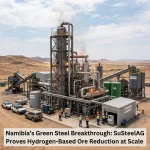
Caption: Modular units at a modern processing facility, similar to the proposed hydrogen electrolysis setups planned for the Namibian coast.
For investors, the Hyphen project serves as a proof of concept for the “Frontier Region” model. It demonstrates that a smaller, more agile government can provide the certainty required for massive capital expenditure. While South Africa discusses “Green Hydrogen Special Economic Zones,” Namibia is already breaking ground on them.
Coastal Development Valleys: The Geography of Success
Namibia’s strategy is geographically focused. By concentrating development in two primary coastal hubs: Lüderitz and Walvis Bay: the country is creating a “plug-and-play” environment for international off-takers, particularly from the European Union.
- The Lüderitz Hub: Focused on the Hyphen project, this southern valley is being transformed from a quiet fishing town into a high-tech energy port. The deep-water potential and proximity to the wind-rich “Sperrgebiet” (forbidden territory) make it the primary export point for ammonia.
- The Walvis Bay Hub: Positioned to serve the industrial and mining heartlands. This hub is increasingly focused on “Green Shipping” corridors and the decarbonization of the regional mining fleet.
Namibia’s success here is a lesson in infrastructure focus. Rather than trying to green the entire national economy at once, they are building highly efficient “islands” of production that can be scaled and eventually linked. This mirrors the “efficiency over scale” pivot we’ve seen in other sectors, such as lithium extraction in the Atacama.
South Africa’s Struggle: The Burden of Scale
South Africa is not “losing” in the sense of potential: its resources are world-class. However, it is “outpaced” by the sheer complexity of its own economy. The South African government’s Hydrogen Society Roadmap is a comprehensive document, aiming for 13 million tons of production by 2050. But the path from roadmap to “shovels in the ground” is fraught with hurdles.
The primary issue is the national grid. South Africa’s energy security remains precarious, and the political pressure to solve domestic power outages (load shedding) often takes precedence over long-term export projects. Furthermore, South Africa’s green hydrogen strategy is deeply intertwined with its Just Energy Transition (JET) goals, which require complex negotiations with labor unions and coal-dependent communities.
While Namibia can focus purely on export and new-build infrastructure, South Africa must manage a transition. This creates a “decision paralysis” that Namibia has successfully avoided.
Comparison: Namibia vs. South Africa
| Metric | Namibia | South Africa |
|---|---|---|
| Primary Strategy | Export-led, autonomous hubs | Grid-integrated, industrial transition |
| Key Advantage | Political speed & high wind/solar synergy | Existing industrial base & chemical expertise |
| Regulatory Status | Hydrogen-specific legislation enacted | Integrated into broader energy policy |
| Flagship Project Status | Hyphen: Land secured, FEED underway | Boegoebaai: Feasibility studies ongoing |
| FDI Attraction | ~$2.1 Billion (N$) in GH2 specific | High total energy FDI, but GH2 fragmented |
The “Coopetition” Model: The Cross-Border Pipeline
Despite the narrative of a “race,” the reality is moving toward regional integration. The most significant development of the last quarter has been the progress on the cross-border green hydrogen pipeline connecting the two nations.
This pipeline, which will eventually link the Namibian production hubs to the industrial demand in South Africa’s Northern Cape and the port of Saldanha, suggests that Namibia might become the “feeder” to South Africa’s industrial engine. Namibia has the space and the speed to produce the molecule; South Africa has the refineries and the manufacturing capacity to use it.
This synergy is critical for the “Southern Africa” brand. If the two nations can harmonize their regulations, they could collectively control the lowest-cost green hydrogen supply chain in the world, rivaling even the Gulf States.
Mining Synergy: Decarbonizing the Frontier
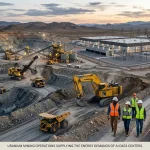
For the readers of Skillings Mining Review, the green hydrogen race is inseparable from the mining sector. Namibia is already a mining powerhouse: particularly in uranium. We’ve seen significant movement in this space with Paladin Energy’s recent decisions.
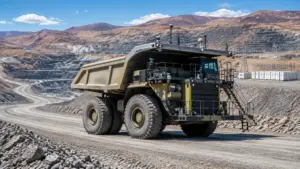
The availability of cheap green hydrogen in Namibia will fundamentally change the cost curve for local miners. Projects like the “Daures Green Hydrogen Village” are testing the use of hydrogen for green ammonium nitrate (explosives) and hydrogen-powered haul trucks. By “green-lining” the mining industry, Namibia is making its mineral exports more attractive to ESG-conscious buyers in the West.

Caption: Advanced underground infrastructure where green energy integration is becoming a standard for mine development.
Conclusion: Why the Sprint Matters
Namibia is currently outpacing South Africa because it has recognized that in a new market, being “first” is more important than being “perfect.” By providing a pragmatic, investor-friendly environment and focusing on coastal export valleys, the Namibian government has reduced the “soft costs” of development that often plague South African projects.
For operators and investors, the lesson is clear: in frontier regions, political will is the most valuable resource. Namibia has it in spades. South Africa has the industrial muscle, but until it can streamline its regulatory pathways, it will likely remain the “follower” in the regional green hydrogen sprint.
2026 Lithium Power Map : Early Access Open ($59) | Get the latest sector data and secure your copy here: https://skillings.short.gy/LithiumPreSale