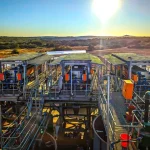
A Komatsu 930E-5AT autonomous haul truck operating in an open-pit mine environment.

By Charles Pitts
On April 21, 2026, Komatsu commissioned its 1,000th autonomous ultra-class haul truck, a 930E-5AT, at Barrick’s Nevada Gold Mines (NGM). The milestone marks a new stage in mine-site automation because it links nearly two decades of operating data with the industry’s push toward electrification.
The deployment also shows how quickly Komatsu’s FrontRunner Autonomous Haulage System (AHS) has scaled. It took years to reach the first 100 units after the commercial launch in 2008. However, adoption has accelerated as miners respond to higher labor costs, tighter safety requirements, and decarbonization targets. The 930E-5AT, with its 290-metric-ton payload and electric-drive design, now sits at the center of that shift.
Why Nevada Gold Mines Matters
Nevada Gold Mines was a logical site for the 1,000th unit because scale is critical for AHS economics. NGM, a joint venture between Barrick Gold and Newmont, ranks among the world’s largest gold-producing complexes. At that scale, small efficiency gains can add up quickly. Consistent cycle times, lower tire wear, and better fuel use can translate into meaningful savings.
More Read

The Komatsu 930E-5AT runs without a driver in the cab. Instead, it relies on GPS, LiDAR, and radar. Because the truck does not stop for shift changes, it can keep moving when the operating area is clear. That model supports adapting to a transforming mining landscape, where miners are under pressure to control cost volatility.


Overhead trolley lines providing electric power to an ultra-class haul truck on an incline.
How FrontRunner Evolved
Komatsu launched FrontRunner in 2008 at Codelco’s Gabriela Mistral mine in Chile. Since then, the system has moved billions of tonnes of material. One reason for its spread is that it can connect with existing mine management systems. In some mines, that allows autonomous and manned equipment to operate in the same network. However, fully autonomous zones still set the benchmark for safety.
More Read
The technology has also changed. Early systems mainly followed fixed routes. Newer trucks can detect obstacles and adjust paths in real time. They also communicate with each other and with dispatch through private LTE or 5G networks. Because of that, the 1,000th unit is far more capable than the 100th unit was a decade ago. It can respond to pit changes and weather with limited human input.
Why Automation and Electrification Are Converging
A major shift in 2026 is the overlap between AHS and electrification. The 1,000th unit uses an electric-drive system. In practice, that means a diesel engine powers a generator, and the generator powers the wheel motors. That setup matters because it creates a pathway to trolley-assist systems.
In May 2025, Komatsu said it had autonomously operated an electric-drive truck while connected to a dynamic trolley line. The system lets the truck draw power from overhead lines on uphill hauls, which are usually the most energy-intensive part of the cycle. As a result, the truck can move faster on grade and cut most of its CO2 emissions on that section.
This convergence is important for modern open-pit mining technologies. Because an autonomous truck can connect to and disconnect from a trolley line with high precision, it can reduce stress on the pantograph and stay on the optimal power path.

Mining professionals monitoring autonomous fleet operations from a centralized control center.
What the Operating Data Shows
The case for autonomous haulage becomes clearer in the operating data. Autonomous fleets often deliver 15% to 30% higher productivity than manual fleets. That improvement usually comes from lower downtime and more consistent haul cycles.
The following table outlines the performance gaps seen in modern ultra-class fleets:
| Metric | Manual Diesel-Electric | Autonomous Diesel-Electric | Autonomous Trolley-Assist |
|---|---|---|---|
| Average Speed on Grade | 12-14 km/h | 13-15 km/h | 25-28 km/h |
| Fuel Consumption (L/hr) | 100% (Baseline) | 90-95% | 10-20% (on grade) |
| Tire Life | Baseline | +15% | +15% |
| Availability | 82-85% | 90%+ | 88-90% |
| Emissions (CO2/tonne) | Baseline | -5% to -10% | -60% to -80% |
The data suggests that capital expenditure (CAPEX) is higher for autonomous trolley-assist fleets. However, lower operating costs (OPEX) and higher throughput can improve returns in large, high-volume mines.
How the Milestone Fits Net Zero Plans
The 1,000th FrontRunner unit also fits the sector’s broader Net Zero agenda. As noted in the EY report on mining challenges, ESG factors remain a major risk and opportunity for mining companies.
For large miners such as Barrick, the 930E-5AT offers a practical emissions-reduction tool. Because the truck is electric-drive and trolley-ready, operators can shift more of the haul cycle toward external power as site infrastructure improves. Over time, the industry’s longer-term goal is to replace onboard diesel generation with battery-based systems and move closer to zero-emission haulage.

The electric drive system and advanced circuitry of a 930E-5AT ultra-class haul truck.
How Autonomous Trolley Assist Works
Adding trolley assist to an AHS fleet requires several systems to work together. The truck’s onboard computer must manage three functions at the same time:
- Alignment: The truck must steer with high accuracy so the pantograph stays aligned with the overhead wires.
- Power Management: The system must shift from diesel-generated power to external electric power without losing speed.
- Safety Interlocks: The truck must detect faults in the trolley line or pantograph and disconnect immediately if needed.
Automation matters because it reduces the risk of human error during the hook-up phase. That phase has long been a weak point in manual trolley systems.
What Comes After the 1,000th Unit
Komatsu’s next phase is likely to extend autonomous haulage into smaller truck classes and underground mines. However, the broader significance of the 1,000th unit goes beyond one truck model. It points to the value of the digital system around the truck.
Many miners now view the future mine site as a centralized intelligence model. In that setup, the haulage fleet does more than move material. It also collects data on road conditions, fragmentation, and equipment health. Because that data feeds maintenance and dispatch systems, operators can improve reliability and optimize pit performance in real time.
For mining professionals and investors, the 1,000th FrontRunner unit serves as a large-scale proof point. It suggests the technology has moved beyond the trial stage and into mainstream deployment. As a result, cost per tonne may increasingly depend on software performance, fleet coordination, and the pace of decarbonization.