Modular nuclear units are increasingly seen as the primary solution for data centers facing a 100GW power deficit by 2028.

By Charles Pitts
The global race for artificial intelligence supremacy has officially hit a physical barrier: the electrical grid. As of April 2026, the “100GW Wall”: a projected shortfall in power capacity required to sustain the next generation of hyperscale data centers: has shifted from a theoretical risk to an operational crisis. For the mining and energy sectors, this bottleneck has triggered an unprecedented pivot toward Small Modular Reactors (SMRs) and a sustained surge in uranium demand.
The scale of the energy requirement is staggering. Recent industry forecasts indicate that AI-driven data centers could account for nearly 12% of total U.S. electricity consumption by 2028, up from just 4% in 2023. With traditional renewables like wind and solar struggling to provide the 24/7 baseload power required by massive GPU clusters, Big Tech has turned to nuclear energy, not just as a “green” alternative, but as a survival strategy.
The 100GW Wall: Why the Grid is Breaking
The term “100GW Wall” refers to the widening gap between the power needs of AI “factories” and the available capacity of aging national grids. In early 2026, the International Energy Agency (IEA) warned that the grid itself, rather than generation capacity, has become the primary bottleneck.
More Read

“We are no longer just looking for power; we are looking for ‘smart’ power that can sit right next to the server racks,” says a senior analyst at a leading energy consultancy.

Companies like Nvidia have attempted to mitigate this through software-defined “flexible AI factories” that can adjust power consumption during peak loads. However, these are stop-gap measures. To maintain the 99.999% uptime required for global AI training models, hyperscalers need dedicated, carbon-free, and reliable energy.
Big Tech’s Nuclear Pivot: The 2024-2025 Deals
The transition to nuclear energy for AI did not happen overnight. It was catalyzed by a series of landmark deals between 2024 and late 2025 that have now entered the construction phase in 2026.
More Read

- Microsoft and the Constellation Deal: In one of the most high-profile moves, Microsoft signed a 20-year power purchase agreement (PPA) with Constellation Energy to restart Unit 1 at the Three Mile Island facility. Targeted for completion by 2028, this project aims to deliver 835 megawatts (MW) of dedicated power to Microsoft’s regional data centers.
- Amazon’s Multi-Pronged Strategy: Amazon has committed over $20 billion to convert Pennsylvania’s Susquehanna Steam Electric Station into a nuclear-powered data center campus. Simultaneously, Amazon is backing SMR developer X-Energy to deploy up to 5 gigawatts (GW) of modular capacity by the early 2030s.
- Google’s Innovation Bet: Google recently finalized its partnership with Kairos Power to deploy a fleet of seven SMRs using advanced molten salt technology. These units are expected to provide 500MW of carbon-free energy, specifically designed to bypass grid congestion by being co-located with Google’s hyperscale facilities.

Collaborative planning at industrial sites remains a critical component of the SMR rollout, as seen in recent strategic briefings across the U.S. nuclear-mining corridor.
Small Modular Reactors: The Strategic Advantage
Unlike traditional large-scale nuclear plants, which take decades to build and require billions in upfront capital, SMRs offer several distinct advantages for the AI era:
- Modularity: SMR components are factory-built and shipped to the site, significantly reducing construction timelines and “first-of-a-kind” risks.
- Scalability: Data center operators can add reactor modules as their compute power grows, matching energy supply with demand in 50MW to 300MW increments.
- Co-location: Due to their smaller footprint and enhanced safety features, SMRs can be built closer to populated areas or directly adjacent to data center campuses, eliminating the need for long-distance transmission lines.
This shift has profound implications for the mining sector, particularly for copper and uranium. As highlighted in our recent analysis on the AI-copper nexus, the electrification of these sites is driving a generational demand spike for high-conductivity metals.
The Uranium Market: Supply and Price Outlook 2026
The surge in nuclear interest has sent shockwaves through the uranium market. As of April 2026, the spot price of U3O8 has stabilized near $86.55/lb, but analysts warn of a “thin market” where even minor supply disruptions could push prices toward the $150/lb mark.
Market Snapshot: Uranium and Nuclear Indicators (April 2026)
| Indicator | Current Value | 12-Month Change | 2026 Forecast (Base Case) |
|---|---|---|---|
| Uranium Spot (U3O8) | $86.55 / lb | +28.99% | $98.50 – $115.00 |
| Global Uncovered Demand | 2.1 Billion lbs | +15% (vs. 2024) | Sustained Upward Trend |
| SMR Projects (Active) | 84 Globally | +40% | Commercial Operation by 2029 |
| Data Center Power Use | 1,100 TWh | +22% | 1,450 TWh by 2028 |
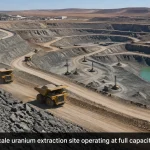
The supply side remains constrained. Production is heavily concentrated, with Kazatomprom and Cameco controlling nearly 86% of the market. This concentration, combined with geopolitical shifts in Western supply chains, has led to a race for domestic production. Projects like the UEC Burke Hollow ISR mine are now critical milestones in the U.S. effort to decouple from foreign supply.
Mining the Infrastructure: Beyond the Reactor
The “100GW Wall” isn’t just about the reactors; it’s about the massive industrial infrastructure required to connect them. This includes a surge in demand for specialized steel, concrete, and the critical minerals used in reactor shielding and control systems.
Moreover, the regulatory environment is shifting. In early 2026, new federal policies have been enacted to streamline the permitting process for SMRs on brownfield sites, particularly former coal plants. This strategy aims to leverage existing grid connections while replacing high-carbon generation with carbon-free nuclear baseload.

Advanced mineral processing facilities are scaling up to meet the increased demand for nuclear-grade materials and reactor components.
Risks to the 2026 Outlook
While the momentum behind SMRs is undeniable, several hurdles remain that could prevent the industry from scaling fast enough to meet the 2028 AI power wall:
- Supply Chain Bottlenecks: The lead times for high-assay low-enriched uranium (HALEU), which many SMR designs require, are still significant.
- Cost Overruns: Despite the “factory-built” promise, the first wave of SMR projects in the U.S. and Canada has seen initial cost estimates rise as labor and material costs fluctuate.
- Regulatory Backlogs: The Nuclear Regulatory Commission (NRC) is currently processing a record number of applications, creating a potential queue that could delay the 2030 deployment targets.
Conclusion: A New Era for Mining and Energy
The intersection of AI demand and nuclear technology represents one of the most significant shifts in the energy landscape since the Industrial Revolution. For the mining industry, this is more than just a commodity boom; it is a structural realignment. The companies that successfully secure the uranium, copper, and specialized metals required for this transition are positioned to lead the market for the next decade.
As the “100GW Wall” looms closer, the question is no longer whether we will use nuclear power to solve the AI crisis, but whether we can build the reactors fast enough to keep the lights on in the digital world.