By Charles Pitts
The transition from manual site inspections to autonomous robotic patrols marks a significant shift in the 2026 mining operational landscape. For decades, the “walk-down”: the process of an engineer or safety officer physically traversing a pit or tunnel to check for structural integrity or gas leaks: was a necessary but high-risk routine. Today, that paradigm is being upended by quadruped robotics, most notably Boston Dynamics’ Spot, which has moved from a novelty of research labs into a standard component of the mining tech stack for remote operations.
As global demand for critical minerals intensifies, operators are under pressure to maximize uptime while adhering to increasingly strict ESG and safety regulations. In this environment, the ability to deploy a semi-autonomous, “all-terrain” sensor platform like Spot is no longer just an efficiency gain; it is a prerequisite for modernizing high-risk assets.
The Evolution of the Industrial Quadruped
Unlike traditional wheeled or tracked robots that often struggle with the unstructured, debris-strewn floors of a mine, Spot utilizes a four-legged gait that mimics biological movement. This agility allows it to navigate stairs, climb over loose muck piles, and traverse uneven rock surfaces that would stop a conventional rover.
More Read

By mid-2026, the hardware has seen several “hardened” iterations specifically for the extractive industries. Current models feature IP67 ratings for dust and water resistance, enabling them to operate in the humid, grit-heavy environments typical of copper and gold operations. More importantly, the integration of 5G and satellite mesh networks has solved the “connectivity gap,” allowing these robots to stream high-definition telemetry from deep underground directly to surface control rooms.


Advanced Sensing: The 2026 Standard
The true value of Spot in a modern mine pit lies not in the robot itself, but in the modular payloads it carries. By 2026, the industry has standardized several key sensor packages that transform the robot into a mobile laboratory:
More Read

- LiDAR and SLAM Mapping: Using Simultaneous Localization and Mapping (SLAM), Spot can generate high-precision 3D digital twins of mine workings. This is particularly vital in “GPS-denied” environments: areas where traditional satellite navigation fails.
- Thermal Imaging: For predictive maintenance, Spot can perform “thermal rounds,” scanning conveyor belts, motors, and electrical substations for hotspots that indicate imminent mechanical failure.
- Gas Detection: Equipped with multi-gas “sniffers,” the robot can enter areas immediately following a blast to check for toxic concentrations of CO, NO2, or methane before human crews are cleared to enter.
- Acoustic Leak Detection: Advanced microphones can detect the high-frequency hiss of a compressed air leak or the subtle grinding of a failing bearing, often before they are audible to the human ear.
These datasets are no longer siloed. Modern AI frameworks, such as Boston Dynamics’ Orbit software, now aggregate this data to provide a comprehensive “site health” dashboard. This allows operators to move from reactive repairs to a truly predictive maintenance model.
Removing the Human from the Hazard
The primary driver for the adoption of quadruped robotics remains safety. In the 2026 operational environment, the goal is “zero-entry” for humans in hazardous zones.
For example, at Glencore’s Kidd Creek copper-zinc mine: one of the deepest in the world: seismic activity and rock stability are constant concerns. Deploying Spot to inspect areas after a seismic event allows engineers to assess damage via 360-degree cameras without putting a single person at risk. Similarly, in the wake of the 2026 copper deficit, operations are pushing deeper into existing pits, where temperature and ventilation become critical bottlenecks. Spot can monitor these environmental conditions autonomously, ensuring that cooling systems are functioning correctly before crews arrive.

Integration with Autonomous Fleets
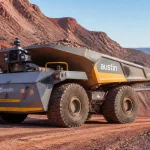
Spot does not operate in a vacuum. It is increasingly part of a broader ecosystem of autonomous machinery. While massive haul trucks, such as those used in Ucore’s Bokan Mountain project, handle the bulk movement of ore, Spot acts as the “scout” for the fleet.
In open-pit operations, Spot is being used to inspect high-walls and haul road conditions. If the robot detects a rockfall or a significant pothole via its LiDAR sensors, it can automatically update the navigation path for the entire autonomous haulage fleet, preventing tire damage or more serious accidents. This level of machine-to-machine communication is a hallmark of the “Mine 4.0” philosophy that has matured significantly over the last 24 months.
| Feature | Manual Inspection | Robotic (Spot) Inspection |
|---|---|---|
| Safety Risk | High (Human in pit/tunnel) | Zero (Remote operator) |
| Data Consistency | Variable (Subjective) | High (Standardized digital twin) |
| Frequency | Intermittent (Weekly/Monthly) | Constant (Daily/Hourly) |
| Environment | Restricted by air quality/temp | Resilient to extreme conditions |
| Cost (Long-term) | High (Labor/Insurance/Travel) | Lower (Opex-focused/Scaleable) |
Case Study: LKAB and the Seismic Challenge
Swedish mining giant LKAB has been a pioneer in integrating Spot into its iron ore operations. By using the robot to inspect underground areas prone to seismic activity, LKAB has significantly reduced the “wait time” between a seismic event and the resumption of production. Historically, engineers had to wait hours: or even days: for the ground to settle before it was deemed safe for a human inspection. Spot, however, can be deployed minutes after an event, providing real-time visual and seismic data that allows for a much faster return to operations.
This capability is particularly relevant as companies look to optimize their uranium and nuclear fuel supplies or secure lithium margins in volatile markets. Every hour of downtime avoided translates directly to the bottom line in a high-commodity-price environment.

The 2026 Outlook: From Tool to Teammate
As we look toward the remainder of 2026 and into 2027, the role of Spot is evolving from a specialized tool into a persistent “teammate.” We are beginning to see “robot-in-a-box” deployments: automated docking stations where Spot can recharge and upload data without any human intervention. This allows for truly continuous site monitoring.
The next frontier is AI-driven edge computing. Rather than simply streaming video, the next generation of Spot payloads will be able to identify structural cracks or gas anomalies in real-time, triggering emergency protocols or shutting down machinery locally before the data even reaches the control room.

For mining professionals and investors, the message is clear: robotics is no longer “future tech.” It is current operational reality. The integration of Boston Dynamics’ Spot into the mine pit has moved from proof-of-concept to a critical component of safety and productivity. As mines get deeper and more complex, the ability to “see” into the dark, dangerous corners of an operation without risking a human life will be the defining characteristic of the industry’s leaders.