By Charles Pitts
The delicate equilibrium of the global uranium supply 2026 roadmap has been jolted by an unexpected environmental factor: a bridge. In the remote reaches of northern Saskatchewan, extreme weather and subsequent flooding have caused the collapse of the Smoothstone River Bridge: the primary logistics artery connecting the world’s highest-grade uranium mines to their essential processing facilities.
While the mines themselves remain secure, the severance of this transportation link has halted the delivery of critical materials and the movement of ore, forcing a temporary shutdown of the Key Lake mill and a significant scale-back at the McArthur River mine. For a market already grappling with a structural deficit and a pivot toward Western-aligned fuel sources, this localized infrastructure failure is creating ripples that extend far beyond the Athabasca Basin.
The logistics of high-grade ore: A single point of failure
Saskatchewan mining operations are legendary for their grade and scale, but they are equally defined by their isolation. The McArthur River mine, operated by Cameco, is the world’s largest high-grade uranium mine. However, it does not process its own ore into yellowcake (U3O8). Instead, the ore is transported as a slurry via specialized trucks to the Key Lake mill, located approximately 80 kilometers away.

The Smoothstone River Bridge serves as the literal and figurative bottleneck for this operation. When the bridge succumbed to floodwaters in late Q1 2026, the vital cycle of ore-to-mill was broken. Unlike typical mining disruptions caused by labor strikes or geological issues, this is a pure logistics crisis.


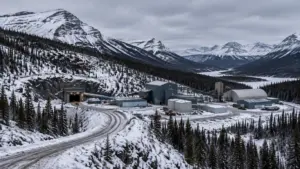
Challenging logistics: Haulage on remote, wet gravel roads remains a vulnerability for northern Saskatchewan operations.
According to industry reports, Cameco’s McArthur River and Key Lake operations were targeting between 14.0 and 16.5 million pounds (Mlbs) of U3O8 for the 2026 calendar year. While the company has maintained its consolidated 2026 production guidance for now, analysts at BMO and other financial institutions warn that a prolonged disruption could shift the needle on global availability.
Quantifying the 2026 supply risk
The math for the uranium supply 2026 outlook is unforgiving. Key Lake accounts for approximately 10% of total global primary mine supply. Market analysts estimate that every month the mill remains offline, the market loses roughly 1.5 million pounds of production.
- Inventory Cushion: Fortunately, the system has some built-in resilience. Slurry tanks at McArthur River and storage containers at Key Lake can typically hold between 7 to 10 days of full production.
- The “Buy” Signal: If the logistics delay extends beyond the three-week mark, the market expectation is that Cameco may be forced to enter the spot market to buy or borrow pounds to fulfill its existing long-term delivery contracts. This would effectively transform a supply loss into a fresh demand spike.
This situation mirrors some of the supply-chain tensions we’ve seen in other sectors, such as the lithium price forecast 2026 drivers, where infrastructure timing often lags behind geological readiness.
Uranium price forecast 2026: Three scenarios
The flooding comes at a time when the uranium market is already on edge due to geopolitical shifts and the ongoing energy transition metals surge. Investors and utility buyers are now weighing three primary scenarios for the uranium price forecast 2026.
1. The Base Case: Temporary Blip
In this scenario, the bridge is bypassed or repaired within 14 to 21 days. Production losses are kept under 1 Mlb, and much of the tonnage is recovered by ramping up throughput later in the year.
- Price Impact: Modest support for spot prices; negligible impact on long-term contract rates.
2. The Bull Case: Protracted Disruption
If environmental conditions prevent a rapid fix and the logistics halt exceeds 30 days, the loss of 1.5–2.0 Mlbs becomes a reality. Utilities, fearing a repeat of the 2025 ground-freezing issues, may accelerate their 2026-2027 procurement plans to lock in remaining Western supply.
- Price Impact: Spot prices could see a 10-15% premium as buyers compete for limited uncommitted volumes.
3. The Bear Case: Macro Dampening
While the supply disruption is bullish, a broader global economic slowdown could dampen the immediate impact of the Saskatchewan floods. If nuclear build-outs in emerging markets face delays, the lost pounds from Key Lake might be absorbed by existing secondary inventories without a significant price rally.
- Price Impact: Prices remain stable or follow the pre-existing trajectory, with the flood acting as a floor rather than a ceiling.

Logistics at a standstill: Infrastructure failures can have immediate impacts on global commodity availability.
Infrastructure fragility in the Athabasca Basin
The Saskatchewan floods serve as a stark reminder that even Tier-1 assets are vulnerable to climate and infrastructure risks. We have seen similar themes play out in Africa with Simandou’s infrastructure risks, and now it is hitting closer to home in North America.
The Athabasca Basin holds some of the world’s most valuable mineral real estate. However, the reliance on a limited network of all-weather roads and bridges in a region prone to increasingly volatile weather patterns: ranging from wildfires to severe spring floods: is a risk factor that mining executives can no longer ignore.
“It’s not enough to have the ore in the ground,” says one mining logistics consultant. “You have to have the industrial resilience to get it to the customer, regardless of what the weather is doing in the boreal forest.”

Modern underground technology at McArthur River remains world-class, but surface logistics are the current bottleneck.
The broader impact on 2026 market dynamics
Beyond the immediate price action, this event is accelerating a trend toward regionalized supply chains. Utilities are increasingly willing to pay a “security-of-supply” premium for pounds sourced from stable jurisdictions like Canada and the United States. However, that premium assumes the infrastructure is as stable as the government.
As we noted in our uranium market outlook for Wyoming and Oregon, the push for domestic U.S. production is partly driven by the need to diversify away from any single point of failure: be it geopolitical or environmental.
Market Snapshot: Uranium Supply Indicators
The following table provides a snapshot of the current variables influencing the 2026 market as of mid-May 2026.
| Variable | Current Status | 2026 Outlook Impact |
|---|---|---|
| Saskatchewan Logistics | Impaired (Bridge Collapse) | Bullish (Potential 1.5 Mlb monthly loss) |
| Cigar Lake Production | Normal Operations | Neutral (Steady state) |
| Kazakhstan Supply | Below Nameplate Capacity | Bullish (Persistent structural deficit) |
| Utility Inventories | Moderate-to-Low | Bullish (Buying pressure returning) |
| Macroeconomic Demand | Growth in SMR Deployment | Long-term Bullish |
Conclusion: Why security of supply is the new priority
The Saskatchewan floods have not changed the underlying geology of the Athabasca Basin, nor have they diminished the global appetite for nuclear energy. What they have done, however, is shift the conversation from “resource abundance” to “operational resilience.”
For mining professionals and investors, the lesson is clear: in the 2026 market, the ability to navigate environmental and logistical hurdles is just as important as the grade of the orebody. As Cameco works to restore the bridge and the Key Lake mill, the global market remains on high alert, watching every truckload that makes its way through the northern woods.

Operational oversight: Real-time monitoring is critical as sites manage the restart of logistics and milling operations.
Shareable Social Media Snippet (LinkedIn/X)
Headline: Bridge Collapse Tightens 2026 Uranium Outlook ⚛️?
Snippet: A logistical bottleneck in northern Saskatchewan is shaking the uranium market. With the primary bridge to McArthur River and Key Lake out of commission, the global supply of high-grade uranium faces a potential 1.5 Mlb monthly shortfall. Is this the catalyst for a fresh run in uranium prices for 2026?
#Uranium #MiningNews #AthabascaBasin #EnergyTransition #UraniumPriceForecast2026 #SkillingsMining
About the Author
Penny Langford is a senior industry analyst and journalist for Skillings Mining Intelligence. With a focus on critical minerals and the energy nexus, she provides daily insights into the commodities driving the global industrial landscape. Penny has a decade of experience reporting on the intersection of mining policy, finance, and operational technology.