By Charles Pitts

As the global race for critical minerals enters a decisive phase in 2026, the Vicuña District on the border of Argentina and Chile has emerged as the primary focal point for large-scale copper-gold development. For Lundin Mining, the integration of its flagship assets into a cohesive “super-district” strategy represents more than just a resource expansion; it is a multi-decade bet on the structural supply deficit currently facing the global market.
Following the formation of Vicuña Corp: a joint venture with BHP: the district has transitioned from a collection of exploration successes into a singular, industrial-scale pipeline. With an integrated technical report expected to set the stage for a major capital sanctioning decision by late 2026, the industry is closely watching how Lundin navigates the geological and logistical complexities of this Andean frontier.
Vicuña Corp: The Lundin-BHP Power Play
The strategic cornerstone of the district is Vicuña Corp, the 50/50 joint venture established between Lundin Mining and BHP. By combining the massive Filo del Sol project with a half-interest in the Josemaria project, the partners have created a vehicle capable of executing what many analysts describe as an “Andean Super-Deposit.”
The logic behind the JV is grounded in infrastructure synergy. Rather than developing two massive, capital-intensive mines in isolation, the partnership allows for shared facilities, including a high-capacity desalination plant, power corridors, and a centralized processing hub. This approach significantly de-risks the mining M&A deals of 2026 by pooling technical expertise and financial weight.
More Read

For Lundin, the 2026 strategy is defined by three distinct phases of development. Stage 1 focuses on the Josemaria sulphide mill, designed to establish initial production and cash flow. Stage 2 layers in the Filo del Sol leachable oxide deposits via an SX/EW plant, while Stage 3 anticipates a full expansion to include the massive Filo del Sol sulphide resource. This phased approach allows the JV to scale production in alignment with global copper demand while managing the initial multi-billion dollar capital outlay.


The centralized sulphide concentrator will serve as the logistical hub for the integrated Vicuña District development.
Filo Sur: The Independent Discovery Catalyst
While the Lundin-BHP JV controls the primary resource base, recent developments at the Filo Sur project have added a new layer of district-wide intrigue. Operated independently by Mogotes Metals, the Filo Sur discovery has yielded high-grade, shallow copper-gold-silver-molybdenum intercepts that suggest the Vicuña porphyry cluster is even larger than previously modeled.
More Read

The 2026 drilling campaign at Filo Sur, utilizing four active rigs, has focused on multiple porphyry and epithermal targets. Although not currently part of the Vicuña Corp partnership, the proximity of these high-grade zones to the planned Josemaria-Filo del Sol processing infrastructure makes Filo Sur a compelling satellite candidate.
The existence of independent high-grade discoveries reinforces the narrative that the Vicuña District is not just a single mine site, but a generational mineral province. For investors, this adds significant “optionality” to the district, as additional feed from satellite deposits could eventually extend the mine life or increase the throughput capacity of the central hub beyond current projections.
Strategic Milestones: The Path to 2026 Sanctioning
Lundin’s 2026 roadmap is heavily weighted toward technical de-risking and the completion of an integrated economic model. The Q1 2026 release of the Integrated Technical Report will be the definitive document for the district, providing updated resource estimates and a consolidated life-of-mine plan.
| Milestone | Expected Timing | Strategic Impact |
|---|---|---|
| Integrated Technical Report | Q1 2026 | Consolidation of Josemaria & Filo del Sol reserves. |
| Filo Sur Resource Update | Q2 2026 | Definition of independent satellite upside. |
| Permitting Finalization | Q3 2026 | Critical path for bilateral Argentina-Chile water/transit. |
| Sanctioning Decision | Late 2026 | Formal FID (Final Investment Decision) by JV partners. |

Exploration drilling continues at high altitude to define the boundaries of the Filo del Sol sulphide mineralization.
Copper Price Forecast 2026: The Demand Tailwinds
The economic viability of a project the scale of Vicuña is inextricably linked to the long-term price of copper. As of May 25, 2026, the market reflects a continued tightening of supply, driven largely by the massive requirements of energy transition infrastructure and the unprecedented demand from AI data centers.
Lundin has historically used a range of price assumptions in its technical work: from a conservative $3.00/lb for copper-equivalent calculations to $4.60/lb for resource pit shells. Current market analysts suggest that a sustained incentive price above $4.00/lb is necessary to bring projects like Vicuña online, given the inflationary pressures on labor and heavy equipment.
Market Snapshot: May 25, 2026
The following table provides a snapshot of the commodity environment underpining the Vicuña District’s 2026 outlook.
| Commodity | Current Price (Spot) | 2026 Forecast Range | Trend |
|---|---|---|---|
| Copper (HG) | $4.45 / lb | $4.10 – $4.85 | Bullish |
| Gold | $2,950 / oz | $2,800 – $3,200 | Stable |
| Silver | $32.00 / oz | $28.00 – $36.00 | Bullish |
| Molybdenum | $22.50 / lb | $20.00 – $25.00 | Consolidation |
Note: Data reflects typical 2026 market intelligence projections for high-altitude Andean producers.
The copper supply gap of 2026 has made the timing of Vicuña particularly relevant. Industry forecasts indicate a structural deficit of nearly 10 million tonnes by the mid-2030s. Large, long-life assets like those in the Lundin portfolio are among the few projects globally capable of providing the tonnage required to stabilize the market.
Operational Logistics and the Andean Frontier
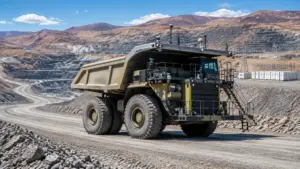
The primary challenge for the Vicuña District is not the geology: which is world-class: but the logistics. Operating at altitudes exceeding 4,000 meters requires specialized fleet management and robust health and safety protocols. Lundin’s use of autonomous haul trucks is expected to play a critical role in mitigating the risks associated with high-altitude environments.

Autonomous technology and telemetry-equipped haul trucks are central to the operational efficiency of the Josemaria stage of development.
Furthermore, the binational nature of the district requires a unique regulatory framework. While the majority of the current resources are on the Argentine side of the border, critical infrastructure like the desalination plant and port facilities will be located in Chile. The “Vicuña Treaty” and subsequent cross-border agreements are essential for the movement of personnel, equipment, and concentrate.
Geologic Scale: The Porphyry Cluster
Geologically, the district is characterized by a cluster of giant porphyry systems. Filo del Sol, in particular, has consistently surprised the market with the depth and grade of its mineralization. Drill results throughout late 2025 and early 2026 have confirmed that the Aurora Zone within Filo del Sol remains open at depth, potentially increasing the sulphide resource beyond the current 2-billion-tonne threshold.
The 2026 gold price forecast also provides a significant “by-product” tailwind for the project. While Vicuña is primarily a copper play, the high gold and silver content across the district serves as a powerful credit against the C1 cash costs of copper production. In a high-gold-price environment, the net cash cost for copper at Vicuña could potentially drop into the lower quartile of global producers.

Advanced monitoring and real-time data integration in the control room allow for precise management of the remote Andean site.
Conclusion: The Strategic Significance of 2026
As Lundin Mining and BHP move toward a final investment decision in late 2026, the Vicuña District stands as a testament to the scale required for modern mining success. The integration of Josemaria and Filo del Sol into a singular district strategy has consolidated the technical and financial resources necessary to unlock one of the world’s last great copper frontiers.
With the independent discovery at Filo Sur underscoring the district’s expansion potential, and the copper market signaling a long-term supply squeeze, the Vicuña “Super-Deposit” is well-positioned to become the anchor of Lundin’s 2026 strategy. For the global mining industry, it represents the next generation of industrial-scale extraction: a complex, high-altitude, binational project that is essential for the energy transition of the late 2020s.