By Charles Pitts

JACKSON, CALIFORNIA : Haranga Resources (ASX: HAR) has formally established its position in the historic Mother Lode Gold Belt, announcing a maiden Mineral Resource Estimate (MRE) for its Lincoln Gold Project that underscores both the high-grade nature of the deposit and its potential for rapid development.
The Perth-based explorer reported a JORC-compliant resource of 402,000 ounces of gold at an average grade of 5.1 grams per tonne (g/t), utilizing a 2.0 g/t cut-off. The result represents a 40.6% increase over previous historical estimates and places Lincoln among the highest-grade undeveloped gold projects in North America.
With significant underground infrastructure already in place and a favorable gold price forecast 2026 outlook, Haranga is pivoting toward a “fast-track” production strategy aimed at capitalizing on a structural bull market in precious metals.
Resource Breakdown: High Grades in the Sierra Nevada
The maiden MRE is concentrated across two primary ore bodies: Lincoln–Comet and Medean. The larger of the two, the Lincoln–Comet structure, hosts 1.50 million tonnes at 5.7 g/t Au for 275,000 ounces. The Medean structure contributes an additional 0.96 million tonnes at 4.1 g/t Au for 127,000 ounces.
More Read

According to Haranga management, the 5.1 g/t head grade is particularly significant given the current gold price landscape, where many global producers are struggling with declining grades at mature assets.

“This maiden resource is a pivotal milestone that validates the high-grade nature of the Lincoln Project,” the company stated in its May 27 filing. “Achieving more than 400,000 ounces at over 5 grams per tonne in our first JORC estimate provides a robust foundation for our goal of building a multi-million-ounce resource base along the Mother Lode.”
A $90 Million Head Start
Unlike many greenfield exploration plays, the Lincoln Gold Project benefits from extensive legacy investment. Previous owners spent approximately US$90 million on site development, leaving behind a wealth of physical assets that significantly lower the barrier to production.
More Read

The current infrastructure includes:
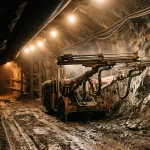
- An 880-meter underground decline.
- Approximately 900 meters of lateral level development.
- Established underground services, including ventilation and water management.
- A surface processing plant, administrative offices, and fully equipped workshops.

The existence of the decline and level development is a critical differentiator. In an environment where permitting and construction of new underground access can take years, Haranga’s ability to access the ore body via dewatered, existing tunnels offers a compressed timeline to first gold.
Geological Context: The Mother Lode Legacy
The Lincoln Project is situated within the Jackson–Plymouth segment of California’s Mother Lode Gold Belt. This 190-kilometer-long structural zone has a storied history, having produced over 3.4 million ounces of gold from the immediate leases now held by Haranga.
Geologically, the Mother Lode is characterized by deep-seated mesothermal gold-quartz veins. Historically, mines in this district have exhibited remarkable continuity, with several operations reaching depths of over 1,000 meters while maintaining consistent ounces-per-vertical-meter productivity.
Notably, Haranga’s maiden MRE is based on drilling that rarely extended beyond 150 meters in vertical depth. The company believes the mineralization remains open both at depth and along strike, presenting a clear path for resource expansion.
Gold Price Forecast 2026: The Macro Tailwinds
The timing of Haranga’s maiden resource coincides with a historic rally in the gold market. As of mid-2026, gold has moved into a “structural bull” phase, driven by aggressive central bank accumulation and persistent geopolitical instability.
Major financial institutions, including Goldman Sachs and UBS, have updated their targets, with many analysts now projecting gold to trade between $5,400 and $6,300 per ounce by year-end 2026. This macro backdrop significantly enhances the economics of high-grade projects like Lincoln.
| Bank / Institution | 2026 Year-End Target (Gold/oz) | Trend |
|---|---|---|
| Wells Fargo | $6,100 – $6,300 | Bullish |
| UBS | $6,200 | Bullish |
| J.P. Morgan | $5,055 (Q4 Avg) | Neutral/Bullish |
| Goldman Sachs | $5,400 | Bullish |
For developers like Haranga, the high grades at Lincoln act as a natural buffer against cost inflation in labor and energy. With the gold price forecast 2026 outlook remaining positive, high-margin underground projects are increasingly becoming the focus of institutional investors.
Mining Stocks to Watch 2026: Why Lincoln Stands Out
As the mining sector navigates the 2026 cycle, investors are looking beyond simple resource size and focusing on “deliverability.” Haranga is frequently cited in lists of mining stocks to watch 2026 due to its combination of high grade, low capital expenditure requirements, and a tier-one jurisdiction.

“Lincoln is the definition of a ‘brownfield’ restart,” says Michael Vance, a senior mining analyst. “When you have 400,000 ounces at 5 g/t and you already have the hole in the ground, you aren’t just an explorer: you’re a developer with a massive head start. That’s why this is one of the more compelling gold stories in the U.S. right now.”
Exploration Upside and Multi-Million Ounce Goal
While the current 402,000-ounce resource provides a solid baseline, Haranga’s internal modeling suggests the Jackson–Plymouth segment has the capacity to support a much larger endowment.
The company’s 2026-2027 exploration program is designed to test depth extensions of the Lincoln–Comet and Medean structures. Analogous mines nearby have historically proven that mineralization can persist for thousands of feet into the Sierra Nevada basement rock.
“We are just scratching the surface,” Haranga’s technical team noted. “The historic production of 3.4 million ounces in this immediate vicinity suggests that our maiden resource is likely just the upper portion of a much larger system. Our goal is to expand this toward a multi-million-ounce scale through systematic step-out drilling.”
Path to Production and Regulatory Status
A major hurdle for any California-based mining project is the regulatory environment. However, the Lincoln Project holds a unique advantage: it is already permitted for mining operations.
The project maintains major regulatory approvals that allow for the extraction of at least 315,000 tonnes of ore per annum. Coupled with the existing surface processing plant and the dewatered decline, Haranga is currently evaluating a restart feasibility study to determine the optimal production rate.

Conclusion: A High-Grade Future in the Mother Lode
Haranga Resources’ delivery of the Lincoln maiden MRE marks a significant shift for the company from speculative explorer to a serious gold developer. By proving up nearly half a million ounces at 5.1 g/t, Haranga has secured its place in the 2026 gold narrative.
With a massive existing infrastructure footprint, a supportive gold price environment, and clear geological evidence of depth persistence, the Lincoln Gold Project is positioned to become a cornerstone asset in the resurgent California gold mining industry. For investors monitoring mining stocks to watch 2026, the progress at Lincoln will be a key benchmark for high-grade North American gold development.