By Salini Krishnan

The global mining sector has entered a period of sharp divergence as 2026 unfolds, characterized by a significant bifurcation in equity valuations and a localized boom in project financing. While the "electrification trade" remains the primary driver of capital flows, investors are becoming increasingly discerning, rewarding high-quality copper and gold assets with significant premiums while marginal projects in the lithium and base metals space struggle to attract sustaining capital.
This landscape is being shaped by a "quality over beta" mindset. In previous cycles, a rising tide in commodity prices generally lifted all boats. Today, factors such as jurisdiction stability, fiscal regimes, and project scale have become the dominant arbiters of value. As capital rotates into tier-one districts, the industry is witnessing a multi-billion dollar M&A wave led by major producers seeking to secure long-life reserves before the anticipated supply deficits of the late 2020s become acute.
Valuation Watch: The P/NAV Bifurcation
The most striking trend in mining investment intelligence this year is the widening gap in Price-to-Net Asset Value (P/NAV) metrics. Historically, mining producers trade in a band between 0.5x and 1.5x NAV. However, as of mid-2026, we are seeing a distinct split based on commodity outlook and project de-risking.
Copper and gold producers are currently commanding an average premium of 1.3x P/NAV. This "copper premium" is driven by the structural demand surge from the AI-driven data center expansion and the ongoing global grid modernization. Investors are willing to pay a premium for producers that can demonstrate a clear path to production growth in stable jurisdictions.
In contrast, the lithium sector is trading at a depressed average of 0.6x P/NAV. After the boom-bust cycle of the early 2020s, the market is currently working through a surplus of marginal, high-cost projects. Only tier-one brine and hard-rock assets with integrated downstream optionality are showing signs of rerating. This bifurcation suggests that while the energy transition remains the core narrative, the "lithium lottery" has ended, replaced by a rigorous focus on cost-curve positioning.


Aerial view of industrial-scale lithium brine extraction facilities in an arid mining region.
M&A and Financing: The Return of the District-Scale Build
The capital rotation toward quality is most visible in the recent surge of high-stakes M&A and project financing approvals. Large-scale, long-life assets are the primary targets, as major miners look to anchor their portfolios with "generational" projects.
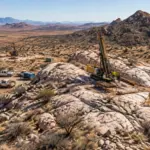
Lundin’s $9.7B Vicuña District and RIGI Approval
In a landmark development for South American mining, Vicuña Corp.: the joint venture vehicle between Lundin Mining and BHP: has received approval for inclusion in Argentina’s RIGI (Incentive Regime for Large Investments). This move covers the massive Josemaría and Filo del Sol projects within the Vicuña district.
The RIGI approval is a game-changer for the $9.7 billion contemplated district build-out. By providing fiscal stability, tax incentives, and regulatory certainty, the Argentine government has successfully positioned the Vicuña district as a premier global copper hub. This represents a broader shift where resource-rich countries are using targeted incentive regimes to attract multi-billion dollar investments rather than relying on simple royalty hikes. The scale of this project reflects the industry's new preference for district-scale development: combining multiple deposits into a single operational camp to maximize efficiency and optionality.
Generation Mining: Securing the North American Pipeline
Project finance is also reopening for strategic assets in Tier-1 jurisdictions. Generation Mining recently announced senior lender credit approval for a US$310 million facility for its Marathon palladium-copper project in Ontario, Canada. Led by Export Development Canada, ING Capital, and Société Générale, this financing package de-risks the construction path for one of the few large-scale critical minerals projects nearing a build decision in 2026. This syndicate-led project finance indicates that commercial banks are returning to the sector, provided the projects feature strong offtake agreements and clear ESG compliance.
Zijin’s $4B Expansion and Regulatory Friction
Meanwhile, Chinese outbound M&A remains a powerful force, albeit one facing increased regulatory scrutiny. Zijin Mining’s $4 billion cash acquisition of Allied Gold highlights China's continued appetite for overseas gold and base metal assets, particularly in Africa. However, delays in approvals from China’s National Development and Reform Commission (NDRC) have slowed the transaction, illustrating the rising geopolitical and regulatory friction that now accompanies cross-border deals.

Modern ultra-class haulage equipment utilized in large-scale copper and gold operations.
Commodity Floor: Uranium’s $100 Regime and Silver’s Pivot
Beyond corporate maneuvers, the commodity markets themselves are establishing new structural foundations. For investors, the search for a "price floor" is centered on uranium and silver, though for different fundamental reasons.
Uranium’s $100/lb Structural Floor
Uranium has entered mid-2026 with a spot price firmly above $100/lb. Unlike previous spikes, this appears to be a regime change rather than a temporary bubble. Utilities are now being forced into long-term contracting at higher price points to secure fuel for the global nuclear renaissance. With energy transition metals taking center stage, uranium is benefiting from a decade of underinvestment. Experts suggest that $100/lb now serves as an incentive price floor; projects requiring lower prices have largely been exhausted, and new supply requires this level to justify development costs.
Silver’s Industrial Breakout
Silver is experiencing a different kind of evolution. Long considered a "poor man's gold," silver is finally decoupling from its purely precious metal status. While it remains a monetary hedge, its role in solar PV manufacturing and high-end electronics is driving an industrial breakout. We are seeing scenarios where silver could test triple digits, but unlike uranium, these moves are framed as volatile spikes rather than stable floors. For investors, the silver trade in 2026 is about capturing the "industrial delta" while managing the inherent volatility of a smaller, more reactive market.

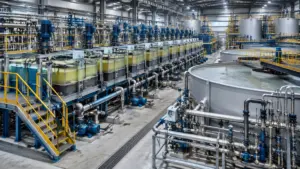
A modern industrial facility focused on the processing of energy transition minerals.
Strategic Outlook for the Remainder of 2026
As we look toward the second half of the year, the "Investment Edge" belongs to those who can navigate the P/NAV bifurcation. The era of generic commodity exposure is over. Instead, success in the 2026 mining market requires a deep understanding of:
- Fiscal Stability Regimes: Projects like Lundin’s Vicuña show that jurisdiction risk can be mitigated through formal investment treaties (RIGI), creating "islands of stability" in traditionally volatile regions.
- District Scale: Investors should favor companies that control entire mineral camps rather than isolated deposits. The operational leverage of a district-scale build is a significant hedge against rising input costs.
- Critical Mineral Syndicates: The return of large banking syndicates to projects like Generation Mining’s Marathon indicates a narrowing window for high-quality developers to secure non-dilutive capital.
The bifurcation we see today is the market's way of separating the future's essential producers from the relics of the previous cycle. In a world defined by metal scarcity and energy transition, the "premium" is no longer just a metric: it is a signal of survival.
Social Media Snippet
LinkedIn/X:
The 2026 mining market is no longer a "rising tide" scenario. We’re seeing a sharp P/NAV bifurcation: Copper/Gold names are commanding 1.3x premiums while Lithium lags at 0.6x. With Lundin’s $9.7B Vicuña RIGI approval and Uranium establishing a $100/lb floor, the focus has shifted to quality and district-scale builds. Is your portfolio positioned for the quality rerate? Read the full analysis on Skillings Mining Intelligence. #MiningInvestment #Copper #Uranium #GoldMining #MandA #EnergyTransition