By Charles Pitts

As global copper markets navigate the third quarter of 2026, a fundamental tension is emerging between record-high production costs and the technical limits of industrial substitution. Copper prices, which have flirted with the $5.20/lb (~$11,500/mt) mark for much of the year, are now facing a dual challenge: a structural supply deficit that supports a high price floor and an accelerating shift toward aluminum in price-sensitive applications.
The current market environment represents a “substitution-incentive” regime. Historically, when the copper-to-aluminum price ratio exceeds 3.5x, industrial consumers begin the rigorous process of re-engineering systems to accommodate aluminum. With the ratio currently hovering near 4.3x, the risks to copper’s long-term demand growth are no longer theoretical.
The $5.20/lb Floor: Drivers and Resistance
The $5.20/lb level is not merely a psychological barrier; it represents the confluence of rising marginal costs and the “substitution wall.” For many operators, this price reflects the minimum required to justify new greenfield developments in jurisdictions like Argentina’s Vicuna District or deep-level expansions in Poland.
| Scenario | Copper Price Target (2026) | Primary Driver |
|---|---|---|
| Bull Case | $6.10/lb | Chronic refined deficit (>250k mt); US-China trade resolution. |
| Base Case | $5.20/lb | Sustained AI and EV demand balanced by incremental substitution. |
| Bear Case | $4.40/lb | Global recession; aggressive aluminum thrifting in power grids. |
Data from the International Copper Study Group indicates a refined copper deficit of approximately 150,000 mt for 2026. While this supports the $5.20/lb floor, the high price environment is actively eroding copper’s market share in the power transmission and distribution sectors.
More Read


Open-pit mining operations continue to face rising extraction costs, supporting a higher global price floor for copper.

The Substitution Ratio: Why 4.0x Matters
The economic decision to switch from copper to aluminum is rarely instantaneous. It requires significant capital expenditure to redesign components and retool manufacturing lines. However, once the price ratio sustains levels above 4.0x, the “price-to-conductivity” advantage of aluminum becomes too significant to ignore.
Aluminum possesses roughly 61% of copper’s electrical conductivity. To achieve the same current-carrying capacity, an aluminum conductor must be approximately 1.6 times larger than its copper counterpart. In applications where space is not a constraint: such as overhead power lines and large-scale busway systems: aluminum is the clear economic winner.
More Read

In 2026, we are seeing this play out in the HVAC sector and the lower-voltage segments of the EV supply chain. Companies like Hydro have reported that aluminum now accounts for nearly 40% of global HVAC unit production, a trend accelerated by the 2026 price spikes that forced engineers to view aluminum as a strategic alternative rather than a secondary substitute.
Technical Constraints: Where Copper Remains King
Despite the aggressive substitution in bulk applications, copper maintains an unassailable lead in high-performance sectors. The “substitution risk” is not universal. For instance, in EV traction motors and high-density windings, the 1.6x size requirement of aluminum is a deal-breaker. Increasing the motor size to accommodate aluminum would add weight and reduce vehicle efficiency, negating the cost savings of the metal itself.
Furthermore, the surge in AI data center demand: a sector projected to add 110,000 tons of copper demand by the end of 2026: relies on copper’s superior thermal performance. A single hyperscale facility can require up to 50,000 tons of copper for precision power distribution where aluminum simply “won’t cut it.” The AI-uranium-nexus and the associated power infrastructure build-out remain the strongest anchors for copper demand.

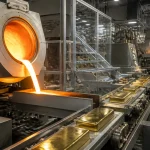
Copper cathodes awaiting distribution; the metal’s high conductivity remains essential for AI and high-density electronics.
S&P Global 2040: The Structural Deficit
The long-term outlook provided by S&P Global frames the current substitution risk within a broader context of scarcity. Global copper demand is expected to rise from roughly 28 million tons in 2025 to 42 million tons by 2040: a 50% increase in just 15 years.
Electrification efforts, including renewables and grid modernization, account for half of this demand growth. Even with aggressive substitution and thrifting, the supply gap is stark. Current projections suggest that without massive new investments: estimated by the IEA at $350 billion by 2040: global production will peak at 33 million tons around 2030, leaving nearly 25% of forecast demand unmet.
This structural deficit suggests that while aluminum substitution may cap the upside of extreme price spikes, it is unlikely to break the $5.20/lb floor. Substitution is effectively a safety valve for the market, preventing a complete supply chain collapse by shifting non-critical demand to other materials.
Geopolitical Volatility: The Tariff Overlay
The substitution landscape is further complicated by US trade policy. The potential for a 10% tariff on copper imports under Section 232 has introduced a new layer of volatility. While tariffs are intended to support domestic production and margins, they also risk slowing macro demand growth by increasing the “total delivered cost” for US manufacturers.
Interestingly, existing 25% tariffs on aluminum have not stopped the metal from gaining ground against copper in the US. This suggests that the absolute price gap between the two metals: often exceeding $9,000 per ton in 2026: is a more powerful driver of industrial behavior than regional trade barriers.

Aluminum continues to capture market share in overhead transmission projects where weight and cost are the primary design drivers.
Operator and Investor Implications
For mining operators, the risk is not that copper demand will vanish, but that the “easy” market share in utilities and construction is being permanently lost to aluminum. This necessitates a shift in strategy toward high-margin, technically demanding applications where copper’s properties are irreplaceable.
For investors, the $5.20/lb floor represents a high-stakes entry point. If the market breaks below this level, it could signal that substitution and thrifting are progressing faster than anticipated. Conversely, a bounce off this support level would confirm the structural tightness of the market.
Key takeaways for the 2026 outlook:
- Substitution is targeted: Watch for aluminum gains in busbars, HVAC, and building wire.
- Copper is anchored: AI, EV motors, and high-performance electronics remain loyal to copper.
- The Floor is technical: $5.20/lb is the new baseline for project viability in a high-inflation, high-demand world.
As the industry moves toward the 2030s, the “copper vs. aluminum” debate will transition from a simple price comparison to a complex engineering choice. For now, the $5.20/lb floor is being tested, but the sheer scale of the electrification transition suggests that there is more than enough room for both metals in the global energy mix.

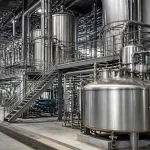
Large-scale infrastructure and processing capabilities are critical as the industry scales to meet the 2040 demand forecast.