By Charles Pitts

The global mining industry has long viewed copper as a bellwether for traditional economic health, but by mid-2026, the “red metal” has transitioned into a strategic cornerstone of the digital and energy revolution. As high-performance computing and generative AI workloads scale globally, the physical infrastructure required to support them: data centers, power grids, and cooling systems: is colliding with a stagnant supply pipeline.
Industry analysts now project a refined copper deficit for 2026 that could reach as high as 600,000 metric tons. This gap is not merely a cyclical fluctuation but a structural mismatch between the rapid-fire deployment of AI hardware and the multi-decade timelines required to bring new copper mines into production. With institutional forecasts from J.P. Morgan and Morgan Stanley signaling a decade-high shortfall, the mining sector is facing unprecedented pressure to deliver.
The AI Factor: Why Silicon Needs Copper
While much of the market’s focus has been on GPUs and silicon, the physical reality of AI is built on copper. AI data centers are significantly more power-dense than traditional cloud facilities. A single hyperscale AI facility, designed to house high-density racks like the Nvidia Blackwell series, can require up to 50,000 tons of copper for its electrical distribution, high-capacity cabling, and advanced cooling systems.
In 2026, AI and data centers are projected to consume approximately 475,000 metric tons of copper globally. This represents a massive shift in demand composition. Copper is the primary material used in busbars: the heavy-duty conductors that distribute power within data centers: and in the power strips and heat sinks that prevent processors from overheating. Unlike software, which can be optimized and scaled digitally, the physical conductivity of copper remains a non-negotiable requirement for high-performance computing.
More Read

The trend has led to a deepening AI-power nexus, where tech giants are increasingly forced to secure not just energy, but the raw materials required to transmit that energy.


The Grid Infrastructure Bottleneck
Beyond the walls of the data center, the broader electrification of the global economy is acting as a “copper sponge.” The International Copper Study Group (ICSG) has noted that electrical infrastructure has surpassed construction as the leading source of global copper demand, now accounting for over 30% of total usage.
More Read

Grid modernization is no longer optional. In China, State Grid has announced plans for 4 trillion yuan (approximately $550 billion) in investment between 2026 and 2030, a 40% increase over previous planning cycles. This expansion is essential to handle the intermittent nature of renewable energy and the localized power surges required by AI clusters.
Similarly, in North America and Europe, aging grids are being overhauled to support electric vehicle (EV) charging and domestic chip manufacturing. Each kilometer of new high-voltage transmission line and every substation transformer adds to the mounting demand. As explored in our recent analysis of copper vs. aluminum substitution risks, while some low-voltage applications can pivot to aluminum, the high-performance requirements of AI and urban grid cores remain firmly tied to copper.

Supply-Side Constraints: The Scoreboard of Shortages
The 2026 deficit is being exacerbated by a series of operational setbacks at major global mines. Production guidance has been downgraded across several Tier-1 assets, including Teck’s Quebrada Blanca in Chile and Freeport-McMoRan’s Grasberg in Indonesia, where technical disruptions and aging ore grades have limited the ability to ramp up output.
Refined production growth for 2026 is expected to hover at just 0.9%, a figure that pales in comparison to the projected 3.5%–4% growth in demand from the tech and energy sectors. The lack of major “greenfield” discoveries over the last decade means the industry is relying on “brownfield” expansions that are increasingly susceptible to logistical delays and regulatory hurdles.
2026 Copper Deficit Scoreboard: Institutional Projections
| Organization | 2026 Deficit Forecast (Metric Tons) | Key Driver Cited |
|---|---|---|
| International Copper Study Group (ICSG) | 150,000 | Low refined production growth (0.9%) |
| J.P. Morgan Global Research | 330,000 | AI data center consumption (~475k tons) |
| Morgan Stanley | 600,000 | Biggest shortfall in 20 years |
| Citigroup | ~400,000 | Low inventory and grid modernization |
The geographical concentration of supply remains a significant risk factor. As the Vicuna District mania in Argentina demonstrates, the industry is searching for new frontiers to bridge the gap, but these projects are years away from delivering the refined cathodes needed by data center developers today.
Operational Complexity and Real-Time Management
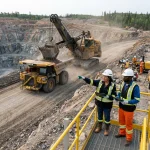
Mining companies are increasingly turning to technology to squeeze efficiency out of existing operations. In control rooms across the copper belt, staff are monitoring real-time equipment status and productivity metrics to minimize downtime. Every hour of lost production at an open-pit site now carries a higher opportunity cost given the tightening market.

The complexity of modern extraction means that even with prices trading above $12,000 per ton, supply cannot be “turned on” instantly. Environmental, Social, and Governance (ESG) requirements, coupled with rising water scarcity in key mining regions like the Atacama Desert, have extended the average permitting-to-production timeline to over 15 years.
Strategic Implications for 2026 and Beyond
The 2026 deficit marks a turning point where copper moves from being a commodity to a strategic asset. For investors and operators, the focus has shifted toward securing long-term supply through M&A and strategic partnerships. Tech companies, once distant from the mining sector, are now exploring direct investment or long-term offtake agreements to ensure their AI expansion plans are not throttled by a lack of wiring.
According to the latest market intelligence, the current inventory levels are near historical lows. If the projected 600,000-ton deficit materializes, the industry may see a scramble for physical material similar to the lithium surge of the early 2020s, but on a much larger scale given copper’s $300 billion annual market size.

As 2026 progresses, the “Critical Mineral Gap” will likely dictate the pace of AI infrastructure deployment. Without a significant response from the supply side: either through breakthrough recycling technologies or rapid-track mine approvals: the copper shortage could become the primary ceiling for the global AI revolution.