By Charles Pitts

Australia’s largest aluminium smelter has secured a long-term electricity pathway after the federal and New South Wales governments agreed to provide about A$2.5 billion (US$1.76 billion) in support over 10 years.
The agreement is designed to keep Rio Tinto-backed Tomago Aluminium operating beyond the expiry of its existing power contract in 2028. It also links the smelter’s future to a major expansion of renewable generation and firming capacity in New South Wales.
Under the new arrangement, Tomago will sign a 10-year power purchase agreement covering supply through to 2038. Electricity supplied to the smelter is expected to become 100% renewable from 2033.
The package addresses a difficult industrial question: how can an electricity-intensive metals facility remain internationally competitive while moving away from coal-fired power?

That question extends beyond Tomago. Aluminium is a foundational material for transport, construction, packaging, transmission infrastructure and renewable energy equipment. The smelter’s survival therefore has implications for Australian manufacturing, regional employment, electricity markets and the country’s wider energy transition.

Tomago’s power problem was also an industrial policy problem
Tomago Aluminium, located near Newcastle in the Hunter region, currently operates under an electricity supply agreement with AGL that expires on 31 December 2028.
The smelter’s electricity demand is substantial and relatively constant. According to reporting by ABC News, Tomago consumes about 10% of New South Wales’ total electricity supply annually and has a near-continuous load of approximately 950 megawatts.

That makes electricity one of the plant’s most important operating costs. It also makes Tomago a strategically significant customer for the state grid.
Without a competitively priced replacement contract, Rio Tinto had warned that the smelter could face closure after 2028. A shutdown would affect approximately 1,000 direct employees, around 200 full-time-equivalent contractors and an estimated 5,000 indirect jobs, according to Rio Tinto.
Tomago can produce up to 590,000 tonnes of aluminium a year, representing almost 40% of Australia’s annual aluminium output, based on figures in the company’s official announcement.
The government intervention is therefore being framed not simply as assistance to one industrial facility, but as support for a domestic manufacturing chain that connects Australian bauxite, alumina refining and aluminium production.

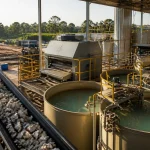
Tomago’s long-term power agreement is intended to protect aluminium production and regional manufacturing employment.
What the A$2.5 billion package covers
The government support is spread across the 10-year power arrangement rather than provided as a single upfront payment. The mechanism is intended to bridge the gap between the cost of new firmed renewable power and the electricity price Tomago can absorb while remaining competitive.
Reporting by Renew Economy indicates that the support could reduce Tomago’s electricity cost by approximately A$35 per megawatt-hour. The precise commercial terms, including the revenue-sharing mechanism that applies when aluminium prices are high, have not been fully disclosed.
| Element | Structure | Industrial significance |
|---|---|---|
| Government support | About A$2.5 billion over 10 years | Underwrites a competitive replacement power supply |
| NSW contribution | Capped at A$1.225 billion | State participation in securing the Hunter industrial base |
| Commonwealth contribution | Approximately matching the NSW commitment; not capped in the same way | Federal support for manufacturing and energy security |
| Power agreement | 10-year PPA after the current contract ends | Secures electricity supply through 2038 |
| Renewable milestone | 100% renewable electricity from 2033 | Establishes a defined decarbonisation pathway |
| Tomago investment | At least A$1.1 billion in real terms to 2038 | Supports plant upgrades, efficiency and operating continuity |
| Decarbonisation allocation | A$100 million within the company investment | Funds emissions-reduction measures and demand response |
| New energy capacity supported | Nearly 3 gigawatts of renewable and firming capacity | Creates demand for wind, solar, storage and dispatchable power |
The distinction between the government package and Rio Tinto’s investment commitment is important. The A$2.5 billion represents public support for the power arrangement, while A$1.1 billion is to be invested by Tomago Aluminium in the smelter through to 2038.
Tomago is owned by Rio Tinto, which holds a 51.55% stake, alongside Gove Aluminium Finance and Norsk Hydro.
The transition will not happen in one step
The agreement does not mean the smelter will switch immediately from its existing power arrangements to a fully renewable supply.
The PPA begins after the current contract expires at the end of 2028, while the 100% renewable milestone is set for 2033. That four-year transition period reflects the time required to develop new generation, storage and grid infrastructure.
The renewable portfolio is expected to include wind, solar and firming capacity. Snowy Hydro is expected to play a role in managing the portfolio, using a combination of hydro, pumped hydro, batteries and other dispatchable assets to support reliability when wind and solar output varies.
The arrangement is also expected to support nearly 3 gigawatts of new renewable generation and firming capacity in New South Wales. That could help unlock projects that have struggled to secure long-term corporate customers or financing.
In this respect, Tomago’s electricity demand functions as an anchor for new energy infrastructure. The smelter provides a large, predictable customer while renewable developers and grid operators work through the engineering challenge of supplying a power-intensive industrial load.

Tomago’s power arrangement is expected to support new wind, solar and firming capacity across NSW.
A large industrial load can also become a grid asset
The agreement includes a demand-response program that will allow Tomago to reduce electricity consumption when the New South Wales grid is under stress.
For a smelter, this is a significant operational role. Aluminium production typically depends on a stable, high-volume power supply, but portions of the load can be managed during periods of peak demand or constrained generation.
Rio Tinto and the governments describe this capability as a way to improve grid reliability and support the integration of more variable renewable energy.
It also changes the conventional relationship between industrial consumers and electricity systems. Instead of being only a large customer, Tomago can provide flexibility comparable to a very large energy-storage resource, reducing demand when supply is tight and returning to normal operations when conditions improve.
The commercial value of that flexibility will depend on how the program is designed, including response times, operating limits and compensation. Those details will be important for energy-market participants assessing the deal’s impact.
The emissions impact is material
Once the smelter is supplied entirely by renewable electricity, Rio Tinto expects its Scope 1 and Scope 2 operating emissions to fall by approximately 7.1 million tonnes per year.
That is a substantial reduction for one facility. It also illustrates why aluminium smelters are central to the debate over industrial decarbonisation.
Aluminium production requires large amounts of electricity because the metal is produced through an electrolytic process. Improvements in energy efficiency can reduce consumption, but the emissions profile of a smelter is heavily influenced by the source of its power.
Switching from coal-intensive electricity to renewable generation therefore has a direct effect on the emissions associated with each tonne of aluminium produced.
The company has also committed A$100 million to decarbonisation initiatives as part of its wider A$1.1 billion investment program. These measures may include energy-efficiency improvements, equipment upgrades and systems that support more flexible electricity use.
The result will not eliminate every emissions challenge. The smelting process itself produces operational emissions, and the broader aluminium chain includes mining, refining, transport and other energy requirements. However, securing lower-carbon electricity addresses one of the largest components of the smelter’s footprint.

Demand-response capability will allow Tomago to adjust electricity use during periods of grid stress.
What the deal means for Australian metals production
The Tomago agreement is part of a wider effort to preserve energy-intensive manufacturing in Australia while the electricity system changes.
Rio Tinto reached a similar long-term arrangement for its Boyne aluminium smelter in Queensland earlier in the year. Together, the two agreements give Australia’s largest aluminium smelters a pathway to remain operational beyond the expiry of older power contracts.
That matters for supply-chain resilience. Australia remains one of the few countries with an integrated aluminium industry spanning bauxite mining, alumina refining and primary aluminium smelting. Losing major smelters would weaken that domestic chain and increase reliance on imported metal.
The agreement also establishes a precedent for how governments may approach other energy-intensive industries, including steel, chemicals, mineral processing and critical-minerals refining.
The central policy test will be whether public support produces wider system benefits. In Tomago’s case, those benefits include employment, domestic production, renewable-energy investment, demand response and lower industrial emissions.
The main risks are execution and cost. Renewable projects must be delivered on schedule, firming capacity must be available when required, and the commercial arrangement must remain workable across changing aluminium and electricity prices.
For operators and investors, the most important measure will be whether the agreement converts into reliable power, sustained production and a credible emissions reduction at the plant.
Under the Iron Ore Standard umbrella, the Tomago deal is a reminder that the future of metals production will be shaped as much by infrastructure and electricity as by ore quality, mine output or commodity prices.
Australia has secured the smelter’s operating horizon to 2038. The next test is whether the country can build the energy system required to keep that promise.
Sources: Rio Tinto, ABC News, and Renew Economy.