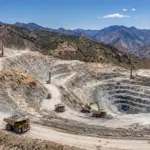
An ultra-class haul truck operates on a high-altitude open-pit mine haul road.

By Sonny Rollins
Autonomous mining technology has moved beyond pilot projects and into a competition over fleet scale, operating hours and mine-wide integration.
Komatsu’s commissioning of its 1,000th ultra-class autonomous haul truck is the clearest marker of that shift. At the same time, China-based CiDi has reported more than 1,900 autonomous mining trucks shipped across nearly 40 mines, while EACON has extended driverless haulage into night shifts at Western Australia’s Havana Pit. SANY has also dispatched its first fleet of autonomous battery-electric mining trucks to South America.
The developments point to a broader change in mining economics. The question is no longer whether a truck can navigate a haul road without a driver. It is whether autonomy can make the entire production system more predictable, safer and less exposed to labor, fuel and maintenance constraints.
Komatsu’s 1,000-truck milestone changes the benchmark
Komatsu announced in April that it had commissioned its 1,000th ultra-class autonomous haul truck equipped with the FrontRunner Autonomous Haulage System.

The milestone vehicle was a 930E-5AT electric-drive truck with a 290-metric-tonne payload, deployed at Barrick’s Nevada Gold Mines operation in the United States. The deployment is significant because it extends large-scale autonomous haulage into gold mining and demonstrates that the technology is no longer concentrated only in the largest iron ore operations.
Komatsu says FrontRunner-equipped customers have moved more than 11.5 billion metric tonnes of material since the system’s commercial introduction in 2008. The company’s global deployments cover North America, South America, Australia and Europe.
The scale also changes how mine operators evaluate risk. A technology used across 1,000 ultra-class trucks has a larger operating history, supplier ecosystem and maintenance data pool than a system confined to a handful of demonstration fleets.
Komatsu has reported improvements in tire and brake life, maintenance costs and equipment utilization in autonomous operating environments. Those results are not universal benchmarks: performance depends on haul-road quality, traffic design, payload discipline, dispatch logic and mine geology. But they show why autonomy is increasingly being assessed as a production-control system rather than a driver-replacement tool.
Skillings’ earlier analysis of autonomous haulage and cabless electric fleets examined how the technology is spreading across surface mining, drilling and fleet management.
CiDi brings Chinese fleet scale into the market
CiDi has reported more than 1,900 autonomous mining trucks shipped across nearly 40 mines, with most deployments located in China. The company says seven mines operate fleets of more than 100 autonomous trucks, while the largest single-mine deployment exceeds 220 vehicles.
Those figures are company-reported cumulative shipments rather than an independently audited global fleet count. Even so, they provide an important indicator of the scale being reached by Chinese autonomous mining integrators.
CiDi’s MetaMine platform is designed to coordinate multiple stages of open-pit material movement, including overburden stripping, coal hauling, waste dumping and crusher feeding. The company has said that one remote operator can supervise approximately 100 autonomous trucks in large-scale operations.
That ratio illustrates the labor shift created by autonomy. A fleet does not become labor-free. Instead, the workforce moves from individual truck cabins into control rooms, maintenance teams, network operations, safety assurance and software support.
The commercial model is also different from a conventional equipment sale. Integrators must support sensor calibration, route mapping, remote intervention, traffic rules, cybersecurity, communications infrastructure and software updates. The value proposition depends on the system remaining reliable over thousands of operating cycles, not simply performing well during a controlled demonstration.

Remote teams monitor equipment status, mine maps and production performance.
EACON takes autonomous haulage into the night
EACON’s work at Havana Pit in Western Australia highlights another important adoption milestone: extending autonomous haulage beyond daylight operations.
The project involves six Komatsu HD1500 rigid trucks retrofitted with EACON’s autonomous haulage system. The fleet is being operated in partnership with Thiess and Norton Gold Fields, a subsidiary of Zijin Mining Group.
EACON began autonomous day-shift operations at the gold mine in the Kalgoorlie region before moving into night-shift haulage. The night phase is significant because low-light conditions place greater demands on perception, localization, obstacle detection and traffic management.
Night operations also test whether autonomous fleets can contribute to more continuous production. A fleet that operates only during limited windows may still deliver safety benefits, but the economic case becomes stronger when the system supports longer utilization hours without exposing workers to fatigue, darkness or isolated haul-road conditions.
The project is based on retrofitting existing equipment rather than replacing the entire fleet with purpose-built autonomous trucks. That creates a potential pathway for mines with large installed bases of conventional haul trucks. It also introduces engineering and integration challenges, because different truck models have different braking systems, control architectures, payload characteristics and maintenance histories.
For operators, the Havana Pit model offers a practical question: can autonomy be added to existing equipment without disrupting production, or does the mine ultimately need a standardized fleet and purpose-built infrastructure?
SANY opens a South American pathway
SANY has dispatched its first fleet of SKT110Ei pure-electric autonomous mining trucks to South America. The company described the shipment as its first autonomous mining truck project in the region and a significant overseas expansion step.
The SKT110Ei is aimed at large open-pit operations that typically use diesel trucks in the 90- to 100-tonne class. Combining electric drivetrains with autonomous operation gives mine developers another route to reduce diesel exposure while addressing the safety and productivity objectives associated with driverless haulage.
The shipment matters beyond the initial fleet size. South America is a major copper, iron ore, gold and lithium-producing region, but mine conditions vary widely. Projects face steep terrain, long haul distances, water and dust constraints, limited grid capacity and complex service requirements.
The success of SANY’s deployment will therefore depend on more than vehicle performance. It will depend on local maintenance capacity, parts availability, communications coverage, charging infrastructure, regulatory acceptance and the operator’s ability to integrate the trucks into existing loading and crushing systems.
The move also increases competitive pressure on established autonomous haulage suppliers. Chinese manufacturers and integrators are increasingly offering lower-cost retrofit and electric options, while established OEMs bring longer commercial operating histories and global service networks.
Autonomous mining’s productivity case is built on consistency
The productivity benefit from autonomy generally comes from reducing variability rather than creating a dramatic increase in peak truck speed.
Autonomous trucks can maintain more consistent spacing, follow predefined routes, avoid unnecessary stops and continue operating through shift changes. When integrated with dispatch systems, they can reduce queueing at shovels, crushers and dumps.
Rio Tinto has previously reported that autonomous trucks in its Pilbara operations operated approximately 700 more hours per year than conventional haul trucks and delivered costs around 15% lower in a historical comparison. Those figures should not be treated as a universal industry standard, but they demonstrate the type of operating advantage that attracts large, high-volume mines.
The strongest productivity gains are likely to appear where:
- haul routes are repetitive and well-defined;
- mines operate large fleets;
- loading and dumping points are stable;
- communications networks are reliable;
- traffic can be separated between autonomous and manually operated equipment;
- short-interval control is connected to the fleet-management system.
Autonomy is less straightforward in rapidly changing pits, narrow road networks, mixed traffic environments and operations with frequent manual intervention.
Labor implications: fewer cab roles, more technical roles
The workforce impact is one of the most important and contested issues in autonomous mining.
Removing drivers from haul trucks can reduce exposure to collisions, dust, vibration, fatigue and extreme weather. However, it can also reduce the number of traditional operating roles available at a mine.
The transition at Freeport-McMoRan’s Bagdad mine in Arizona provides an example of workforce redesign. The operation converted a 33-truck fleet to autonomous haulage and said more than 200 haul truck drivers were retained through redeployment, retraining and movement into other roles.
That approach is likely to become more common as mines scale autonomy. New positions emerge in:
- autonomous fleet supervision;
- equipment and sensor maintenance;
- control-room operations;
- network and communications support;
- data analysis;
- safety assurance;
- software and systems integration.
The transition still creates uneven outcomes. Workers may need new qualifications, relocate to control centers or compete for a smaller number of higher-skilled positions. Workforce planning therefore becomes part of the capital case, rather than a separate human-resources issue.
Fleet deployment tracker
The following dataset summarizes publicly reported deployments and milestones. Figures attributed to equipment manufacturers or technology providers should be read as company-reported data.
| Company or operation | Technology or fleet | Reported scale | Main significance | Evidence status |
|---|---|---|---|---|
| Komatsu FrontRunner | Ultra-class autonomous haul trucks | 1,000 commissioned | Largest OEM-reported ultra-class autonomy milestone | Komatsu announcement |
| Komatsu 930E-5AT | Electric-drive autonomous haul truck | 290-tonne payload | 1,000th truck deployed at Nevada Gold Mines | Komatsu announcement |
| CiDi MetaMine | Autonomous mining trucks | 1,900+ trucks across nearly 40 mines | Chinese integrator reaches multi-site commercial scale | Company and Reuters-reported |
| CiDi largest mine deployment | Autonomous haulage fleet | More than 220 trucks | Demonstrates high-density single-mine deployment | Company-reported |
| EACON–Thiess–Norton Gold Fields | Retrofitted Komatsu HD1500 trucks | Six trucks | Day-shift autonomy extended into night operations at Havana Pit | EACON and industry-reported |
| SANY SKT110Ei | Battery-electric autonomous mining trucks | First fleet shipment to South America | Opens a regional market for Chinese autonomous electric equipment | SANY and industry-reported |
| Rio Tinto Pilbara | Autonomous haul trucks and drills | 130+ trucks; 40 drills | Combines haulage, drilling and centralized mine operations | Company-reported |
This tracker is designed as a linkable reference point for operators, investors and researchers comparing the commercial maturity of autonomous mining systems.
The cost curve is moving from equipment to infrastructure
Autonomy introduces a different cost structure from conventional fleet replacement.
At the equipment level, operators must consider the truck, autonomous-control hardware, sensors, redundant braking and steering systems, and specialized maintenance requirements. At the site level, costs include private wireless networks, high-precision positioning, control rooms, traffic-management systems, digital mine models and workforce training.
A simple way to view the adoption curve is:
| Adoption stage | Main capital burden | Main operating question |
|---|---|---|
| Pilot | Sensors, software, route mapping and temporary support | Can the system operate safely in a defined area? |
| Partial fleet conversion | Retrofit kits, traffic separation and control-room capacity | Can autonomous and manual equipment work together? |
| Full fleet conversion | Network redundancy, standardized maintenance and workforce transition | Does autonomy improve total mine productivity? |
| Integrated mine system | Dispatch, drilling, blasting, energy and processing integration | Does the mine plan improve across the full value chain? |
The economics become more attractive as fleet scale increases because infrastructure and control-room costs can be spread across more trucks. But scale also raises the consequences of a network outage, software failure or poorly designed traffic system.
Electrification adds another layer. Battery-electric fleets require charging or battery-swapping facilities, grid capacity and energy-management software. Trolley-assist systems require suitable haul-road geometry and electrical infrastructure. Autonomy must coordinate these energy constraints with production targets.
Outlook: autonomy becomes a mine-design decision
The next phase of autonomous mining technology will be defined by integration.
Komatsu’s 1,000-truck milestone demonstrates commercial maturity. CiDi’s reported 1,900-truck deployment base demonstrates the speed of Chinese fleet expansion. EACON’s night-shift work shows that autonomy is moving toward longer operating windows, while SANY’s South American shipment signals a widening competitive and geographic market.
The leading operators will be those that treat autonomy as part of mine design rather than as an isolated equipment upgrade. Geological models, drill-and-blast plans, dispatch, maintenance, energy supply and processing capacity must be connected if the technology is to deliver more than driverless movement.
For investors and decision-makers, the most useful indicators are sustained production hours, cost per tonne, intervention rates, safety performance, component life and the quality of workforce transition. Announced pilots may attract attention, but repeatable performance at operating mines will determine which autonomous platforms shape the next generation of mining.
Related reading: Mining technology and operations coverage from Skillings and Mining operations news.