By Salini Krishnan

CONAKRY / LONDON : Mining major Rio Tinto and its joint venture partners in the Simandou iron ore project have finalized crucial financing approvals and capital injections: including strategic rail and infrastructure allocations equivalent to over $620 million in targeted corridor enhancements: to accelerate export capacity across the 620-kilometer TransGuinéen rail link. The concerted push aims to cement initial commercial shipments through 2026 while laying the groundwork for a rapid, multi-year ramp-up toward a combined 120 million tonnes per annum (Mtpa) export ceiling.
The multi-partner infrastructure initiative, anchored by Rio Tinto’s SimFer joint venture alongside Winning Consortium Simandou (WCS) and the Republic of Guinea, represents a defining milestone for global iron ore markets. As steelmakers seek high-grade, low-impurity feedstock to meet tightening decarbonization mandates, Simandou’s massive reserves of direct-shipping ore (DSO) are transitioning rapidly from decades of conceptual planning into active, commercial reality.
Overcoming Logistical Frontiers: The 620-Kilometer TransGuinéen Corridor
Stretching across challenging terrain characterized by tropical ridges, river basins, and dense highland forests, the 620-kilometer TransGuinéen railway forms the backbone of the entire Simandou development. Engineering teams have prioritized structural completions along both the primary dual-track trunk line managed by WCS and the dedicated 70-kilometer SimFer rail spur connecting the southern mining blocks to the central artery.
+----------------------------------------------------------------------------------------+
|                      SIMANDOU INFRASTRUCTURE CORRIDOR AT A GLANCE                      |
+--------------------------+-----------------------+-------------------------------------+
| Component                | Stakeholder           | Operational Status & Target         |
+--------------------------+-----------------------+-------------------------------------+
| Main Trunk Rail (620 km) | WCS & Partners        | Commissioning complete / active     |
| SimFer Rail Spur (70 km) | SimFer (Rio Tinto JV) | Mechanically complete (Q1 2026)     |
| Coastal Port Terminal    | Combined JV / WCS     | Initial transshipment operational   |
| 2026 Export Guidance     | SimFer (Rio Tinto)    | 5–10 Million Tonnes (H1/H2 2026)    |
| Full Capacity Target     | SimFer / WCS          | 60 Mtpa SimFer / 120 Mtpa Total     |
+--------------------------+-----------------------+-------------------------------------+
According to technical updates released by project operators, the mechanical completion of key rail spurs and rolling stock maintenance depots in early 2026 has resolved critical bottlenecks that previously constrained heavy-haul transit trials. Rail telemetry systems and automated signaling infrastructure are now fully integrated, allowing heavy-haul locomotives to cycle between the inland mountain deposits and coastal transshipment facilities with improved turnaround times.


Production Guidance and 2026 Export Outlook
Following the successful execution of initial trial runs and the formal establishment of regular rail-to-port logistics, Rio Tinto has reaffirmed its production schedule for the SimFer operation. Operational guidance outlines expected initial commercial sales of 5 to 10 million tonnes of high-grade iron ore originating from Rio Tinto’s share of the Simandou project throughout 2026.
Industry analysts note that while initial 2026 tonnages represent a modest fraction of the ultimate design capacity, they mark a pivotal psychological and physical threshold for the Atlantic and Pacific seaborne iron ore markets.
- Initial Commercial Volumes (2026): Rio Tinto guides to 5–10 Mt from SimFer as port handling systems and locomotive fleets scale up.
- Combined Corridor Capacity: Total system output across SimFer and WCS is projected by independent analysts to approach 15–20 Mt as secondary spur links reach full utilization.
- Ramp-Up Trajectory: Operating agreements stipulate a formal 30-month ramp-up period following full common-infrastructure commissioning, targeting steady-state production of 60 Mtpa for SimFer by late 2028.
"The physical realization of rail transit from Simandou alters the long-term supply calculus for high-grade blast furnace feed," noted sector analysts tracking West African mining logistics. "Executing the initial export phase in 2026 validates the multi-billion-dollar engineering investment and clears the path for broader regional integration."
Engineering Scale and Technological Integration
The scale of the Simandou rail and port project demands advanced technological oversight. Control rooms equipped with real-time geotechnical monitoring, automated train protection (ATP), and predictive maintenance software oversee every kilometer of the 620 km corridor.

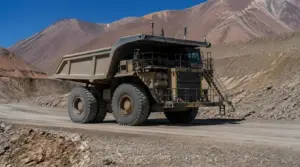
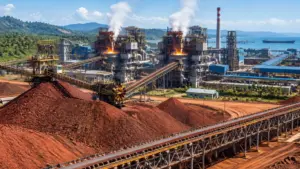
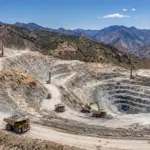
Mining operations at the SimFer deposit utilize modern ultra-class haul trucks and electric rope shovels configured for high-efficiency bench extraction. Extracted ore is conveyed directly to crushing and sizing stations before being loaded onto unit trains designed to withstand heavy axial loads and extreme tropical weather conditions.
Environmental and social governance (ESG) compliance remains a core operational pillar. The multi-user rail corridor was specifically designed to minimize ecological fragmentation, incorporating dedicated wildlife crossings, advanced stormwater management systems, and rigorous dust-suppression protocols along coastal port zones.
Market Implications and Economic Impact for Guinea
For the Republic of Guinea, the acceleration of Simandou export capacity represents a transformative economic catalyst. The joint venture framework ensures substantial royalty streams, local employment generation, and direct investment in regional transportation networks that benefit non-mining sectors alike.
Global steel producers, meanwhile, are closely monitoring the grade profile of Simandou ore. With average iron content exceeding 65% and exceptionally low silica and alumina impurities, the material enables steelmakers to reduce carbon intensity in traditional blast furnaces: making the project a critical bridge asset during the global industrial energy transition.

As locomotive fleets expand and coastal transshipment vessels ramp up continuous loading cycles through the remainder of 2026, market participants will watch quarterly shipping volumes closely to gauge whether the infrastructure can outpace its initial 30-month ramp-up schedule. For now, the successful funding and execution of the rail link expansion ensure that Simandou’s century-in-the-making potential is finally translating into seaborne reality.