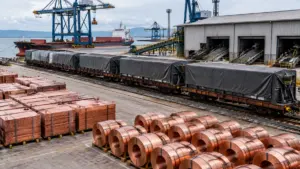
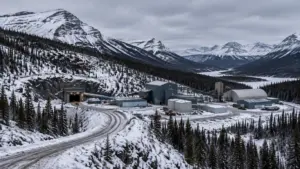
Modern uranium processing infrastructure in a remote northern mining region.

By Sonny Rollins
Uranium prices are sending a more constructive signal through the forward curve than through the spot market. Spot uranium is around US$88 per pound, while the long-term contract indicator is near US$97/lb and the five-year forward level is approximately US$105/lb.
That three-tier structure matters because uranium is not primarily a spot-traded commodity. Nuclear utilities typically secure fuel through bilateral contracts years before reactor reloads are required. The widening premium for future delivery therefore reflects more than short-term trading activity: it points to concerns over supply security, contracting gaps and the time required to develop mines and fuel-cycle infrastructure.
The market is also being reshaped by the AI-energy nexus. Data-center electricity demand is strengthening the case for firm, low-carbon generation, while reactor life extensions, restarts, small modular reactors (SMRs) and advanced fuels are extending the potential demand horizon. At the same time, Kazakhstan and Cameco continue to emphasize disciplined supply, leaving investors to weigh a strong long-term demand narrative against execution, permitting and fuel-cycle risks.
Market snapshot: three uranium price signals
| Indicator | Approximate level | What it measures | Market implication |
|---|---|---|---|
| Spot uranium | US$88/lb | Near-term purchases of uranium concentrate, generally U₃O₈ | Useful for liquidity and sentiment, but represents a relatively thin market |
| Long-term contract indicator | US$97/lb | Indicative pricing for multi-year utility supply agreements | Signals that reliable future supply commands a premium |
| Five-year forward | US$105/lb | Indicative price for delivery further along the curve | Reflects expectations for future scarcity, contracting and incentive pricing |
| Spot-to-term premium | US$9/lb | Long-term indicator less spot | Approximately 10% above spot |
| Spot-to-five-year premium | US$17/lb | Five-year forward less spot | Approximately 19% above spot |
These levels should not be treated as interchangeable benchmarks. Spot can move on a small number of transactions because the market is relatively illiquid. Term prices are negotiated between utilities and suppliers and can include escalation provisions, floors, ceilings, delivery flexibility and origin requirements. The five-year forward is an indication of expected future pricing rather than a guaranteed realized price for every producer or utility.

The current premium structure is consistent with the market dynamics described in Cameco’s supply and demand analysis, which highlights rising reactor demand, declining secondary supplies and greater competition for uranium, conversion and enrichment services.
Why the term premium is the more important signal
Utilities have spent much of the post-Fukushima period relying on legacy contracts, inventories and limited spot purchases. That strategy reduced near-term procurement costs but left a growing volume of future reactor requirements uncovered.
Cameco cites approximately 116 million pounds of uranium placed under long-term contracts in 2025, below the roughly 150 million pounds often used as an annual replacement benchmark. The gap does not necessarily create an immediate physical shortage, but it increases the volume of future demand that must eventually return to the contracting market.
The difference between US$88/lb spot and US$97/lb long-term pricing suggests buyers are willing to pay for delivery certainty. The five-year forward near US$105/lb extends that message: the market is assigning a higher value to pounds that can be delivered after current inventories, mine schedules and fuel-cycle capacity have been tested.
The signal is particularly relevant for new projects. A sustained term market near or above US$100/lb can improve the economics of development-stage assets, but only if companies can convert geological potential into permitted, financed and operating production.

Process equipment illustrating the conversion and enrichment stages beyond the mine gate.
AI power demand is a forward uranium driver
Artificial intelligence does not directly consume uranium. It consumes electricity, often at a scale that can challenge existing grid planning.
Wood Mackenzie has estimated global data-center electricity demand at approximately 460 terawatt-hours in 2026, with substantial growth expected by 2030 and beyond. In the near term, that demand will be met by a combination of gas, renewables, storage, transmission upgrades and additional output from existing nuclear plants.
Nuclear power is relevant because data centers require reliable electricity around the clock. Existing reactors can provide firm generation without the fuel-price exposure associated with gas-fired power, while reactor restarts, uprates and life extensions can add capacity faster than a new-build programme.
The connection to uranium prices is therefore primarily forward-looking. A data-center announcement does not immediately increase reactor fuel consumption. It can, however, influence utility planning, power-purchase agreements and decisions to preserve or expand nuclear capacity. Those decisions translate into uranium procurement years before the associated electricity demand is fully online.
SMRs could add another layer of demand. Most SMR projects are not yet large consumers of uranium, but developers moving toward licensing, demonstration or final investment decisions may seek early fuel reservations. Some advanced designs will require high-assay low-enriched uranium (HALEU), generally enriched above the conventional reactor-fuel range but below weapons-grade levels.
HALEU creates additional pressure on conversion, enrichment, deconversion and fabrication capacity. The fuel requirement is not simply a mining issue. A reactor may have uranium feedstock available and still face delays if it cannot secure the downstream services needed to produce qualified fuel.
Supply discipline keeps the curve elevated
Kazakhstan remains central to the market because it is the largest uranium-producing jurisdiction. Kazatomprom has indicated 2026 production guidance of approximately 27,500–29,000 tonnes of uranium, equivalent to roughly 71.5–75.4 million pounds of U₃O₈ on a 100% basis.
The company has also described a market-centric approach that prioritizes long-term value over maximizing production. Its guidance remains below earlier nominal production levels, and output is exposed to operating factors such as sulphuric acid availability.
Cameco has historically followed a similar contract-driven approach. Its production decisions have been linked to customer commitments and market conditions rather than an assumption that all licensed capacity should run at full output. That discipline limits the speed at which higher prices can generate new supply.
The market is not short of uranium resources in the geological sense. It is short of rapidly available, financeable and politically acceptable supply. New mines require permitting, infrastructure, construction, commissioning and ramp-up. The lead time is long enough that a price signal in 2026 may not produce meaningful additional pounds until the end of the decade or later.
Development pipeline: Phoenix and Rook I
Two Canadian projects illustrate the difference between a supportive price environment and actual supply growth.
Denison Mines’ Phoenix ISR project at Wheeler River has received the primary provincial and federal approvals required to begin construction. Denison made its final investment decision in February and is targeting first production around mid-2028, subject to construction and subsequent operating authorization.
The project’s 2026 capital update places initial capital costs at approximately C$600 million, compared with the earlier feasibility-study estimate of less than C$420 million. Phoenix has an estimated 56.7 million pounds of proven and probable reserves on a 100% basis and is designed as an in-situ recovery operation. Its project page provides the company’s technical assumptions and reserve details.
NexGen Energy’s Rook I is a larger, longer-dated development in Saskatchewan’s Athabasca Basin. The project is permitted to produce up to 30 million pounds of U₃O₈ annually, with construction progressing through shaft preparation, earthworks and surface infrastructure. NexGen describes a roughly four-year build, implying a production target around 2030 if the schedule is maintained.
The Rook I project overview highlights planned underground automation, two vertical shafts and an underground tailings management facility. The project’s scale could materially affect future Western supply, but its contribution remains dependent on construction execution, commissioning, operating licensing and capital discipline.

Remote infrastructure associated with in-situ uranium recovery operations.
Uranium price forecast 2026: base, bull and bear cases
The following scenarios are analytical ranges, not investment recommendations or formal consensus estimates.
| Scenario | Indicative 2026 range | Conditions required |
|---|---|---|
| Bear case | US$65–85/lb | Slower utility contracting, delayed reactor projects, stronger mine output and additional secondary supply |
| Base case | US$85–115/lb | Continued term contracting, disciplined producer output and steady reactor operations |
| Bull case | US$120–150+/lb | Supply disruption, accelerated utility restocking, fuel-cycle bottlenecks or faster nuclear demand commitments |
Base case
The base case assumes spot uranium remains supported but volatile, while term pricing holds above spot. Utility contracting improves without becoming disorderly, and reactor life extensions offset some of the delays affecting new nuclear capacity.
Under this scenario, the five-year forward near US$105/lb acts as a reference point for the incentive price required by new supply, rather than a guaranteed spot target.
Bull case
The bull case would require multiple pressures to arrive together. A production shortfall in Kazakhstan, delays at major mines, restricted Russian fuel-cycle access or a conversion and enrichment disruption could force utilities to compete for non-Russian supply.
A sudden return of under-contracted utilities to the term market would amplify the move. The thin spot market could respond sharply even if the underlying annual volume were relatively modest.
Bear case
The bear case would require a meaningful change in demand timing. Data-center construction could slow, SMR projects could remain in the licensing stage, or utilities could delay contracting if inventories prove more substantial than expected.
Higher prices themselves are also a bear-case mechanism over time. They encourage restarts, exploration, mine development and investment in conversion and enrichment. The question is how quickly that supply arrives.
Investor checklist: what to monitor next
Investors assessing uranium exposure should track the physical market and the fuel cycle together.
- Term contracting: Are annual volumes moving toward or above the replacement requirement?
- Contract structure: Are prices being agreed near US$97–105/lb, and do contracts include escalation, floors or flexible delivery terms?
- Kazakhstan output: Are production targets being met, and are sulphuric acid, logistics or export constraints emerging?
- Cameco supply response: Is additional output tied to firm customer commitments or broader market expectations?
- Conversion and enrichment: Can Western capacity expand fast enough to process available uranium into reactor fuel?
- Rook I execution: Are shaft sinking, procurement, earthworks and capital costs tracking the construction plan?
- Phoenix milestones: Is Denison maintaining its construction schedule and progressing toward operating authorization?
- AI power demand: Are data-center projects securing firm electricity supply and supporting reactor restarts or life extensions?
- SMR and HALEU progress: Are projects moving from announcements to licensing, financing, fuel contracts and construction?
- Demand uncertainty: Are reactor utilization, policy support and long-term nuclear capacity targets holding?
Bottom line
The current uranium price forecast for 2026 is best understood through the relationship between spot, term and forward prices. Spot near US$88/lb shows a firm market, but the US$97/lb long-term indicator and US$105/lb five-year forward provide the stronger signal about future supply risk.
The base case is a higher-for-longer market supported by utility contracting, reactor life extensions, AI-related power demand and disciplined production. The upside case depends on supply or fuel-cycle disruptions colliding with faster procurement. The downside case requires weaker demand, delayed contracting or a faster-than-expected supply response.
For operators, utilities and investors, the critical question is not simply whether uranium spot prices rise. It is whether the market can secure enough mine production, conversion, enrichment and qualified fuel capacity to support the next phase of nuclear growth.
Shareable LinkedIn/X snippet:
Uranium spot is near US$88/lb, but long-term pricing around US$97/lb and a five-year forward near US$105/lb suggest the market is pricing future supply security: not just near-term scarcity. Utility contracting, AI power demand, SMRs and fuel-cycle bottlenecks will determine whether 2026 becomes a contracting reset or a supply response year.