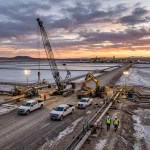
Diamond drilling at a remote Arctic copper exploration site.

By Charles Pitts
White Cliff Minerals has expanded the known copper-mineralized trend at the Danvers 1 system in Nunavut, Canada, to approximately 4.75 kilometres, up about 480% from the roughly 820 metres tested during its 2025 drilling program.
The latest step-out result, from hole DAN26035, returned 24.75 metres at 0.43% copper from 110.5 metres, including 5 metres at 1.21% copper. The hole was drilled more than 2.5 kilometres northeast of the original Danvers 1 core, extending the area of known copper mineralization along the interpreted Teshierpi structural corridor.
The results mark a shift in the exploration focus at White Cliff’s Rae Copper Project. Rather than testing a relatively concentrated discovery footprint, the company is now working to establish whether the broader corridor contains continuous mineralized zones with sufficient width, grade and geological continuity to support future resource work.
More Read

White Cliff said infill drilling is being accelerated along the northeastern extension, with additional drilling expected to begin within weeks.

Danvers drilling extends mineralization along Teshierpi corridor
The Rae Copper Project is located in the Kitikmeot region of Nunavut. White Cliff holds 93 mineral claims across three blocks and one mineral lease covering approximately 1,228 square kilometres, according to the company’s announcement to the Australian Securities Exchange.
Danvers is one of several copper targets within the project area. Mineralization at Danvers is associated with the regional Teshierpi Fault Zone and includes copper sulphides hosted in breccias, basalt flow tops and quartz-carbonate veins.
More Read

The latest drilling tested widely spaced positions northeast of the original Danvers 1 mineralized zone. White Cliff said holes in this area were generally spaced between 300 and 670 metres along strike. That spacing is sufficient to demonstrate that copper-bearing structures continue through the corridor, but not to establish a continuous resource model.
The most distal result reported so far came from DAN26035. The hole was collared more than 2.5 kilometres northeast of the Danvers 1 core and intersected a broad interval of copper mineralization at relatively shallow downhole depth.
| Drill hole | Position or context | Copper intersection | Included interval |
|---|---|---|---|
| DAN26027 | 225m northeast of DAN25020 | 17m at 1.41% Cu and 12g/t Ag from 194m | 2m at 4.39% Cu |
| DAN26031 | Approximately 1.1km farther northeast | 14.5m at 1.49% Cu from 166.5m | 3m at 3.96% Cu and 18g/t Ag |
| DAN26033 | Northeastern expansion area | 34m at 0.18% Cu from 136m | : |
| DAN26035 | More than 2.5km northeast of Danvers 1 core | 24.75m at 0.43% Cu from 110.5m | 5m at 1.21% Cu |
| DAN26041 | Between recent northeastern drill positions | Assays pending | More than 40m of copper-sulphide-bearing core observed |
Source: White Cliff Minerals ASX announcement. Intersections are reported as downhole widths, not true thicknesses.
The results from DAN26027 and DAN26031 are important because they show that higher-grade intervals were not confined to the original Danvers 1 core. DAN26027 also returned separate copper-bearing zones deeper in the hole, while DAN26031 included a narrow, higher-grade interval associated with chalcocite-rich quartz veining.
DAN26035 returned a lower average grade than the two higher-grade step-out holes but extended the mineralized footprint significantly farther northeast. The company is using the combination of broad copper-bearing intervals, structural continuity and geophysical responses to guide the next phase of drilling.
What the 480% expansion establishes
The increase from approximately 820 metres to 4.75 kilometres represents a 3.93-kilometre extension in the tested trend. On a percentage basis, the latest footprint is about 5.8 times the length tested during 2025, equivalent to an increase of approximately 480%.
That figure describes the length of the mineralized trend intersected by drilling. It does not represent a resource increase, a tonnage estimate or an economic assessment.
The immediate geological question is whether the mineralization is continuous between the widely spaced drill holes. White Cliff said the Teshierpi corridor remains consistent across the reported area, with magnetic responses helping trace the host structure to the northeast.
The company’s geological interpretation is that Danvers mineralization changes style along the corridor. Near the original Danvers 1 core, copper is associated more strongly with fault breccia. Farther northeast, the structure becomes narrower and mineralization appears more commonly related to veins within basalt.
That distinction matters for follow-up drilling. A narrow structural zone may carry significant grades but offer less width, while wider magnetic lows may indicate better-developed breccia zones with the potential for broader mineralized intervals. White Cliff is therefore using oriented core, structural measurements and geophysical data to identify areas where width, brecciation and grade may coincide.

Copper-bearing drill core from a mineral exploration program.
Infill drilling becomes the next test
White Cliff said it is fast-tracking infill and depth drilling along the Danvers 1 extension. The objective is to close the gaps between existing holes, determine the geometry of individual mineralized zones and test whether stronger breccia development occurs along the broader corridor.
The program is also expected to test the depth potential of the system and refine drill orientations. The company has stated that the current holes are drilled toward the southeast to intersect northeast-southwest-trending structures, but that the mineralized zones may dip steeply. Additional scissor holes and oriented core will be required to estimate true widths more accurately.
Assays are also pending from DAN26041, which was drilled between reported northeastern holes. White Cliff said more than 40 metres of copper-sulphide-bearing core was observed in that hole. The company has cautioned that visual estimates of sulphide abundance are not substitutes for laboratory assays.
The next round of results will therefore be closely watched for three reasons:
- whether mineralization continues between the widely spaced holes;
- whether the system broadens into more substantial breccia zones; and
- whether higher-grade copper intervals recur consistently along strike and at depth.
Rae Copper Project context
The Danvers system forms part of a wider copper and silver exploration portfolio at Rae. White Cliff is also evaluating the Hulk target, where drilling has tested sediment-hosted copper near the contact between the Rae Group and the underlying volcanic sequence.
At Danvers, the company has reported earlier high-grade results including 50.9 metres at 2.81% copper from DAN26026, 79.24 metres at 1.59% copper from DAN26015 and 19.81 metres at 6.64% copper from DAN26012. Those results are from separate zones and should not be combined into a single resource estimate without additional geological modelling and verification.
The project also includes a historic estimate for the Danvers prospect of 4.16 million tonnes at 2.96% copper. White Cliff states that the estimate is historic and does not comply with the JORC Code. It should not be treated as a current mineral resource or reserve until sufficient modern drilling, sampling, verification and geological interpretation have been completed.
Previous metallurgical test work on Danvers material produced copper recoveries of up to 95.4% and silver recoveries of up to 93.3% through conventional flotation. Those results provide preliminary processing information, but they were based on selected composites and do not establish processing performance across the expanded northeastern trend.

Remote exploration infrastructure on the Nunavut tundra.
Risks remain at the exploration stage
The 4.75-kilometre trend is an exploration result, not a defined mineral resource. The northeastern holes remain widely spaced, and further drilling is required to demonstrate continuity, establish true widths and understand grade distribution.
White Cliff reports all current intersections as drilled widths. Because the orientation and dip of the mineralized structures are not fully established, the reported widths may differ materially from true thicknesses.
Other risks include variations in grade between drill sections, changes in mineralization style along the fault corridor, assay turnaround, Arctic field logistics and the ability to operate consistently during short seasonal work windows. The company must also complete additional environmental, permitting, engineering and metallurgical work before any potential development scenario could be assessed.
For now, the significance of Danvers lies in the scale of the geological system being outlined. DAN26035 demonstrates that copper mineralization persists more than 2.5 kilometres beyond the original core, while DAN26027 and DAN26031 show that higher-grade intervals can occur farther along the same interpreted corridor.
The next phase of infill drilling will determine whether that long strike length can be converted into a coherent set of mineralized zones with the continuity and width required for resource definition.
Sources
- White Cliff Minerals ASX announcement: Danvers 1 copper system expanded by 480%
- Mining News North: Danvers copper trend grows nearly sixfold
- Skillings copper market and mining analysis

Geological logging helps refine the structural model ahead of infill drilling.