2026 Lithium Power Map : Early Access Open ($59) | Get the latest sector data and secure your copy here: https://skillings.short.gy/LithiumPreSale

By Salini Krishnan
The AI-Energy Nexus: Why Big Tech is Financing the 2026 Uranium Bull Run
As of April 2026, the global uranium market has transitioned from a cyclical recovery into a structural bull run, driven by an unconventional catalyst: the Silicon Valley balance sheet. While traditional nuclear utilities have long been the primary movers of the yellowcake market, a new class of “hyperscale” buyers: including Microsoft, Amazon, and Google: has fundamentally altered the supply-demand equation.
The spot price of uranium, which broke the $100 per pound barrier in January 2026, continues to trade at levels not seen in nearly two decades. This pricing pressure is the direct result of a collision between two worlds: the massive, carbon-free baseload power requirements of next-generation AI training clusters and a uranium mining sector that has faced 13 consecutive years of under-contracting.
The Massive Energy Demand of Next-Gen AI
The computational scaling required for Large Language Models (LLMs) and generative AI has reached an inflection point. In 2026, the energy intensity of data centers is no longer a peripheral concern for tech companies; it is the primary bottleneck for their growth. A single state-of-the-art AI training cluster today can consume as much electricity as a mid-sized city.
More Read

Unlike traditional internet workloads, which can tolerate some variability, AI training requires constant, 24/7 “five-nines” reliability. Furthermore, these tech giants have committed to aggressive carbon-neutrality goals, effectively ruling out new coal or natural gas capacity to power their expansions. This leaves nuclear energy as the only scalable, carbon-free baseload option.


The “AI-Energy Nexus” refers to this symbiotic dependency. Without massive injections of stable energy, the AI revolution stalls. Without the financing and political weight of Big Tech, the nuclear industry would struggle to revitalize the aging Western reactor fleet or deploy new Small Modular Reactors (SMRs).
More Read

Behind-the-Meter: A Strategic Realignment
One of the most significant shifts in 2026 is the rise of “Behind-the-Meter” (BTM) power purchase agreements (PPAs). In these arrangements, tech companies are bypassing the public grid entirely, co-locating data centers directly at nuclear power plant sites.
By connecting directly to the source, hyperscalers avoid grid congestion charges and the long wait times for traditional utility interconnects. For the nuclear operator, these deals provide a stable, long-term premium over wholesale market rates. More importantly, these tech companies are not just buying the power: they are increasingly financing the fuel.
We are seeing a trend where Big Tech firms are providing the capital for uranium producers to restart idled mines or accelerate the development of new projects. This ensures that the reactors powering their data centers have a guaranteed supply of uranium for the next decade, insulating them from spot market volatility. This shift is similar to the “Silicon-Lithium Nexus” observed in the battery sector, where securing the upstream supply chain became a matter of corporate survival. For more on the evolving battery supply chain, see our report on the Global Battery Revolution.
The Impact on Long-Term Uranium Contracts
The entry of Big Tech into the uranium market has shattered the traditional contracting cycle. Historically, nuclear utilities moved in a slow, synchronized manner, often waiting for prices to dip before securing long-term supply. However, tech companies operate on “software time”: which is significantly faster than “mining time.”
Hyperscalers are signing 15- to 20-year PPAs that include clauses for fuel security. This has forced traditional utilities back into the market to compete for a limited pool of available pounds. According to recent market data, the supply gap could reach between 7,000 and 14,000 tonnes by 2030 if the current pace of AI-driven nuclear expansion continues.

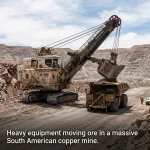
With uranium mine development cycles typically spanning 7 to 15 years, the supply side cannot react instantly. Even as facilities like the one pictured above ramp up production, the structural deficit remains. This is particularly true as major producers like Kazatomprom have signaled tighter state control over their exports, reinforcing the reality that cheap, unconstrained supply is a thing of the past.
Strategic Importance for US Energy Independence
The AI-Energy Nexus is also a matter of national security. In early 2026, the United States officially designated uranium as a critical mineral tied to national security, a move that parallels the strategic realignment seen in other sectors like rare earths in Greenland.
For the U.S., the goal is to decouple the AI infrastructure: the backbone of the future economy: from foreign-sourced energy and fuel. Currently, a significant portion of the global uranium supply is controlled by entities within the Russian or Chinese spheres of influence. By financing domestic or friendly-nation uranium production, Big Tech is effectively subsidizing U.S. energy independence.
This intersection of government policy and private capital is de-risking junior mining operations that were previously considered too speculative. We are seeing a surge in “Buy American” mandates for nuclear fuel, supported by Department of Energy incentives that favor domestic enrichment and conversion.

SMR Energy: The Next Frontier
While existing large-scale reactors are the immediate beneficiaries of the 2026 bull run, the medium-term focus is shifting to Small Modular Reactors (SMRs). These units are designed to be factory-built and deployed directly at industrial sites or data centers.
Microsoft and Amazon have already made significant investments in SMR technology, recognizing that the current reactor fleet cannot meet the projected load of the 2030s. The fuel requirements for SMRs are often different: requiring High-Assay Low-Enriched Uranium (HALEU): which adds another layer of complexity and value to the uranium supply chain. This technological push is similar to the innovations seen in deep-sea mining technology, where the industry is forced to look to new frontiers to satisfy unprecedented demand.
2026 Market Outlook: Base, Bull, and Bear Cases
As we look toward the remainder of 2026, the uranium market sits at a critical juncture.
The Bull Case: AI demand continues to outpace energy efficiency gains. More hyperscalers announce direct investments in uranium mining equities or pre-payment offtake agreements. Spot prices move toward $150/lb as utilities panic-buy to cover shortfalls.
The Base Case: Prices stabilize in the $100-$110 range. The market begins to price in the “tech premium,” and new production from Tier-1 mines in Canada and Australia starts to hit the market by late 2027, preventing a total supply collapse.
The Bear Case: A significant global economic slowdown reduces AI investment, or a major technical breakthrough in fusion or long-duration battery storage lessens the perceived need for nuclear baseload. However, given the 10-year lead times for such technologies, the bear case appears increasingly unlikely in the current decade.
Conclusion
The 2026 Uranium bull run is unique because it is being financed by the most well-capitalized companies in human history. For Microsoft, Google, and Amazon, the cost of uranium is a rounding error compared to the risk of their AI infrastructure going dark.
For the mining industry, this represents a once-in-a-generation shift. The uranium market is no longer just a utility story; it is a technology story. As long as the demand for intelligence remains high, the demand for the fuel that powers it will follow suit.

For operators and investors, the message is clear: the AI-Energy Nexus has created a floor for uranium prices that was previously unimaginable. Those who understand the interplay between silicon and uranium will be the ones best positioned to navigate the complexities of the 2026 commodity landscape. To stay ahead of the curve in other critical mineral shifts, such as the US copper supply realignment, follow our daily updates at Skillings Mining Review.