By Charles Pitts

The global struggle for critical minerals has entered a new phase of urgency as the West attempts to secure supply chains for "choke-point" metals essential to modern warfare and industrial safety. At the center of this geopolitical storm is antimony, a metalloid primarily used in munitions, flame retardants, and high-tech sensors. With China and Russia controlling nearly 80% of global production, the discovery of exceptionally high-grade stibnite: the primary ore of antimony: at Krakatoa Resources’ (ASX: KTA) Zopkhito project in Georgia represents more than just a mining success; it is a strategic defense play.
Krakatoa recently confirmed visual intercepts of stibnite mineralisation reaching estimated concentrations of 40% to 50% in core samples from its maiden drilling program. This discovery, situated in the country of Georgia, arrives as Western defense contractors face a severe antimony shortage exacerbated by Chinese export controls and the ongoing depletion of domestic stockpiles. For investors and defense planners, Zopkhito is emerging as a potential non-aligned pillar of supply in a market where "zero-sum" resource competition is the new normal.
The Antimony Choke-Point: A Military Necessity
Antimony is often described as the "most critical" mineral that the average person has never heard of. In the defense sector, its applications are fundamental and largely irreplaceable. It is used to harden lead in ammunition: ranging from small-arms bullets to heavy artillery shells: ensuring ballistic stability and structural integrity upon impact. Beyond kinetics, antimony trioxide is a vital component in flame-retardant materials for military uniforms, aircraft interiors, and electronic housings.
Perhaps most critically for 2026 and beyond, antimony is a key ingredient in infrared detectors, night-vision goggles, and laser-sighting systems. As the U.S. and its allies accelerate the production of 155mm shells and advanced surveillance hardware to replenish depleted stockpiles, the demand for antimony has surged.
More Read

The strategic vulnerability of this supply chain was laid bare in 2024 when China placed antimony on a dual-use export control list, citing national security. This move effectively throttled Western access to refined antimony, driving prices from approximately $13,500 per tonne to nearly $60,000 per tonne by mid-2025. In this environment, any project capable of delivering high-grade material outside of the China-Russia-Tajikistan triad becomes an asset of national significance.

Zopkhito: High-Grade Visuals and Geological Upside

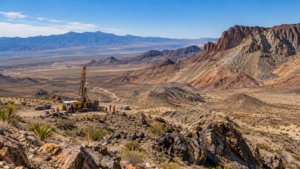
The Zopkhito project is located in the southern slopes of the Greater Caucasus range in Georgia. While the region has a long history of mining, Krakatoa is applying modern exploration techniques to a system that was largely defined during the Soviet era. Historical records suggest a foreign resource estimate of approximately 7.1 million tonnes at 3.7% antimony, containing roughly 262,000 tonnes of metal.
More Read

However, Krakatoa’s recent drilling has revealed zones that far exceed these averages. The discovery of core intercepts with up to 50% visible stibnite suggests the presence of "bonanza" grade veins within the broader orogenic system. These high-grade zones are not isolated; the company reported that 12 of its first 15 surface drill holes and 7 of 9 underground core holes intercepted visible mineralisation.
The significance of a 50% stibnite intercept cannot be overstated. In mining economics, grade is king, but in critical minerals, accessible grade is paramount. The presence of such high concentrations allows for a more flexible mining plan and potentially lower processing costs, as the "ore-to-metal" ratio is significantly more favorable than at lower-grade deposits.
Project Economics and the Gold Multiplier
One of the most compelling aspects of the Zopkhito project is its polymetallic nature. The deposit is not purely an antimony play; it is an orogenic antimony-gold system. Historical data indicates that the 7.1 million tonne resource also carries a gold grade of approximately 3.7 g/t, equating to over 800,000 ounces of gold.
For project economics, gold acts as a powerful "by-product credit." In a scenario where gold prices remain elevated, the revenue generated from gold production can effectively drive the "all-in sustaining cost" (AISC) of antimony production toward zero, or even into negative territory. This makes the project resilient to fluctuations in the antimony market while providing a dual-revenue stream that appeals to both precious metal and critical mineral investors.
Furthermore, Georgia offers a favorable fiscal environment for mining. With a flat corporate tax rate of 15% and a supportive regulatory framework, the "jurisdictional risk" is significantly lower than in other antimony-producing regions like Tajikistan or parts of Africa. Krakatoa holds an exclusive option to acquire up to 80% of the mining licence, a deal that looks increasingly attractive as the global deficit widens.
Historical Infrastructure: The Soviet Head Start

Developing a new mine from scratch: a "greenfield" project: typically takes a decade or more. Krakatoa, however, is working with a "brownfield" advantage. The Zopkhito site features approximately 27 kilometers of existing underground adits and workings developed during the Soviet era.
These tunnels provide immediate access to the mineralised veins, allowing for faster and cheaper drilling from underground stations. More importantly, they provide a blueprint for future production. By utilizing this existing infrastructure, Krakatoa can potentially shave years off the development timeline and millions of dollars off the initial capital expenditure (CAPEX). The current 7,000-to-10,000-meter drilling program is specifically designed to confirm the continuity between these historical workings and the new high-grade surface intercepts.
Geopolitical Context: Diversifying Away from the East
The Western world’s reliance on Chinese and Russian antimony is a structural weakness that military planners are desperate to solve. The U.S. Department of Defense (DoD) has already begun investing in domestic projects, such as Perpetua Resources’ Stibnite project in Idaho. However, domestic production alone is unlikely to meet the total demand for the NATO alliance.
Strategic partnerships with "near-shore" or friendly jurisdictions like Georgia are becoming essential. Georgia’s aspirations for closer ties with the European Union and its strategic location as a transit hub between Asia and Europe make it a logical partner for Western mineral security.
Krakatoa’s discovery aligns with broader industry moves to secure antimony. For instance, Teck Resources has expanded its Trail operations to process more critical minerals, and the Defense Logistics Agency (DLA) is actively re-rating critical minerals stocks as it seeks to bolster the National Defense Stockpile.
Market Outlook 2026: The Base, Bull, and Bear Case
As we look toward late 2026, the antimony market remains in a state of structural deficit.
- Bull Case: Continued Chinese export restrictions and a ramp-up in global munitions production could see antimony prices stabilize above $70,000/t. In this scenario, high-grade projects like Zopkhito would command a significant premium, attracting major mid-tier mining houses or defense-linked investment funds.
- Base Case: Prices remain volatile but elevated (between $45,000 and $55,000/t) as new supply from projects in Australia, Canada, and Georgia begins to enter the feasibility stage. Krakatoa delivers a maiden JORC-compliant resource that confirms the high-grade nature of the deposit.
- Bear Case: A de-escalation of global conflicts leads to a temporary softening of demand, or China relaxes export controls to regain market share. However, the long-term trend toward supply chain diversification suggests that even in a bear market, high-grade, non-Chinese assets will remain strategically valuable.
Conclusion: A Maiden JORC on the Horizon

Krakatoa Resources is currently focused on converting its visual successes into a modern, JORC-compliant mineral resource estimate. The metallurgical testwork completed to date is promising, showing that a high-grade, low-arsenic stibnite concentrate can be produced with recoveries exceeding 90%.
The 50% stibnite intercepts at Zopkhito are a wake-up call for the industry. In a world where the supply of critical minerals is being weaponized, finding a high-grade, polymetallic deposit with existing infrastructure in a friendly jurisdiction is rare. For the defense industry, it’s a potential lifeline. For the mining industry, it’s the next major critical minerals story.
As the drilling continues, the focus will shift from "how much is there?" to "how fast can it be brought to market?" Given the current geopolitical climate, the answer to the latter cannot come soon enough.
Strategic Takeaway for Decision Makers:
- Operators: High-grade visual intercepts at Zopkhito suggest a robust mineral system with significant underground access via 27km of historical adits.
- Investors: The gold-antimony mix provides a hedge against commodity price volatility while tapping into the "defense metal" premium.
- Policymakers: Diversification of antimony supply away from China/Russia is a national security priority; Georgia represents a critical "near-shore" opportunity.
Antimony Market Snapshot: 2026 Projections
| Indicator | Current Status (Mid-2025) | 2026 Outlook | Impact on Projects |
|---|---|---|---|
| Global Price (MT) | ~$60,000 | $55,000 – $75,000 | Highly Positive |
| Supply Concentration | 80% (CN, RU, TJ) | 75% – 78% (Diversifying) | Strategic Premium |
| Defense Demand | High (Munitions) | Increasing (Stockpiling) | Multi-year Support |
| Project Viability | Grade Dependent | High-Grade Focus | Favors Zopkhito-style assets |
LinkedIn/X Snippet:
Krakatoa Resources confirms visual intercepts of up to 50% stibnite at the Zopkhito project in Georgia. With China controlling 80% of global antimony, this high-grade gold-antimony discovery is a major strategic win for Western defense supply chains. Read the deep dive: [Link]