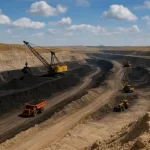
Bukuya, Uganda — The sound of celebration echoed through Bukuya Town Council on November 7, 2025, as miners gathered under tents, children sang traditional songs, and officials from Kampala stepped onto the red soil that has sustained the local economy for decades. That morning, the Mubende United Miners’ Assembly (MUMA) officially began operations under Small-Scale Mining License SML 00575, covering 100.8 hectares in Kassanda District.

But even beyond the cheering and speeches, the day carried deeper national significance: artisanal mining Uganda is no longer an informal activity. It is now formally ring-fenced for Ugandan citizens — and recognized as a legitimate economic sector under national law.
The turning point came with the Mining and Minerals Act, 2022, which explicitly reserves artisanal and small-scale mining (ASM) for Ugandans only, shutting the door on foreign ownership. It marks a rare moment in African mining policy — one built on local control, not foreign license bidding.
“This is not just a license. It is a declaration that artisanal mining Uganda belongs to Ugandans,” said a senior official from the Department of Geological Survey and Mines (DGSM).
From Eviction to Recognition
The road to formalisation has been far from smooth. In 2017, security forces evicted thousands of informal miners from the Mubende gold region. The government accused them of illegal extraction, child labour, tax evasion and uncontrolled mercury use. Most miners lost everything.
But instead of disappearing, the miners reorganized.
More Read

Supported by civil society organisations, they formed two legal bodies — MUMA and the Uganda Association of Artisanal and Small Scale Miners (UGAASM) — developing governance structures, safety protocols and financial procedures. Their documentation helped shape new regulation and opened dialogue with Kampala.

The new Mining and Minerals Act arrived five years later, officially acknowledging artisanal mining Uganda as a viable and licensable industry.
“We were treated like a problem. Now, we are seen as a sector,” one miner told Skillings.
More Read

Bukuya: The Town Built by Gold
Today, Bukuya looks markedly different from the village it once was. Shops have multiplied. Lodges are full. Food demand has soared and trucks carrying market goods arrive daily from neighbouring districts.
Official estimates from local leaders suggest Bukuya is now one of the fastest-growing rural economies in Uganda — almost entirely fueled by artisanal mining Uganda.
Across the wider sector:
- Over 60% of Uganda’s mining workforce operates in ASM.
- ASM employs 20 times more people than industrial mining.
- Around 80% of earnings stay within local communities, according to figures cited by Uganda’s Ministry of Energy and Mineral Development.
That level of economic retention is rare in mineral-rich regions. In countries like Tanzania and DRC, most ASM income is lost through illicit trade, intermediaries and unregulated refining networks. This is exactly what Uganda says it is trying to avoid.
Monetary Policy Meets Artisanal Mining Uganda
MUMA’s new license enables participation in an even bigger shift: the Bank of Uganda’s Domestic Gold Purchase Program, which allows the Central Bank to buy gold directly from licensed ASM operators to stabilize foreign reserves and strengthen the shilling.
For artisanal mining Uganda, this is significant — it opens a direct corridor from rural mining towns to national monetary strategy.
Countries such as Ghana and Ethiopia have experimented with similar gold-based reserve mechanisms. Uganda is now positioning itself to see whether ASM can be aligned with responsible sourcing requirements, fiscal policy and export readiness — without collapsing under regulatory pressure.
“This could work, but only if traceability is real — not theoretical,” said a mining analyst familiar with African gold trade flows.
Guarding Against a “Dirty Gold” Label
MUMA has already distanced itself from false reports linking its license to Euro Gold Refinery. While technical discussions have taken place, no refining, smelting or trading agreements exist. This raises a bigger issue — if artisanal mining Uganda is to reach export markets, it will face instant scrutiny under global ESG rules.
Uganda’s mining authorities are aware of the risk. The 2022 law outlines strict requirements on:
- Mercury-free extraction
- Zero child labour
- Worker registration & safety
- Community impact mitigation
- Local ownership and participation only
Uganda may find that formalization is the easy part — compliance will be harder.
Skillings Analysis — What Industry Should Watch
- The policy design is strong. The challenge remains implementation — monitoring ASM at scale requires both credibility and soft power.
- ASM could qualify for ESG-linked funding and carbon credit programs if standards are met — that would significantly change mineral economics in Uganda.
- Bukuya may become the first test case of whether artisanal mining Uganda is a survival mechanism — or a structured pillar of national growth.
A Quarter That Matters
The first six months of 2026 will determine whether this shift becomes a model — or a warning.
| Critical Moment | Implication |
|---|---|
| Central Bank begins gold purchases | Sector enters fiscal policy framework |
| ESG audits begin on ASM sites | Determines international credibility |
| Refinery partnerships formalize | Could unlock export readiness |
| Fresh licensing applications surge | Will reveal investor confidence |
For now, artisanal mining Uganda stands at the edge of a national experiment — where local miners are no longer being chased from their land. Instead, they are being invited to shape its future.
The question facing Kampala — and the industry — is whether governance can match ambition.
If artisanal mining Uganda succeeds here, the policy conversation across Africa may start in Bukuya — the town built by gold.