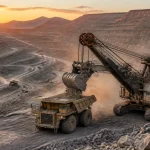
The commercial deployment of driverless heavy machinery has transitioned from an experimental frontier into the baseline standard for high-productivity open-pit extraction. In April 2026, industrial equipment manufacturing reached a watershed moment when Komatsu commissioned its 1,000th ultra-class autonomous haul truck worldwide. Deployed at Barrick’s Nevada Gold Mines operation in the United States, this milestone model: a Komatsu 930E-5AT electric drive truck boasting a 290-metric-ton payload: cements a structural shift toward fully autonomous fleet operations across precious metal and critical mineral extraction.

For industry operators, fleet managers, and resource investors, reaching the one-thousand-unit threshold is more than a marketing milestone. It validates the reliability, economic viability, and safety credentials of cabless haulage on a massive global scale. As mining companies face tightening grade profiles, rising labor costs, and aggressive decarbonization targets, autonomous haulage systems (AHS) have evolved from nice-to-have innovations into core operational necessities.
Anatomy of the Milestone: The Komatsu 930E-5AT
The vehicle at the center of the April 2026 milestone represents the pinnacle of modern mining engineering. The Komatsu 930E-5AT is an ultra-class electric drive truck (EDT) designed to handle grueling duty cycles in remote, high-altitude, or arid environments. Operating under Komatsu’s proprietary FrontRunner Autonomous Haulage System, the truck integrates advanced GPS guidance, obstacle detection radar, laser scanners, and redundant steering and braking systems.
Unlike traditional manned fleets where operator fatigue, shift changes, and restricted visibility limit continuous operation, autonomous trucks operate around the clock with consistent cycle times. The integration at Nevada Gold Mines: one of the world's most prolific gold-producing complexes: demonstrates that autonomous systems can be successfully deployed within complex, multi-pit operations involving mixed fleets of manned and unmanned vehicles.


Behind every autonomous haul truck stands an intricate digital ecosystem. Control centers monitor dozens of live telemetry streams, tracking tire temperatures, payload distribution, fuel or energy consumption, and exact GPS coordinates across the entire pit. This level of data transparency allows maintenance teams to execute predictive servicing before component failures occur, drastically reducing unscheduled downtime.

Safety and Operational Metrics at Scale
Across nearly two decades of commercial deployment: beginning with Komatsu's pioneering AHS installations in Chile back in 2008: the cumulative operational data tells a compelling story. Worldwide, FrontRunner-equipped trucks have autonomously hauled more than 11.5 billion metric tons of overburden and ore.
Significantly, industry data across major deployment sites records zero system-related safety injuries attributed to autonomous haulage operations. By removing human operators from hazardous high-wall environments, unstable dump zones, and heavy dust conditions, AHS addresses one of the most persistent occupational risks in surface mining.

| Metric / Operational Area | Legacy Manned Fleets | Autonomous Fleet (FrontRunner AHS) |
|---|---|---|
| Daily Operational Window | ~18 to 20 hours (accounting for shift changes & breaks) | 22.5 to 24 hours (continuous operation) |
| Tire Life & Wear Variance | High variance due to operator braking and cornering habits | Optimized via automated speed and acceleration profiles |
| Fuel / Energy Efficiency | Variable based on operator experience | Standardized, highly consistent fuel burn per ton |
| Safety Incident Exposure | Moderate to high in extreme weather/visibility | Eliminated in active haul zones via redundant detection |
Operational efficiency gains extend directly to consumables. Automated acceleration, precise braking, and standardized cornering significantly reduce tire wear: a major operating expense for ultra-class fleets: while optimizing diesel fuel consumption and lowering greenhouse gas emissions per ton moved.
Integrating Cabless Fleets into Mapped Mine Ecosystems
Deploying autonomous trucks is rarely a simple "plug-and-play" exercise. Mine engineering teams must redesign haul road networks, establish geofenced exclusion zones, and implement strict communication protocols between autonomous trucks, manned auxiliary equipment (such as graders and water carts), and frontline personnel.

At large-scale operations, the transition to autonomy requires comprehensive change management. Operators of light vehicles entering the pit must carry specialized transponders, and heavy excavators must synchronize bucket positioning with autonomous trucks approaching the loading face. The success of the 1,000-truck milestone underscores how rapidly mining operators have mastered these complex logistical workflows.
Furthermore, as global miners ramp up production of copper, gold, and critical minerals to supply the energy transition: topics explored extensively in our daily mining market coverage: the speed and predictability afforded by autonomous fleets provide a vital competitive edge.
The Broader Cabless Revolution: OEM Competition and Retrofits
Komatsu’s milestone does not happen in a vacuum. Major rival original equipment manufacturers (OEMs), including Caterpillar and Liebherr, have aggressively expanded their own autonomous and zero-emission haulage portfolios. Simultaneously, independent technology providers offer retrofit kits capable of converting legacy mechanical and electric drive trucks into autonomous units.
This dual-track approach: buying new factory-integrated autonomous trucks versus retrofitting existing fleets: has lowered the barrier to entry for mid-tier mining companies. While initial capital expenditure for AHS infrastructure remains substantial, payback periods have compressed dramatically as operations report productivity uplifts ranging from 10% to 25% across diverse geological settings.

The convergence of autonomy with electrification represents the next major frontier. As mines increasingly adopt trolley-assist systems, battery-electric haul trucks, and hydrogen fuel cell prototypes, autonomous navigation algorithms are being tuned to maximize energy capture during regenerative braking and optimize battery charging cycles.
Economic Resilience and Future Outlook
In an economic climate where mining houses face rigorous scrutiny over capital allocation, environmental compliance, and operational risk, technology investments must deliver clear, measurable returns. The rapid scaling of autonomous fleets from a handful of experimental trucks in the late 2000s to 1,000 units from a single manufacturer highlights an industry-wide commitment to structural modernization.
As regulatory frameworks evolve and mining companies navigate complex geopolitical supply chain shifts: such as those reshaping critical mineral sourcing outlined in our critical minerals supply chain analysis: operational resilience is paramount. Cabless haulage insulates operations against labor shortages, enhances workplace safety, and stabilizes unit production costs.
The crossing of the 1,000-truck threshold marks the end of the early adoption phase for autonomous mining. As fleet sizes expand toward multiple thousands over the remainder of the decade, autonomous haulage is no longer transforming the future of mining( it is defining its present.)