Here's the thing nobody wants to admit: blockchain has been the mining industry's favorite buzzword for half a decade, but 2026 might actually be the year it stops being theoretical.

Not because the technology suddenly got better. Because the economics finally caught up.
Clean minerals: verifiable, traceable, ethically sourced: are commanding a price premium that's impossible to ignore. Early estimates suggest that premium could hit 15-20% by 2030. When you're talking about critical minerals worth billions, that's not marketing spin. That's a business model.
What Blockchain Actually Does (And Why It Matters Now)
Blockchain for mineral traceability isn't magic. It's a distributed ledger that creates an immutable record of where a mineral came from, who handled it, and how it moved through the supply chain.
Every transaction gets timestamped. Every transfer gets verified. From the mine face to the refinery to the manufacturer, there's a digital trail.

The value proposition is straightforward: proof of origin. In a world increasingly obsessed with ESG compliance, carbon accounting, and supply chain diversification, that proof matters.


Companies sourcing cobalt for EV batteries need to demonstrate it didn't come from artisanal mines using child labor. Rare earth processors need to show their materials aren't routed through Chinese intermediaries subject to export restrictions. Defense contractors need chain-of-custody documentation that satisfies government auditors.

Blockchain provides that documentation. Theoretically.
The Premium Is Real
The 15-20% premium projection isn't pulled from thin air. It's already showing up in pilot programs and early commercial deployments.
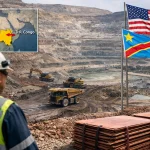
European battery manufacturers are paying premiums for certified cobalt from the Democratic Republic of Congo. Japanese electronics firms are sourcing traceable rare earths at markup. American defense suppliers are building "trusted supplier" networks with price incentives baked in.
Why? Regulatory pressure. The EU's Corporate Sustainability Due Diligence Directive. The U.S. Uyghur Forced Labor Prevention Act. ESG reporting requirements from institutional investors. Carbon border adjustment mechanisms.
These aren't theoretical compliance burdens. They're hard costs with actual penalties. The premium for clean, traceable minerals is cheaper than the risk of regulatory violation or reputational damage.
And that calculus is driving adoption.
Real Implementations, Real Money
ReElement Technologies and SAGINT Inc. announced a tokenization services agreement in late 2025 that signals where this is heading. They're creating verifiable digital warehouse receipts and fully traceable digital assets for refined critical and rare earth minerals.

End-to-end provenance tracking. From mine origin through delivery. Every handoff documented. Every custody transfer recorded.
American Resources, ReElement's parent company, took an equity position in SAGINT. That's not a pilot program. That's a strategic bet on blockchain-enabled traceability becoming industry standard.
The system enables secure, borderless financing options. It verifies origin, ownership, and movement of strategic raw materials. For critical mineral supply security, that verification isn't nice-to-have. It's essential.
Blockchain for traceable sourcing ranks among the top mining industry trends to watch in 2026, alongside supply chain diversification and domestic processing initiatives. That's not hype. That's where capital is flowing.
The Challenges Nobody Talks About
But here's where it gets uncomfortable.
Blockchain can verify the data that gets entered. It cannot verify the data is accurate in the first place. If a mine provides false documentation about origin or extraction methods, blockchain dutifully records that false information as immutable truth.

The limitation is validation. Mines must be willing to provide necessary documentation. They must have systems in place to generate that documentation accurately. They must allow third-party verification.
In mature mining jurisdictions with strong regulatory oversight, that's feasible. In artisanal mining operations in the DRC or rare earth processing facilities in Myanmar, it's significantly harder.
The other problem: standardization. Blockchain-enabled projects currently lack shared understanding of definitions, concepts, and data attributes across supply chain actors. What counts as "ethically sourced"? What documentation proves "low-carbon processing"? What chain-of-custody standards satisfy different regulatory regimes?
Implementation requires sufficient adoption by multiple actors with interoperable platforms. One company using blockchain doesn't create traceability. You need miners, processors, refiners, manufacturers, and logistics providers all using compatible systems.
That's a coordination problem, not a technology problem.
2026 as Inflection Point
So why is 2026 different?
Regulatory deadlines. The EU's supply chain due diligence rules kick in. U.S. government procurement requirements for traced critical minerals take effect. Major automakers' ESG commitments require verified sourcing documentation.
These aren't aspirational targets. They're contractual requirements with financial consequences.
Simultaneously, the technology is maturing. Platforms are becoming interoperable. Industry consortiums are developing shared standards. Governments and miners are actively deploying blockchain tools for supply chain diversification and compliance.

The convergence of regulatory pressure and technological capability creates market pull. Companies that can provide traced minerals capture premium pricing. Companies that cannot face limited market access.
2026 represents the moment when the cost of not implementing traceability exceeds the cost of implementation.
What Happens Next
The "digital mineral" isn't universally established. Adoption remains nascent. But momentum is building faster than skeptics expected.
For copper, lithium, cobalt, and rare earths: the materials powering electrification and digitalization: traceability is becoming table stakes. Not because miners suddenly care more about ESG. Because buyers are demanding it and willing to pay for it.
The 15-20% premium by 2030 assumes widespread adoption. That assumption looks increasingly reasonable.
Early movers in blockchain traceability are establishing themselves as preferred suppliers. Late adopters will face market access challenges and price pressure. The window for competitive advantage is measured in quarters, not years.

But the challenges remain real. Data validation requires trusted intermediaries and verification protocols that don't yet exist at scale. Standardization requires industry-wide coordination that historically takes years. Adoption requires investment from actors with tight margins and limited capital.
2026 is the year blockchain traceability moves from experimental to operational. From pilot programs to commercial deployments. From optional to essential.
Whether it becomes truly universal depends on solving coordination problems that have nothing to do with blockchain technology itself. But the economic incentives are aligning. The regulatory pressure is mounting. The infrastructure is being built.
Welcome to the era of the digital mineral. It won't happen overnight. But it's happening.