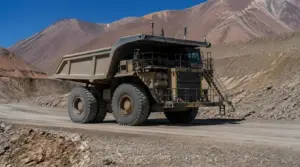
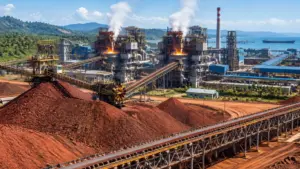
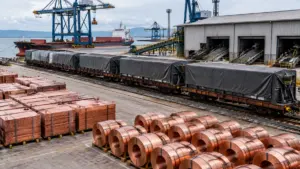
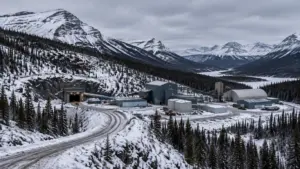
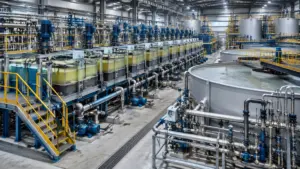
Illustrative image of rare-earth exploration where industrial development meets Brazil’s forest frontier.

By Penny Langford
Brazil’s rare-earth sector is moving from geological promise to strategic competition, but the rush to build a non-Chinese supply chain is colliding with some of the country’s most sensitive landscapes and communities.
An analysis of National Mining Agency records by AP and Reporter Brasil found 2,727 rare-earth exploration applications in Brazil through June. More than 86% were filed during the past three years, including 268 in the first half of 2026. Foreign-backed companies account for more than four in 10 applications, with Australian and U.S. firms leading the expansion.
The figures make Brazil an increasingly important node in the critical minerals supply chain 2026 landscape. The country has the world’s second-largest rare-earth reserves after China, yet it remains a small producer. That gap is attracting Western capital, Chinese strategic positioning and growing government interest in domestic processing.
It is also increasing pressure on ecosystems and communities. At least a quarter of the applications overlap with, or sit within 10 kilometres of, protected areas and Indigenous territories, according to analysis by the Energy Transition Observatory. The potential impacts include deforestation, chemical pollution, radioactive waste and pressure on water resources.

The central policy question is no longer whether Brazil can attract rare-earth investment. It is whether supply security can be pursued without transferring environmental and social costs to the Amazon and traditional communities.
Brazil’s exploration surge is large, but applications are not mines
The scale of the exploration boom is significant, although the data require careful interpretation. An application does not establish that a commercial deposit exists, nor does it represent an approved mine. Exploration companies must still complete geological work, secure environmental licences, demonstrate technical and economic viability and address land and community issues.
| Indicator | What the data show | Why it matters |
|---|---|---|
| Rare-earth exploration applications | 2,727 through June | Shows the size of Brazil’s prospective pipeline |
| Applications filed in the past three years | More than 86% | Confirms that the rush is recent |
| Applications filed in the first half of 2026 | 268 | Indicates momentum has continued |
| Foreign-backed applications | About 42% | Highlights the role of international capital |
| Applications in or near protected and Indigenous areas | At least 25% | Creates material permitting and ESG exposure |
| Australian applications | 695 | Australia is the largest foreign source of applications |
| U.S. applications | 347 | Reflects supply-chain diversification efforts |
Source: AP/Reporter Brasil analysis of National Mining Agency records and Energy Transition Observatory geospatial analysis. Application data should not be treated as equivalent to permitted production capacity.
The foreign participation is consistent with the strategic importance of rare earths to electric motors, wind turbines, electronics, defence systems and other advanced manufacturing sectors. It also reflects the difficulty of developing new supply outside China, which remains dominant in separation, refining and magnet production.
Brazil offers several advantages to developers. Its reserves are substantial, its electricity system includes a large renewable component and parts of the country host ionic-clay deposits that may be processed differently from conventional hard-rock ores. But those advantages do not eliminate the need for careful water management, chemical controls, waste planning and community consent.
The distinction between resource potential and supply-chain readiness is crucial. Brazil may hold large quantities of rare earths, but commercial supply depends on processing capacity, qualified products, transport infrastructure, long-term customers and a credible regulatory framework.
Western capital is moving first through ownership and exploration
The competitive picture is visible in Brazil’s leading projects and corporate relationships.
| Player | Position in Brazil | Strategic significance | Main risk or uncertainty |
|---|---|---|---|
| Serra Verde | Brazil’s only commercial rare-earth producer, operating in Goiás | Acquired by U.S.-backed USA Rare Earth and positioned as a non-Chinese source of magnetic rare earths | Scaling production while managing environmental risk and downstream processing |
| Aclara Resources | Developing a Goiás project associated with ionic-clay rare earths | Received $5 million in development financing from the U.S. DFC | Overlap with the Afro-Brazilian Kalunga community and local opposition |
| China Nonferrous Metal Mining Group | Acquired Mineração Taboca and is assessing rare-earth potential connected to the Amazon | Gives China a foothold through an existing Brazilian mining asset rather than new applications | Questions over future Amazon development, processing strategy and political scrutiny |
| Shenghe Resources | Pursuing agreements with WEG Mineração and Fenrir do Brasil | Provides a partnership-based route into Brazil’s emerging rare-earth chain | Agreements do not automatically create production or local processing capacity |
The contrast between Western and Chinese participation is notable. Chinese companies had filed no rare-earth exploration applications in Brazil as of June, according to the AP analysis. That does not mean China is absent from the sector.
China Nonferrous has positioned itself through its acquisition of Mineração Taboca, which operates the Pitinga mine in Amazonas and is assessing the region’s rare-earth potential. Shenghe Resources has pursued agreements with WEG Mineração and Fenrir do Brasil. These approaches rely more on existing assets, partnerships and processing relationships than on a large volume of new exploration filings.
For Brazil, this creates a more complicated policy challenge than a simple contest between domestic and foreign ownership. The country must decide how to attract capital while ensuring that exploration rights, processing technology, data, offtake agreements and strategic assets contribute to domestic industrial development.
That concern is reflected in the government’s emphasis on processing inside Brazil. President Luiz Inácio Lula da Silva has backed legislative action on critical minerals while arguing that Brazil should not simply export unprocessed material and import higher-value products.
The Amazon risk is not limited to mine footprints
Rare-earth projects can create environmental impacts at several stages. Exploration may involve road construction, vegetation clearing and drilling. Later development can disturb soil and water systems, while processing may require chemical reagents and produce waste streams containing unwanted elements.
Some rare-earth minerals, including monazite, can contain thorium and uranium. That creates a radioactive-waste management issue, even when those elements are not the primary economic product. The risk is not uniform across deposits, but it must be assessed early rather than treated as a downstream technical detail.

Illustrative view of the containment and water-management systems required at rare-earth facilities.
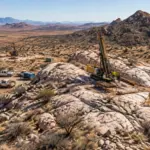
The location of the exploration pipeline increases the stakes. The Energy Transition Observatory found that at least 25% of applications are inside or within 10 kilometres of protected areas and Indigenous territories. A buffer-zone assessment matters because roads, water withdrawals, sediment movement and indirect settlement pressure can affect protected areas even when a mine boundary does not cross one.
The social dimension is especially visible around Aclara’s project in Goiás. The company’s proposed development overlaps with the Afro-Brazilian Kalunga community’s territory, and residents fear that operations could begin as early as 2028. The U.S. Development Finance Corporation has provided $5 million in development financing, giving the project strategic weight beyond its local footprint.
For communities, the question is not limited to whether a project is technically outside a protected boundary. It includes access to land, water, cultural sites, livelihoods and decision-making processes. For companies, those concerns translate into permitting delays, redesign costs, litigation exposure and reputational risk.
This is where mining ESG compliance 2026 becomes an operational issue rather than a reporting exercise. Developers will need evidence that impact assessments are complete, consultation is meaningful, water data are reliable and waste controls can withstand scrutiny from regulators, lenders and affected communities.
Brazil’s policy response aims to protect strategic autonomy
Brazil is considering a federal framework for critical and strategic minerals under a bill authored by lawmaker Zé Silva. The proposal would establish investment priorities, create a national council to monitor foreign influence and support projects connected to mining, processing and industrial development.
The policy debate is being shaped by two objectives:
- Attract capital and technology to develop rare earths and other strategic minerals.
- Retain more value inside Brazil through processing, refining and manufacturing.
| Policy development | Direction of travel | Implication for rare earths |
|---|---|---|
| Bill proposed by Zé Silva | Creates a federal critical-minerals policy | Establishes a clearer national framework |
| Chamber of Deputies approval | Moves the proposal toward Senate review | Could accelerate project incentives and oversight |
| Senate consideration | Lula has indicated support for progress | Determines whether the framework becomes law |
| National council proposal | Monitors foreign influence and strategic transactions | Could affect ownership changes and M&A |
| Domestic-processing emphasis | Links strategic minerals to Brazilian industrialisation | Raises the value of refining and separation capacity |
| Environmental and community debate | Critics seek stronger safeguards and consultation | May shape the bill’s final language and project approvals |
The legislation could give Brazil more leverage in negotiations with the United States and other partners. It may also allow the government to scrutinise foreign acquisitions of companies holding strategic mineral rights.
That authority could become relevant after USA Rare Earth’s acquisition of Serra Verde. The transaction illustrates the type of cross-border deal that policymakers may want to assess under a strategic-minerals framework.
However, investment screening alone will not resolve the sector’s environmental risks. A policy can identify rare earths as strategically important while still leaving uncertainty over monitoring standards, radioactive waste, cumulative impacts and consultation with Indigenous and traditional communities.
Brazil’s policymakers therefore face a sequencing problem. If incentives and strategic designations move faster than safeguards, projects may gain momentum before regulators and communities have the information needed to evaluate them. If rules become too uncertain, capital may move elsewhere and Brazil may remain a reserve holder rather than a producer.
What operators, investors and policymakers should watch
The next phase of Brazil’s rare-earth development will be measured less by the number of exploration applications than by the quality of projects that advance.
Five indicators will be particularly important:
- Conversion of applications into disciplined exploration: Companies will need to show geological progress rather than simply accumulate claims.
- Protected-area and community screening: Early spatial analysis should identify overlaps before capital is committed to mine plans.
- Water and waste controls: Developers should publish credible plans for chemical use, water balances, tailings and potentially radioactive materials.
- Domestic processing commitments: Brazil is likely to favour projects that develop separation, refining or other value-added capacity locally.
- Ownership and offtake transparency: Regulators will need to understand who controls projects, where products will be processed and which customers will receive them.

Water monitoring will be central to evaluating rare-earth projects near sensitive ecosystems and communities.
The country’s rare-earth opportunity is real. Its reserves could help diversify supply for industries that are increasingly exposed to geopolitical disruption. But geology alone cannot create a secure supply chain.
A mine that is delayed by unresolved community concerns is not secure supply. A processing plant without a reliable waste-management system is not resilient supply. And a project that exports concentrate while importing refined material may add volume without delivering the domestic industrial value Brazil is seeking.
Brazil’s rare-earth boom is therefore becoming a test of strategic governance. The country can offer the world an alternative source of critical minerals, but the credibility of that alternative will depend on whether supply security and environmental responsibility are designed together.
For continuing coverage, see Skillings’ rare earths analysis, its review of the critical minerals supply chain in 2026, and its analysis of mining ESG compliance in 2026.
Reporting basis: AP and Reporter Brasil analysis of Brazilian National Mining Agency records; Energy Transition Observatory geospatial analysis; company and government disclosures; and legislative reporting from Brazil. The AP investigation is available here. Background on the proposed critical-minerals framework is available from LeFosse and Covington.