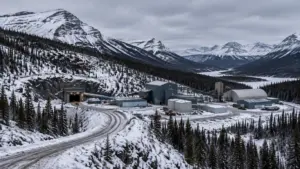
Bunker Hill Mine infrastructure in Idaho’s Silver Valley.

By Salini Krishnan
Bunker Hill Mining Corp. has agreed to acquire Silver47 Exploration Corp. in an all-stock merger valued at approximately US$163 million, combining an Idaho mine moving toward commercial production with silver and critical-minerals projects in Alaska, Nevada and New Mexico.
The transaction, announced by the companies on August 21, would create a U.S.-focused silver and polymetallic minerals group at a time when domestic supply is receiving greater attention from policymakers, manufacturers and investors. The combined company plans to seek a name change to Bunker Hill Silver Corp. and remain listed on the Toronto Stock Exchange.
Silver47 shareholders will receive 0.1724 Bunker Hill shares for each Silver47 share they own. Based on Bunker Hill’s TSX closing price on August 20, the exchange ratio represents approximately US$0.67, or C$0.93, per Silver47 share.

The offer represents a premium of about 38% to Silver47’s previous closing price and approximately 30% to its 20-day volume-weighted average price, according to the companies.

Transaction terms and shareholder ownership
Existing Bunker Hill shareholders are expected to own approximately 57% of the combined company on a basic basis after closing. Silver47 shareholders would hold the remaining 43%.
The transaction is structured as a court-approved plan of arrangement under British Columbia’s Business Corporations Act. It requires approval from both companies’ shareholders, the Supreme Court of British Columbia, the TSX and the TSX Venture Exchange.

The companies expect the transaction to close shortly after shareholder meetings planned for November, subject to the required approvals and other customary closing conditions.
| Transaction measure | Key term |
|---|---|
| Transaction structure | All-stock plan of arrangement |
| Implied value | About US$163 million |
| Silver47 exchange ratio | 0.1724 Bunker Hill shares per Silver47 share |
| Implied Silver47 consideration | About US$0.67 per share |
| Premium to previous close | Approximately 38% |
| Premium to 20-day VWAP | Approximately 30% |
| Post-closing ownership | Bunker Hill holders 57%; Silver47 holders 43% |
| Expected listing | TSX, subject to the proposed name change |
| Target closing | Expected after shareholder meetings in November |
Certain directors, officers and shareholders of Silver47 have agreed to support the transaction with voting agreements covering approximately 6.3% of the company’s issued shares. Support agreements covering approximately 51.5% of Bunker Hill’s issued shares have also been signed, including by Sprott Private Resource Streaming & Royalty Corp. and Teck Resources affiliates.
The arrangement includes mutual non-solicitation provisions and matching rights for superior proposals. Under specified circumstances, a termination fee of approximately US$6.6 million could be payable to Silver47 if Bunker Hill terminates the agreement. A separate fee of approximately US$5.7 million could be payable to Bunker Hill in certain circumstances if Silver47 terminates the agreement.
An operating mine and a U.S. exploration pipeline
The merger brings together Bunker Hill’s operating asset in Idaho’s Silver Valley with Silver47’s three principal U.S. projects.
Bunker Hill says its mine has achieved first production and is being ramped toward commercial production in the fourth quarter. The historic operation produced lead, zinc and silver for nearly a century before closing in 1981. The company is also examining an expansion from 1,800 tonnes per day to 2,500 tonnes per day under its proposed Bunker Hill 2.0 plan.
According to the transaction announcement, analyst consensus projects production of more than 980,000 silver-equivalent ounces in 2026 and approximately 2.5 million silver-equivalent ounces in 2027 at the Bunker Hill Mine. The company says the planned expansion could support annual production approaching 5 million silver-equivalent ounces, although those figures remain forward-looking and depend on operating performance, capital availability and project execution.

Underground equipment works at a hard-rock mining operation.
Silver47 adds exposure to projects that the company describes as high-grade, U.S.-focused silver and critical-minerals assets:
- Red Mountain, Alaska: An inferred resource of approximately 168.6 million silver-equivalent ounces at 336 grams per tonne silver equivalent, according to Silver47. The project is located about 100 kilometres south of Fairbanks in the Bonnifield Mining District.
- Hughes, Nevada: Indicated in-situ resources of approximately 10.3 million silver-equivalent ounces and inferred in-situ resources of about 32.9 million silver-equivalent ounces, alongside an inferred historic-tailings resource of roughly 2.74 million silver-equivalent ounces.
- Mogollon, New Mexico: An inferred resource of approximately 32.1 million silver-equivalent ounces in the historic Mogollon Mining District.
The companies say the combined portfolio contains approximately 80 million silver-equivalent ounces of measured and indicated resources and 308 million inferred silver-equivalent ounces across four U.S. projects. Resource figures are not equivalent to mineral reserves and may not demonstrate economic viability.
Why the merger matters for the critical minerals supply chain
The transaction reflects a broader shift in mining M&A deals in 2026: companies are seeking scale not only through producing assets, but also through jurisdictionally concentrated development pipelines.
For Bunker Hill, Silver47 provides additional exploration exposure and a larger project base around a mine that is approaching commercial production. For Silver47, the merger offers access to an operating platform, financing relationships and a management team with mine-restart experience.
The companies also point to the potential for a more diversified revenue profile. Bunker Hill’s mine is expected to produce zinc, lead and silver concentrates, while Silver47’s projects contain silver alongside gold, copper, zinc, lead, antimony and gallium.
That mix could matter as the United States attempts to build a more resilient critical minerals supply chain in 2026. Silver is used in electronics, solar equipment, electrical contacts and other industrial applications, while the associated base and specialty metals are relevant to manufacturing, infrastructure and defense supply chains.
However, the transaction does not immediately create new production from Silver47’s exploration assets. Red Mountain, Hughes and Mogollon remain exploration and development projects, and their resources will require additional drilling, metallurgical work, permitting, feasibility studies and capital before any construction decision.

Exploration drilling in a remote Alaskan mineral district.
Financing supports the mine ramp-up
Alongside the merger, Bunker Hill has arranged up to US$10 million through a concentrate prepayment facility with Ocean Partners UK. The company has also drawn US$1 million under an existing standby facility with Teck Resources.
The funding is intended to provide working capital and support the ramp-up of operations at the Idaho mine. Silver47 has agreed to use commercially reasonable efforts to make available an unsecured debt facility of up to US$5 million, although that facility remains subject to definitive documentation, approvals and the arrangement continuing in force.
The financing arrangements are important because the combined company’s strategic rationale depends partly on Bunker Hill becoming an operating cash-flow platform. Any delay in reaching commercial production, weaker-than-expected recoveries, cost inflation or lower metal prices could reduce the capital available for exploration and development.
Bunker Hill’s release also identifies potential support from U.S. government agencies and departments, including the Environmental Protection Agency, the Export-Import Bank and the Department of Energy. Those relationships may help with permitting and financing discussions, but they do not guarantee government funding or approvals.
Silver price prediction 2026 adds market context
The merger comes as silver prices have moved sharply higher and market participants debate whether the rally can be sustained.
Skillings’ silver price prediction 2026 analysis notes that silver recently traded near US$69.47 an ounce, with the market supported by a weaker U.S. dollar, industrial demand and a persistent supply deficit. The same analysis outlines a base-case range of US$65 to US$72 an ounce, a bull case above US$75 and a bear case below US$60, depending on monetary policy, investor flows, industrial substitution and recycling.
Higher silver prices can improve project economics and increase the value of exploration assets. They can also raise expectations for operating costs, royalties, sustaining capital and development spending. The commercial outcome for the combined company will therefore depend on both the silver price and the mine’s ability to achieve planned throughput and recoveries.

Silver-bearing polymetallic ore and exploration core under geological review.
Key risks before closing and beyond
The immediate risk is transaction completion. Shareholder and court approvals are still required, and the companies have warned that there is no assurance all conditions will be satisfied.
After closing, investors and operators will likely focus on five execution measures:
- Bunker Hill’s production ramp-up: Whether the mine reaches commercial production as planned and maintains stable mill performance.
- Working capital: Whether concentrate prepayments and other facilities are sufficient to support operations without excessive dilution or additional financing.
- Resource conversion: Whether Silver47’s inferred resources can be upgraded through drilling and technical studies.
- Permitting and infrastructure: Particularly at remote projects such as Red Mountain, where access, power, seasonal conditions and logistics can affect schedules.
- Portfolio prioritization: How management allocates cash flow between mine expansion, exploration and development across four U.S. assets.
The merger gives both companies a larger platform, but it also creates a broader set of operational and capital-allocation demands. Its success will depend less on the transaction headline than on whether Bunker Hill can become a reliable producer while Silver47’s exploration assets advance toward economic development.
For broader context, see Skillings’ coverage of the critical minerals supply chain in 2026 and mining market intelligence.
Social snippet
Bunker Hill Mining and Silver47 Exploration have agreed to a US$163 million all-stock merger, combining an Idaho mine moving toward commercial production with silver and critical-minerals projects in Alaska, Nevada and New Mexico. The proposed transaction adds scale to the U.S. silver supply chain, but execution, approvals and project development remain key risks.