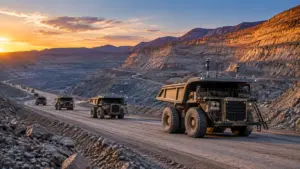
In a bold demonstration of its industrial green pivot, China has launched over 100 electric mining trucks, forming the core of a new China mining fleet aimed at achieving zero-carbon mining. The initiative—unveiled in key mineral hubs like Inner Mongolia—signals an aggressive turn toward decarbonizing the heavy machinery sector.

The fleet, fully autonomous and battery-powered, is the largest of its kind globally. With this launch, China seeks to reduce emissions from one of its most carbon-intensive sectors while positioning itself as the leader in sustainable extraction technologies.
Related News
- U.S.-Led Peace Talks Could Unleash Rwandan Processing of Congo’s Critical Minerals
- Rare Earth Supply Chain Splinters as U.S. and Brazil Ramp Up Processing Capacity
- Green Hydrogen and Automation Are Redefining Mining—But Skills Lag Behind
- Mined Grassland Restoration in China: 7 Strategies to Tackle Carbon Loss Crisis
Electric Mining Trucks Anchor China’s Climate Strategy
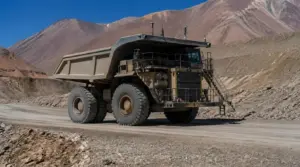
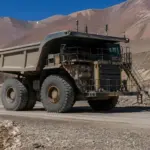
The newly deployed electric mining trucks are equipped with high-capacity lithium-iron phosphate batteries and advanced autonomous navigation systems. Each truck is capable of carrying up to 90 tons of material, operating continuously with minimal human oversight.
This fleet upgrade is part of a broader national goal to reach peak carbon emissions by 2030 and achieve net-zero by 2060. The trucks will replace diesel-based fleets, eliminating thousands of tons of CO₂ annually. Officials from China’s Ministry of Industry hailed the deployment as a “critical pillar” in the country’s zero-carbon mining framework.
China Mining Fleet Scales Faster Than Global Rivals
While Western companies like Caterpillar and Komatsu are still in testing phases for similar equipment, the China mining fleet has already gone operational at scale. The vehicles, built by Inner Mongolia North Hauler (NHL) and supported by Baosteel and Huawei’s AI division, are functioning in varied terrain, including high-altitude and sub-zero regions.
More Read
This rapid scaling may give China a dominant position in the global green mining supply chain. By automating and electrifying its extraction sites, Beijing is enhancing both energy efficiency and mineral security—especially in rare earths and lithium, essential for electric vehicles and renewable energy technologies.

AI-Powered Autonomy and Green Charging Infrastructure
Each truck in the China mining fleet is fitted with level-4 autonomous driving capabilities and linked to smart dispatch systems that optimize load cycles and minimize idle time. Charging stations, powered in part by renewable sources, allow for full battery replenishment in under two hours.
Although current charging infrastructure includes a mix of renewable and grid power, China has committed to transitioning all mining charging points to green energy by 2027, further reinforcing its zero-carbon mining credentials.
Zero-Carbon Mining as an Economic Strategy
Beyond environmental benefits, China’s electrification of its mining sector is an economic maneuver. By reducing reliance on fossil fuels and automating labor-intensive processes, the country expects significant cost savings and productivity gains.
The government has also hinted at exporting the technology to partner nations under the Belt and Road Initiative. This could allow China to influence mining standards globally while embedding its electric vehicle technology in emerging markets.
“China is not only decarbonizing its own operations but rewriting the rules of global mining,” said Liu Yanhua, a policy analyst at the Chinese Academy of Sciences. “The China mining fleet is a model that other nations may be forced to follow.”
The launch of over 100 electric mining trucks is more than a climate milestone—it’s a calculated move in China’s geopolitical and industrial strategy. As it accelerates toward zero-carbon mining, China is setting new benchmarks in automation, sustainability, and global leadership in resource extraction.
With plans to double the China mining fleet by 2026, the world’s second-largest economy is proving that green innovation and heavy industry are no longer mutually exclusive.