China rare earth monopoly is now shaping global mining strategy, with Beijing controlling an estimated 70% of global rare earth mining and nearly 90% of processing capacity (USGS, IEA). For the mining industry, this level of concentration is unmatched in any other critical mineral segment. The dominance spans the entire value chain — from ore extraction to magnet-grade oxides — leaving U.S. and allied supply chains exposed at a time of rising geopolitical tension.

Rare earth elements power technologies across the defence, energy transition, and automotive sectors. Permanent magnets containing neodymium, praseodymium, dysprosium, and terbium are indispensable for F-35 guidance systems, EV drivetrains, and high-efficiency wind turbines. The deeper China’s rare earth monopoly becomes, the more leverage Beijing holds over these downstream industries.
How China Rare Earth Monopoly Took Shape Over 40 Years
The China rare earth monopoly did not emerge overnight. According to decades of USGS production data, Beijing began overtaking U.S. supply dominance in the 1990s, helped by lower production costs, state-backed financing, and looser environmental rules.
Consolidation Into State Champions
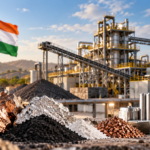
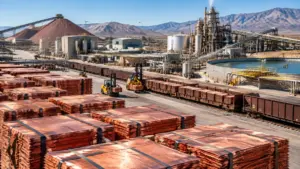
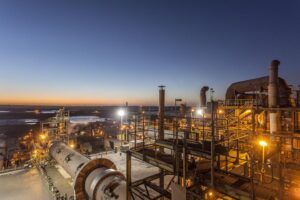
Beijing’s consolidation of the sector into China Northern Rare Earth Group and China Rare Earth Group accelerated its grip. These companies absorbed dozens of smaller producers, enabling strict central oversight of mining quotas, pricing, and export flows. In Ganzhou, the heart of heavy rare earth mining, AFP reporters documented fleets of trucks moving ore through expanded separation plants, underscoring the scale behind China’s rare earth monopoly.
U.S. Retreat Enabled the Shift
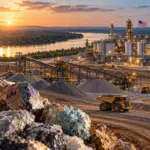
Mountain Pass once accounted for over 60% of global rare earth output, but environmental violations and rising costs forced closure in the early 2000s. As Western investment dried up, China ramped up both capacity and technical expertise, ultimately securing leadership in both supply and IP — including refining patents that prevent technology transfer abroad.
More Read

Trade Tensions Reveal the Risk of a China Rare Earth Monopoly
Beijing’s October restrictions on select rare earth refining technologies served as a reminder of the strategic nature of the China rare earth monopoly. Although not a full export ban, the rules immediately raised costs for global manufacturers of magnets, motors, and defence components.

A temporary minerals truce negotiated in Seoul between Presidents Trump and Xi ensures one year of stable shipments, but analysts view this as a short-term patch. A Pentagon risk assessment concluded that a full restriction on magnet-grade rare earth oxides could delay defence production by 18–24 months, affecting aerospace, missile systems, and naval propulsion.
The Department of Defense has since allocated $800 million under the Defense Production Act to rebuild domestic and allied supply chains — a direct response to China’s rare earth monopoly.
Allied Cooperation: The Primary Counterweight to China Rare Earth Monopoly
With mine development timelines averaging 12–16 years (IEA), the U.S. is leaning heavily on allies to accelerate diversification.
Australia Partnership
Washington and Canberra recently announced an $8.5 billion critical minerals partnership, aimed at expanding supply from Australian producers like Lynas Rare Earths, the largest non-Chinese processor globally.
Japan, Malaysia, Thailand
Japan continues long-term financing commitments for rare earth procurement, while Malaysia and Thailand have agreed to new processing and R&D cooperation agreements.
North America & Europe
Projects in Saskatchewan (Canada) and Kiruna (Sweden) are emerging as long-term alternatives, though none yet rival the integrated scale underpinning China’s rare earth monopoly.
U.S.-based companies such as MP Materials, Energy Fuels, and Texas Mineral Resources are pushing to develop a “mine-to-magnet” chain, but most still rely on China for midstream processing.
Why the China Rare Earth Monopoly Matters for Mining Companies
Price Instability
The China rare earth monopoly increases volatility: NdPr prices climbed more than 20% YoY, with exposure concentrated at the processing and magnet stages.
Capital and ESG Barriers
Western companies face tight permitting regimes and high capex requirements to build environmentally compliant separation facilities — a key competitive advantage China exploited early.
Value Chain Vulnerability
Even when mining capacity increases in the U.S. or Australia, lack of refining capability pushes material back into China’s rare earth monopoly, limiting the value captured by Western miners.
(See prior Skillings coverage on EV magnet bottlenecks and U.S. critical minerals policy.)
Skillings Analysis
- The China rare earth monopoly is primarily a refinery and magnet-manufacturing monopoly, not a geological one. Western miners must prioritize midstream investment to capture margin.
- Expect aggressive incentives in 2025–2027 for Western magnet plants. The U.S. and EU are shifting from exploration funding to downstream industrial strategy.
- M&A and strategic partnerships will accelerate. OEMs cannot tolerate long-term exposure to China’s rare earth monopoly and will move upstream to secure supply.
Outlook: Strategic Pressure Building Into 2026
With the minerals truce expiring in late 2025, the China rare earth monopoly will remain a defining challenge for global miners entering Q4 and the 2026 planning cycle. Western governments are preparing new incentives, while China continues to consolidate control and restrict technical know-how. Both price volatility and geopolitical leverage are expected to intensify, making rare earths one of the most strategically sensitive commodities of the decade.
For now, China’s rare earth monopoly remains firmly entrenched — but a global diversification push is underway, and its success will shape mining investment for years ahead.