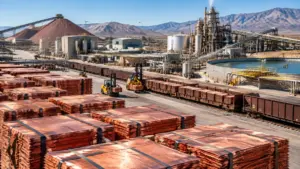
BRUSSELS — The European Union will next week introduce a sweeping package of measures aimed at reducing its reliance on China for EU critical minerals, a supply imbalance that threatens the bloc’s EV, renewable energy, defense, and semiconductor sectors. China currently commands over 90% of the world’s refined graphite, 70% of rare earth mining, and 85–90% of rare earth processing, according to the International Energy Agency (IEA) and European Commission data. For Europe’s industrial base, diversified access to EU critical minerals is quickly becoming a strategic necessity.

Europe Recasts Industrial Policy Around EU Critical Minerals Security
China’s dominance in mining and processing rare earths, graphite, gallium, germanium, lithium, and magnesium has been repeatedly highlighted in EU risk assessments. The bloc currently imports 98% of its rare earth permanent magnets and 86% of its magnesium from China — a stark vulnerability for European automotive and aerospace supply chains.
The upcoming package expands on the EU Critical Raw Materials Act, accelerating permitting, unlocking capital for domestic processing, and deepening strategic partnerships with Canada, Australia, Namibia, and Chile. This marks one of Brussels’ most assertive attempts to stabilise access to EU critical minerals. As previously reported by Skillings, automakers like Stellantis and Volkswagen have already begun securing upstream supply through long-term offtakes and equity positions.
For miners and processors, the policy direction signals sustained demand for exploration, refining, and recycling capacity tied directly to EU critical minerals.
Permitting and Processing Bottlenecks Still Threaten EU Critical Minerals Ambitions
Despite the political momentum, experts warn that Europe’s push to strengthen resilience in EU critical minerals faces structural barriers. Permitting times for new mines can stretch 10–15 years — among the slowest globally — due to stringent environmental rules and community objections, the European Court of Auditors notes.
More Read

Processing capacity remains Europe’s weakest link. Even where mining projects advance, the lack of domestic refining forces manufacturers to export ores or intermediates before reimporting finished materials. Consulting groups like Wood Mackenzie and CRU have repeatedly emphasized that without midstream investment, Europe cannot secure true supply-chain autonomy for EU critical minerals.

Realistically, analysts expect diversification rather than independence.
Global Competition Intensifies as Nations Target EU Critical Minerals Supply Chains
The EU’s pivot mirrors a global trend. The United States is deploying the Defense Production Act to support rare earth separation and battery metals processing. Japan is subsidizing magnet manufacturers, and Canada and Australia have launched their own critical minerals strategies. All aim to counterbalance China’s entrenched position.
This alignment intensifies competition for strategic assets across Africa, Latin America, and Scandinavia — regions increasingly central to EU critical minerals sourcing. Automotive groups and gigafactory developers are moving upstream in parallel, seeking long-term stability even at higher cost.
Should the EU succeed, it could build a more reliable industrial base for clean-tech and defense manufacturing. However, the transition will likely bring higher near-term material costs as alternative EU rare earth minerals supply chains scale.
A Pivotal Moment for Europe’s EU Critical Minerals Strategy
With EV adoption accelerating and renewable deployment breaking records, Brussels now views EU rare earth minerals as foundational to industrial sovereignty. Officials involved in the process call the new package “Europe’s most comprehensive minerals security framework ever attempted.”
The coming quarter will reveal whether the EU can translate policy into action, particularly in processing — the decisive battleground for EU critical minerals over the next decade.
Skillings Analysis
- Expect more EU-backed financing, guarantees, and diplomatic partnerships to secure stable non-China supply routes.
- Europe is transitioning from acknowledging risk to executing a plan, positioning EU critical minerals as a core industrial priority.
- The true choke point is refining. Mining investment will stall unless processing capacity for EU rare earth minerals expands in parallel.