By Charles Pitts

The global shift toward artificial intelligence has moved beyond the realm of software and into the high-stakes world of industrial commodities. For the mining industry, the “AI Energy Nexus” represents a fundamental recalibration of market fundamentals. While much of the early market attention focused on H100 GPUs and high-bandwidth memory, the physical constraints of the AI rollout are increasingly defined by a more traditional asset: copper.
As hyperscalers accelerate their capital expenditure programs, copper demand from AI data centers is emerging as a critical pillar of the global energy transition. By 2026, the intersection of record-high data center power requirements and a stagnant mining supply pipeline is expected to create a structural deficit that will reshape the valuation of copper-leveraged mining stocks.
The Infrastructure Math: Why AI Consumes 4x More Copper
Traditional data centers have long been consistent users of copper for power distribution and grounding. However, the generative AI era has fundamentally changed the intensity of this consumption. AI-ready campuses are significantly more metal-intensive than their predecessor cloud facilities, often requiring 3x to 4x more copper per megawatt of capacity.
The primary driver is power density. Standard server racks typically operate at 10 to 15 kilowatts (kW). In contrast, AI-optimized racks, particularly those housing the next generation of Blackwell-class hardware, can exceed 100kW per rack. This surge in density necessitates massive upgrades in electrical infrastructure.
More Read

- Busbars and Power Distribution: High-density AI chips require massive copper busbars: solid strips of copper used to conduct high-current electricity: within the data center to manage the load.
- Thermal Management: Because AI chips run hotter, traditional air cooling is being replaced by liquid cooling. This requires a vast network of copper heat exchangers and specialized piping to dissipate heat effectively.
- Internal Cabling: The interconnectivity required for large language model (LLM) training involves a dense web of high-speed copper cabling between server nodes.
A single 1-gigawatt (GW) data center can require approximately 50,000 tons of copper. To put that in perspective, global copper production is roughly 25 million tons annually. With hundreds of gigawatts of capacity currently in the global planning pipeline, the incremental “call on copper” is substantial.

The Indirect Multiplier: Grid and Generation
The AI energy nexus extends far beyond the data center walls. For every ton of copper used inside a server hall, several more are required to bring power to the site. Hyperscalers like Microsoft, Amazon, and Google are increasingly forced to invest in their own power infrastructure to circumvent grid bottlenecks.
This involves the construction of dedicated substations, massive high-voltage transformers, and miles of transmission lines. All of these components are copper-heavy. Furthermore, as tech giants commit to carbon-neutral operations, the demand for renewable energy generation: wind and solar, which use 4x to 5x more copper per megawatt than fossil fuel plants: adds another layer of demand.
More Read

Recent reports, such as those detailing Rio Tinto’s interest in the Los Azules copper project, highlight how major miners are positioning themselves specifically to capture this tech-driven demand. The strategy is clear: secure long-life, high-volume assets to feed a customer base that is less sensitive to copper prices than traditional industrial users.

Advanced electrical and utility infrastructure at a modern mining site, reflecting the complexity of power delivery in the energy transition.
2026: The Deficit Inflection Point
The mining industry is currently facing a “scissor effect”: rising demand from the AI nexus is meeting a supply wall. Industry analysts project that 2026 will be the year this tension results in a significant market deficit.
The International Copper Study Group (ICSG) and various market intelligence firms have forecasted a refined copper deficit of approximately 150,000 tons starting in 2026. This is not a temporary dip but a structural shortfall driven by several factors:
- Aging Mines and Ore Grade Decay: Major producing mines in Chile and Peru are seeing declining ore grades. This means more rock must be processed to produce the same amount of metal, increasing operational costs (AISC) and energy use.
- The Permitting Paradox: Bringing a new copper mine online currently takes an average of 15 to 17 years. While projects like Resolution Copper represent significant potential supply, they face decades-long legal and environmental hurdles before the first ton of ore is moved.
- Capital Intensity: Building a new mine today requires multi-billion dollar commitments in high-risk jurisdictions, leading to a conservative “M&A over exploration” mindset among major producers.
By 2026, the lead times for critical copper-intensive hardware: such as high-voltage transformers: are expected to stretch to nearly four years. For data center developers, the “copper problem” is no longer just a cost issue; it is a schedule risk.
Strategic Positioning: AI Energy Nexus Mining Stocks
For investors and decision-makers, the 2026 outlook emphasizes a flight to quality. The market is increasingly differentiating between companies with “growth-ready” copper portfolios and those struggling with legacy operations.
The Major Producers
Diversified majors like BHP and Rio Tinto offer exposure to the copper theme with the protection of strong balance sheets and diversified commodity baskets. Rio Tinto’s strategic pivot toward copper projects in Argentina and its joint venture at Resolution Copper in Arizona underscore its long-term bet on the energy transition and AI infrastructure.
The Copper Pure-Plays
Companies like Freeport-McMoRan (FCX) and Antofagasta are often the primary vehicles for expressing a bullish copper view. Freeport, as one of the world’s largest publicly traded copper producers, has significant operating leverage. When copper prices move, these companies’ earnings-per-share often expand at a faster rate due to their fixed-cost bases.
The 2026 Outlook Developers
The mid-tier and development sector is where the most significant valuation resets may occur as we approach 2026. Projects that can show a clear path to production within the next three to five years are being actively scouted for acquisition. As noted in our 2026 mining investment outlook, the “P-NAV reset” is favoring assets that provide immediate supply visibility.

Modern control rooms integrate real-time data to optimize the extraction of critical minerals like copper.
Risk Factors: Substitution and Macro Headwinds
While the bull case for copper demand in AI data centers is compelling, it is not without risks. High prices historically incentivize substitution. In some electrical applications, aluminum can be used as a lighter, cheaper alternative, though it lacks copper’s superior thermal and electrical conductivity: a dealbreaker for the high-density requirements of AI servers.
Additionally, the broader macroeconomic environment remains a factor. While AI demand is relatively inelastic, traditional copper demand is heavily tied to the Chinese property sector and global manufacturing. A deep recession or a prolonged slowdown in China could offset the gains from the data center sector, at least in the short term.
The Long-Term Industrial Reality
The AI energy nexus has effectively “pulled forward” the copper demand curve. What was once seen as a steady climb driven by EVs and renewables has been supercharged by the physical requirements of the digital frontier.
As we move toward 2026, the mining industry is no longer just a supplier to the automotive and construction sectors; it is a critical partner in the global computing infrastructure. For operators and investors, the key to navigating this nexus lies in understanding that the digital world cannot scale without the physical world providing the atoms: specifically, the copper atoms: to power it.

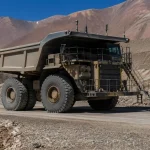
The scale of modern fleet management is essential for maintaining production levels as ore grades decline across the industry.
Key Data Snapshot: The 2026 Copper/AI Nexus
| Metric | Traditional Data Center | AI-Ready Data Center (Estimated) |
|---|---|---|
| Copper Intensity (per MW) | 5 – 15 tons | 40 – 50 tons |
| Average Rack Power Density | 10 – 15 kW | 60 – 120 kW |
| Primary Cooling Method | Air | Liquid (Copper Heat Exchangers) |
| Incremental Annual Demand (Global) | Baseline | 400,000+ tons by 2028 |