By Charles Pitts

The global copper market is entering a period of structural realignment where traditional industrial demand is being eclipsed by the dual pressures of the energy transition and the explosive growth of artificial intelligence (AI). As we move toward 2026, the mining industry is confronting a reality where the “electrification of everything” is no longer a distant forecast, but an immediate operational challenge.
While the role of copper in electric vehicles (EVs) and renewable energy grids is well-documented, the copper intensity of AI-capable data centers is emerging as a primary catalyst for a looming supply crisis. By 2026, the convergence of limited mine-side expansion and a 3.5x increase in per-facility copper requirements for “AI factories” is projected to push the refined copper market into a significant deficit.
The AI Intensity Gap: Why Data Centers Need Massive Copper Volumes
Historically, data centers were material-intensive but did not dominate global copper consumption. Conventional facilities typically required between 5,000 and 15,000 tonnes of copper for basic power distribution and cooling. However, the shift toward generative AI training and large language models (LLMs) has fundamentally altered the infrastructure requirements.
AI training facilities require significantly higher power densities, which translates directly into copper consumption. According to current engineering benchmarks, AI data centers require approximately 47 tonnes of copper per megawatt (MW), compared to roughly 21 tonnes per MW for traditional or crypto-focused facilities.
More Read



For a single 1-gigawatt (GW) hyperscale “AI factory” campus, the copper requirement can soar to 50,000 tonnes. This volume is equivalent to the entire annual production of a mid-sized copper mine. JPMorgan estimates that AI-driven data center demand could add 110,000 tonnes of incremental copper demand by the end of 2026: a material shift that is already being felt in long-term procurement strategies by hyperscalers like Microsoft, Amazon, and Google.
Forecasting the 2026 Supply-Demand Balance
The 2026 outlook for copper is characterized by a “scissor effect”: demand is scaling exponentially while supply remains constrained by aging assets and a lack of Tier 1 discoveries.
More Read
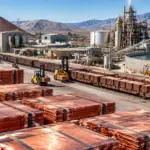
Data from the International Copper Study Group (ICSG) and leading commodity analysts suggest that the refined copper market will face a structural deficit of between 150,000 and 400,000 tonnes in 2026. While this represents only 0.5% to 1.5% of the 28-million-tonne global annual demand, the impact is magnified by historically low inventory levels.
2026 Copper Market Snapshot
| Metric | 2024 (Actual/Est) | 2026 Forecast | Change |
|---|---|---|---|
| Total Global Demand | ~26.5M tonnes | ~28.8M tonnes | +8.6% |
| Data Center Share | ~1.0% | ~2.2% | +120% |
| Refined Supply Balance | -50,000 tonnes | -304,000 tonnes | Widening Deficit |
| Visible Inventories | Low | Critical | Structural Depletion |
This deficit is not merely a result of AI. It is the cumulative effect of the energy transition. For instance, the Lobito Corridor project in Africa is becoming a critical strategic link to bring Central African copper to Western markets, but even these logistics improvements cannot fully offset the production declines in mature jurisdictions like Chile.
Copper Price Forecast 2026: Drivers, Risks, and Cases
The pricing environment for 2026 is expected to reflect this scarcity. Analysts are increasingly modeling a “base-case” where copper prices sustain levels above $11,000 per tonne, with significant upside if AI build-outs accelerate.
The Bull Case ($14,000 – $15,000/t)
Driven by a faster-than-anticipated deployment of AI-ready power grids and a failure of major projects (like those in Panama or the DRC) to meet production targets. In this scenario, copper becomes a hard bottleneck for AI infrastructure, forcing hyperscalers to pay a significant “scarcity premium.”
The Base Case ($11,000 – $12,500/t)
Assumes steady growth in AI data centers and continued grid expansion in the U.S. and China. This case accounts for some substitution (e.g., using aluminum for certain cooling components) but recognizes that copper remains the preferred conductor for high-density power applications.
The Bear Case ($9,000 – $9,500/t)
Requires a significant global macroeconomic slowdown or a technological pivot toward copper-less cooling technologies (like advanced immersion cooling) that reduces per-MW intensity more quickly than current forecasts suggest.

Operational Hurdles: Why Supply Can’t Keep Up
The mining industry cannot simply “turn on” more copper production. The sector faces three primary structural constraints that will define the 2026 crisis:
- Declining Ore Grades: In major producing regions like the Atacama Desert, average ore grades have dropped from over 1.0% to nearly 0.6% in the last decade. To maintain the same level of output, mines must process nearly double the amount of rock, increasing energy costs and waste management requirements.
- Permitting and Lead Times: The average time from discovery to first production for a major copper mine now exceeds 15 years. Even with the US government’s focus on critical minerals, regulatory hurdles and ESG requirements remain rigorous.
- Mine Electrification: Ironically, to produce the copper needed for the green transition, mines themselves must transition. Operators are investing heavily in mine electrification and diesel displacement, which requires significant capital expenditure and further increases the internal demand for electrical components.

Strategic Implications for Investors and Operators
For mining executives and investors, the 2026 outlook suggests a pivot toward “supply security” rather than just cost optimization. Decision-makers are increasingly focused on:
- Vertical Integration: Tech giants may move closer to the mine gate, securing long-term offtake agreements or directly investing in mining projects to ensure their AI roadmaps aren’t derailed by material shortages.
- Operational Efficiency: The use of “digital twins” and AI-driven predictive maintenance in mines is becoming a standard to squeeze every possible tonne out of existing operations.
- Secondary Supply: Copper recycling (urban mining) will likely see a surge in investment, though it is unlikely to meet more than 30% of the total demand gap by 2026.

The Path Forward: 2026 and Beyond
As AI demand becomes a permanent fixture of the copper market, the industry must adapt to a high-price, high-scrutiny environment. While copper represents less than 0.5% of a data center’s total capital expenditure, its absence is a terminal risk for project timelines.
In 2026, the “supply crisis” will likely manifest not as a total physical absence of the metal, but as a series of cascading project delays, price spikes, and geopolitical maneuvering for secure supply lines. For those in the mining sector, the challenge is clear: the digital future is built on a foundation of industrial-scale copper extraction, and the race to bridge the supply gap is now the defining contest of the decade.