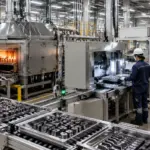
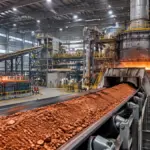
Furnaces and conveyors inside a ferronickel processing plant.

By Sonny Rollins
The European Commission is preparing to issue a statement of objections to MMG’s proposed acquisition of Anglo American’s Brazilian nickel business, according to reports, raising the prospect of a tougher regulatory review of a deal valued at up to $500 million.
The Commission is concerned that MMG, which is controlled by China Minmetals, could redirect ferronickel supplies away from European stainless steel producers after acquiring Anglo American Niquel Brasil, Shanghai Metals Market and MINING.COM reported. Global Banking & Finance has also reported on the regulatory concerns surrounding the transaction.
A statement of objections would set out the Commission’s preliminary competition concerns and give MMG and Anglo American an opportunity to respond. It would not represent a final decision to block the transaction, but it would mark a significant escalation in the European Union’s review.

The case highlights the growing overlap between competition policy and strategic supply-chain security. Ferronickel is a key raw material for stainless steel, while nickel more broadly is also used in batteries, alloys, coatings and other industrial applications. European regulators have increasingly scrutinized transactions involving critical minerals as governments seek to reduce exposure to concentrated or geopolitically sensitive supply chains.

Deal covers operating assets and growth projects
Anglo American agreed to sell its Brazilian nickel business to MMG Singapore Resources, a wholly owned subsidiary of MMG, in February 2025.
The transaction includes the Barro Alto and Codemin operations, which together produced 39,400 tonnes of nickel in 2024, according to Anglo American. The business also includes the Jacaré and Morro Sem Boné greenfield projects.

MMG has agreed to pay $350 million in upfront cash. The total consideration could reach $500 million through a price-linked earnout of up to $100 million and a further $50 million tied to final investment decisions on the two development projects.
MMG said the acquisition would provide entry into Brazil, strengthen its exposure to nickel and expand its geographic footprint. The company described Nickel Brazil as a low-cost operation with a long operating life and further growth potential.
In its transaction announcement, MMG said the assets produced about 40,000 tonnes of nickel in ferronickel annually across the two operating sites. It also said the business could provide exposure to battery-grade nickel through its development pipeline.
Anglo American has framed the sale as part of a broader effort to simplify its portfolio around copper, premium iron ore and crop nutrients. The company said the transaction represented a strong outcome for shareholders, employees and Brazilian stakeholders.

Processing infrastructure and material-handling systems at a Brazilian nickel operation.
EU focuses on European ferronickel access
The Commission’s concern centers on whether the acquisition could weaken reliable access to ferronickel for European stainless steel manufacturers.
According to reporting cited by MINING.COM, regulators are examining whether MMG could divert production from Europe or otherwise reduce the availability of ferronickel to European customers. The Commission is also assessing whether alternative sources would be sufficient to constrain any change in supply or pricing.
Nickel is particularly important to the stainless steel industry. MMG said in its transaction materials that roughly two-thirds of refined nickel is used in stainless steel production. Stainless steel commonly contains between 8% and 10% nickel, although the exact composition varies by grade and application.
For European mills, the concern is not only the quantity of material available but also the reliability, quality and cost of supply. Any disruption could affect production planning and raise costs for manufacturers serving construction, engineering, transport, food processing and other industrial markets.
The Commission has previously said that the transaction may jeopardize continued and reliable access to ferronickel in Europe. Its review therefore extends beyond a conventional assessment of market shares and focuses on the strategic role of the product in a region with limited domestic nickel production.
European stainless steel producers already face high energy costs, competition from imports and pressure to reduce emissions. A less predictable supply of a key alloying input could add to those challenges.
China’s role adds geopolitical weight
MMG is controlled by China Minmetals, a state-owned Chinese metals company. That ownership structure has given the transaction a wider geopolitical dimension, particularly as governments in Europe and elsewhere assess China’s position across critical-mineral supply chains.
China has a major role in the global processing and refining of several minerals used in industrial production and the energy transition. Although the Brazilian assets are located outside China and would continue to operate in Brazil, European officials are assessing whether ownership could influence where material is marketed and how supply is allocated.
The review comes as the EU seeks to improve access to critical raw materials and strengthen domestic industrial resilience. The bloc’s strategic-minerals policies aim to reduce excessive dependence on single suppliers while encouraging new production, processing and recycling capacity.
Nickel has a more complex position within that policy framework. The metal is essential to stainless steel and remains important for some battery chemistries, but a rapid expansion of Indonesian production has changed global market dynamics. Excess supply and lower prices have pressured producers, while governments have become more attentive to the ownership and geographic concentration of processing capacity.
The MMG transaction therefore sits at the intersection of three policy concerns: competition in the ferronickel market, the resilience of European manufacturing and China’s growing influence in mining and metals.
Anglo American argues the market is broad
Anglo American has argued for unconditional clearance, according to reporting on the review, maintaining that European buyers have access to a sufficiently deep market.
That argument is likely to be central to the parties’ response if the Commission issues its objections. MMG and Anglo American could seek to demonstrate that ferronickel producers outside the transaction remain capable of supplying European mills and that customers can switch between suppliers, products or regions.
The companies may also point to the structure of the market for nickel units. Ferronickel is one form of nickel feedstock, and stainless steel producers may use other materials, including nickel pig iron, refined nickel and stainless steel scrap, depending on quality requirements, plant configuration and relative prices.
The Commission, however, is expected to examine how easily those alternatives can replace the Brazilian material in practice. Transport costs, product specifications, contractual arrangements and the availability of suitable grades could limit the effectiveness of theoretical alternatives.

Stainless steel production remains a major source of global nickel demand.
Possible remedies remain under discussion
The transaction has already been subject to regulatory scrutiny in multiple jurisdictions. Completion is conditional on competition and other regulatory clearances.
Reports have said that Anglo American and MMG offered a long-term supply arrangement under which Anglo American would purchase ferronickel from MMG for resale into Europe for as long as 10 years. Such an arrangement could be designed to preserve access for European customers while allowing MMG to take ownership of the assets.
The Commission would need to determine whether such a commitment would address its concerns. It could seek additional safeguards covering volumes, pricing mechanisms, customer eligibility, contract terms or the duration of supply obligations.
Long-term supply agreements can provide continuity, but they do not necessarily eliminate concerns about market power. Regulators may also examine who controls the commercial terms, whether customers can obtain material on competitive conditions and how the agreement would work during periods of tight supply or sharply changing prices.
If the Commission remains dissatisfied after reviewing the companies’ response, it could require more extensive remedies or ultimately prohibit the deal under EU merger rules. A prohibition would be an unusually serious outcome for a transaction of this size, but the case’s strategic-minerals implications give it significance beyond the headline purchase price.

Control-room systems help operators monitor mineral processing and supply-chain performance.
Brazilian assets remain strategically important
For MMG, the Brazilian nickel business would add a new country and commodity to a portfolio centered on copper, zinc and cobalt. The company has described the assets as established operations with strong operating performance and additional development upside.
For Anglo American, the sale would advance its portfolio simplification plan and release capital from a business outside its future core focus.
For European regulators, the issue is whether those corporate strategies could affect the availability of ferronickel for a major downstream industry. The Commission’s review reflects a broader shift in how mining transactions are assessed: ownership, market structure and geopolitical alignment are increasingly considered alongside traditional competition measures.
The next stage will depend on the content of the Commission’s objections and the remedies offered by MMG and Anglo American. Until the Commission reaches a final decision, the transaction remains subject to regulatory uncertainty.
What is clear is that the case has become a test of how Europe balances open markets with supply-chain protection. The outcome could influence not only the future of Anglo American’s Brazilian nickel assets, but also the regulatory treatment of future deals involving critical minerals and strategically important industrial inputs.
Sources: MMG transaction announcement, Anglo American sale announcement, MINING.COM reporting.