By Penny Langford

As of May 21, 2026, the gold market has entered a phase that many analysts previously considered a statistical outlier. With the spot price hovering near $4,500 per ounce, the global mining landscape is undergoing a fundamental re-valuation. Nowhere is this shift more pronounced than in Canada, where high-cost, remote operations: once the "problem children" of major portfolios: have transformed into significant cash-flow engines.
For Canadian producers, the current price environment is not merely a windfall; it is a structural lifeline that has redefined the All-In Sustaining Cost (AISC) benchmark. While inflationary pressures on labor, diesel, and equipment have pushed costs upward, the delta between extraction expenses and realized revenue has widened to historic levels. This analysis examines how Canadian operators are navigating this high-margin reality, the critical role of currency denominations, and the strategic pivot toward Tier-2 assets that were once deemed marginal.
The AISC Paradox: Rising Costs vs. Exploding Margins
In the previous decade, an AISC of $1,200/oz was the hallmark of a healthy mine. By early 2026, those figures have shifted. Inflationary cycles and supply chain complexities have seen average Canadian AISC creep toward $1,600 to $1,900 USD per ounce. In remote regions like Nunavut or the northern reaches of Ontario and Quebec, costs can easily exceed $2,200 USD per ounce.
Under a $1,800 gold regime, these operations were survival stories at best. At $4,500/oz, however, even a mine with an AISC of $2,500/oz is generating a margin of $2,000 per ounce: a figure that exceeds the total gold price seen throughout much of 2022 and 2023.
This margin expansion has allowed companies to absorb the rising costs of "hard-rock" mining without sacrificing shareholder returns. In fact, as we noted in our report on mining’s 2026 shift toward execution, the focus has moved from simple survival to optimizing throughput.


The Canadian Currency Tailwind
A primary driver of Canadian success in this $4,500/oz environment is the persistent strength of the U.S. Dollar (USD) relative to the Canadian Dollar (CAD). Gold is priced globally in USD, providing the revenue for these miners. Conversely, the majority of their operating expenses: wages for Canadian staff, local procurement, property taxes, and domestic energy: are settled in CAD.
At a conversion rate of approximately 1.35 CAD per 1 USD, the "realized" price for a Canadian miner at $4,500 USD gold is effectively over $6,000 CAD per ounce. This currency arbitrage acts as a natural hedge, shielding operators from the full brunt of global USD-denominated inflation in heavy machinery and specialized reagents. For remote operations that rely on massive diesel consumption, the CAD-denominated labor cost provides the necessary buffer to keep the AISC manageable relative to the astronomical revenue.
Market Snapshot: May 2026 Gold Economics (Estimated)
| Metric | Conservative Base Case | Bull Case (Spot) | Impact on Remote Mines |
|---|---|---|---|
| Gold Price (USD/oz) | $4,500 | $4,850 | High Margin Floor |
| USD/CAD FX Rate | 1.35 | 1.38 | Revenue Magnifier |
| Realized Price (CAD/oz) | $6,075 | $6,693 | Historical Record |
| Avg. Remote AISC (CAD/oz) | $2,800 | $3,100 | Fully Covered |
| Net Margin (CAD/oz) | $3,275 | $3,593 | 50%+ Operating Margin |
Remote Resurgence: The Profitability of the North
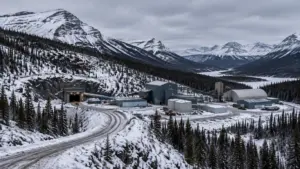
Remote mining in Canada has traditionally been a game of logistical endurance. Sites like Agnico Eagle’s Meliadine or Meadowbank complexes in Nunavut require fly-in/fly-out (FIFO) workforces and strict adherence to seasonal sealift schedules for fuel and supplies. The cost of maintaining an "Arctic-ready" site is immense.
However, the $4,500/oz price has changed the investment calculus for these high-latitude assets. Previously, lower-grade sections of these deposits were left in the ground because the cost to extract them was too close to the gold price. Today, the "cutoff grade": the minimum grade required to make mining a block of ore profitable: has plummeted.
Operators are now re-sequencing their mine plans to include these lower-grade zones, effectively extending the mine life of Canadian northern assets by years, if not decades. The ability to mine at lower grades also allows for more consistent mill throughput, reducing the volatility of quarterly production reports.

Technology as a Cost-Containment Tool
While the gold price provides the margin, Canadian operators are not resting on their laurels. To prevent "margin creep" from eroding their newfound wealth, the industry is accelerating the adoption of autonomous and semi-autonomous systems.
As discussed in our recent analysis of autonomous haulage vs. traditional mining, the ROI for these systems becomes undeniable at $4,500 gold. For a remote mine, automation reduces the number of people required on-site, which in turn slashes the cost of FIFO flights, camp maintenance, and emergency medical support. In 2026, "survival" for a high-cost mine means investing the current profits into technology that will ensure profitability even if the gold price eventually retracts to $3,000/oz.

Institutional Investor Perspective: The Shift to Dividend Payers
The influx of cash has also altered the relationship between mining companies and the capital markets. For years, the gold sector was criticized for poor capital discipline: chasing growth at the expense of returns. In the current environment, the massive free cash flow (FCF) generated by Canadian mines is being channeled back to shareholders.
We are seeing a surge in "special dividends" and aggressive share buyback programs. This has made mid-tier Canadian producers particularly attractive. Investors are no longer just looking for "gold in the ground"; they are looking for "dividends in the bank." Our recent list of top 5 mid-tier dividend payers for 2026 highlights several Canadian operators that have leveraged $4,500 gold to become yield-generating powerhouses.
Operational Risks and Oversight
Despite the euphoria of record prices, operational risks remain. High-cost mines are often sensitive to labor shortages and geopolitical regulatory shifts. In Canada, federal and provincial governments are increasingly eyeing the "windfall" profits of the extractive industries to fund environmental and social initiatives.
Furthermore, the integration of ESG (Environmental, Social, and Governance) metrics is no longer optional. Remote mines, which often rely on diesel power, are under pressure to transition to LNG, wind, or solar-battery hybrids. The current profit margins provide the capital necessary for these expensive transitions, but the execution risk remains.

Conclusion: A New Baseline for Canadian Gold
The era of $4,500/oz gold has validated the persistence of the Canadian mining sector. High-cost, remote, and marginal projects have transitioned from being liabilities to becoming the crown jewels of many portfolios. By leveraging CAD-denominated costs against USD revenues, and by aggressively adopting autonomous technology, these mines have secured their place in the global supply chain for the foreseeable future.
As we look toward the remainder of 2026, the question for operators is no longer "can we survive?" but "how do we optimize?" For the Canadian gold industry, the answer lies in the frozen north, where the machines continue to move, and the gold continues to flow, more profitably than ever before.