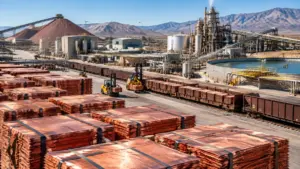
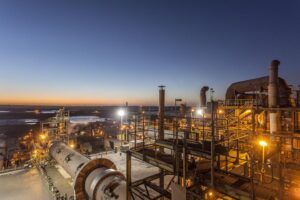
When Prime Minister Anthony Albanese and U.S. President Donald Trump unveiled a US $13 billion rare-earths partnership in October, it was framed as a defining step in the global race for “clean-energy independence.” The deal—pitched as part of a joint strategy to secure the future of green energy—also exposes what analysts are calling the green energy paradox: in its push to break China’s dominance over critical minerals, Australia risks inheriting the same environmental and social costs that once made rare-earth mining politically toxic in the West.

Strategic Urgency Meets the Green Energy Paradox
China still controls 70 percent of global rare-earth mining and over 90 percent of refining, according to Geoscience Australia and the Lowy Institute. These minerals—neodymium, praseodymium, dysprosium, lithium, and cobalt—form the backbone of electric vehicles, wind turbines, and defense systems.
Australia’s ambition to become a “critical-minerals superpower” fits neatly within its clean-energy narrative. Yet analysts at Mining Technology caution that the green energy paradox is already evident: while new projects promise strategic independence, most remain a decade away from full supply-chain maturity, and nearly all rely on energy-intensive processes that challenge the nation’s emission goals.
“Every tonne of green-energy material mined today carries a carbon shadow tomorrow,” one senior commodities strategist told Skillings Mining Review.
Heavy-Metal Footprints in “Clean” Minerals
The green energy paradox deepens when examining environmental data. A study in the Harvard International Review estimates that each tonne of rare-earth oxide generates up to 2,000 tonnes of toxic and radioactive waste.
More Read

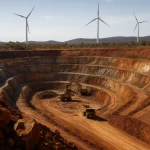
In Australia’s arid mining zones—Western Australia and the Northern Territory—Farmonaut® satellite imagery shows significant land disturbance and ecosystem fragmentation around exploration leases. Refining processes depend on acid leaching and solvent extraction, which, according to Science News Explores, leave behind thorium- and uranium-contaminated residues if tailings aren’t meticulously contained.

While regulators tout Australia’s “world-class environmental standards,” Yale E360 warns that “tailings ponds, chemical leaks, and groundwater pollution” remain the most under-reported risks of rare-earth expansion. The promise of renewable energy, in other words, could come wrapped in radioactive contradictions—the essence of the green energy paradox.
Indigenous Rights and the Social-Licence Challenge
More than half of Australia’s critical-minerals projects are located on or adjacent to Indigenous lands, a fact highlighted by The Strategist (ASPI). The Koppamurra rare-earth project in South Australia, for instance, has already sparked pushback from local farmers and traditional owners concerned about groundwater contamination and land disruption (ABC News, Oct 2024).
More Read
This underscores another layer of the green energy paradox: while the transition aims to create a sustainable future, it risks repeating extractive injustices of the past. Mining companies can no longer rely on procedural consultations; social licence now directly affects ESG compliance and project financing. For investors, reputational risk is fast becoming as material as ore grade.
Public Spending, Private Gain
The Australian federal budget has allocated billions in subsidies and concessional loans to accelerate critical-minerals capacity. Yet, as Mining Technology notes, ASX-listed explorers have tripled in value this year, even as production timelines lag. Critics warn that taxpayer money may be funding speculative gains rather than industrial transformation—a familiar pattern within the green energy paradox.
The Strategist argues that Australia must use its “high environmental and social standards as leverage, not compromise them in the rush to compete.” Without transparency on who profits, who bears risk, and who cleans up, the national goal of clean-energy sovereignty may degenerate into another public-cost, private-gain cycle.
Supply-Chain Security vs. Sustainability
The geopolitical urgency to diversify supply away from China has redefined critical minerals as a national-security asset. Yet, as Mining Technology economists point out, breaking China’s monopoly requires more than extraction—it requires refining, processing, and end-product integration.
If Australia fails to invest across the value chain, it risks replicating the “dig-and-ship” dependency that characterized its iron-ore era—a dynamic at odds with the ethos of the green energy paradox. True sustainability means building a domestic ecosystem that transforms raw ores into magnets, batteries, and components at home, while managing carbon and waste footprints transparently.
Toward a Credible Industrial Strategy
Experts agree that Australia’s rare-earth ambition will only succeed if the green energy paradox is addressed head-on through governance and accountability:
- Rigorous Environmental Oversight: Real-time tailings monitoring and independent water-use audits.
- Indigenous Partnership Frameworks: Revenue-sharing and cultural-heritage integration, not symbolic consultation.
- Full-Cycle Industrial Investment: From ore to oxide to magnet—localizing high-value steps.
- Public-Fund Transparency: Linking taxpayer support to measurable ESG and employment outcomes.
- Balanced Public Narrative: Green energy is not clean by default—it must be made clean through process discipline.
Skillings Analysis
“The green energy paradox is no longer theoretical—it’s unfolding in real time,” writes Skillings Mining Review. “Australia’s challenge is to prove that clean-energy leadership does not come at the expense of its land, water, and communities.”
“For mining professionals, this is a strategic inflection point: environmental stewardship and Indigenous engagement are becoming competitive differentiators as vital as ore quality or logistics efficiency.”
“Those who manage ESG risk as an engineering problem—not a PR obligation—will define the next decade of mining leadership.”
The Road Ahead
As global demand for electric vehicles and renewables accelerates through 2026, Australia’s critical-minerals push will remain under intense scrutiny from markets, regulators, and communities. Success will hinge on whether the government can turn the green energy paradox into a green-industry opportunity—balancing national ambition with environmental credibility.
The clean-energy transition is unstoppable. But without structural reform, the mining behind it could become the forgotten carbon debt of the 21st century—a costly reminder that “green” supply chains are only as clean as the mines that feed them.