i-80 Gold Corp. (TSX: IAU) has closed a $500 million financing package that positions the Nevada-focused gold producer to triple its output and transition into the mid-tier category by decade's end, the company announced this week.

The dual-structured deal combines a $250 million royalty sale to Franco-Nevada Corp. and a $150 million gold prepay facility led by National Bank of Canada and Macquarie Bank. Proceeds will fund phases one and two of i-80's Nevada production ramp-up, which targets 300,000 to 400,000 ounces of annual gold output by 2029: up from fewer than 50,000 ounces currently.
The financing also retires approximately $175 million in existing debt and funds expansion drilling across five Nevada gold projects, including the company's flagship Mineral Point deposit.
Financing Structure: Royalty and Prepay
Franco-Nevada's $250 million commitment purchases a 1.5% net smelter return royalty covering all i-80 mineral properties through December 2030. The rate steps up to 3% beginning January 2031. The transaction closes March 17, 2026, with $225 million available immediately and $25 million reserved for Mineral Point project advancement later this year.
The gold prepay facility commits $150 million upfront, with an optional $100 million accordion feature. i-80 will deliver 39,978 ounces of gold to the lenders over 30 months starting January 2028. The prepay structure allows i-80 to avoid dilution while locking in near-term cash flow certainty during construction.


Production Timeline: Three-Phase Buildout
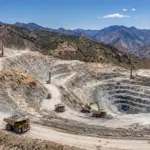
Phase 1 (2026-2029) focuses on the Granite Creek underground mine ramp-up and the Archimedes project. i-80 expects Granite Creek to contribute meaningful ounces as early as 2027, supported by refurbishment of the Lone Tree processing mill. Archimedes, a heap leach operation, adds lower-cost production in 2028.
Phase 2 (2030-2031) expands the Cove underground mine and initiates Granite Creek open pit operations. Combined, these projects push annual output toward 400,000 ounces by 2031.
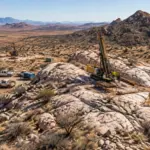
Phase 3 (2032+) brings Mineral Point online: the company's largest asset. Mineral Point holds the potential to produce more than 600,000 ounces annually beginning in 2032, positioning i-80 as a mid-tier gold producer. The company has allocated $50 million in 2026 for resource expansion drilling, metallurgical testing, and early-stage permitting at Mineral Point.
The phased approach avoids the capital intensity of concurrent construction while sequencing cash flow from earlier-stage projects to fund later development.
Nevada Consolidation Play
i-80's land package spans the prolific Battle Mountain-Eureka and Carlin trends in northern Nevada. The company controls more than 43,000 acres and has identified multiple satellite deposits within trucking distance of centralized processing infrastructure.
The Lone Tree mill, acquired from Newmont Corp. in 2020, anchors the strategy. i-80 plans to refurbish the facility to process oxide and refractory ore from Granite Creek, Archimedes, and Ruby Hill. Restarting existing infrastructure cuts capital costs compared to greenfield mill construction and accelerates permitting timelines.
Nevada remains the top-ranked mining jurisdiction in North America, with established regulatory frameworks and access to skilled labor. The state produced approximately 4.5 million ounces of gold in 2025, trailing only China and Australia globally.
Market Context: Mid-Tier Gap and M&A Dynamics
The financing positions i-80 to fill a widening gap in the mid-tier gold producer category. Consolidation among senior producers: including Newmont's acquisition of Newcrest and Agnico Eagle's purchase of Yamana Gold: has reduced the number of pure-play 300,000- to 600,000-ounce producers available to investors.
Mid-tier producers historically trade at premiums to junior developers due to de-risked production profiles and improved access to capital. i-80's Nevada-focused portfolio avoids the jurisdictional and permitting risks that have stalled projects in South America and West Africa.
Gold prices remain elevated, with spot prices trading near $2,680 per ounce as of February 13, 2026. Central bank buying, persistent inflation concerns, and geopolitical risk continue to support bullion demand. The elevated price environment improves project economics and expands financing options for developers.
| Financing Component | Amount | Structure | Key Terms |
|---|---|---|---|
| Franco-Nevada Royalty | $250M | 1.5% NSR (2026-2030); 3% NSR (2031+) | $225M at close (March 2026); $25M for Mineral Point |
| Gold Prepay Facility | $150M + $100M accordion | Delivery of 39,978 oz over 30 months | National Bank of Canada, Macquarie Bank |
| Total Package | $500M | Debt retirement, capex, drilling | Fully funds phases 1 & 2 |
Risks and Execution Challenges
i-80 faces execution risk across multiple concurrent projects. Permitting delays, construction cost overruns, or metallurgical challenges could push timelines and compress returns. The company's track record remains limited: it transitioned from explorer to producer only in recent years.
The royalty structure also introduces long-term margin compression. Franco-Nevada's 3% NSR beginning in 2031 applies across all properties, reducing cash flow as production scales. The step-up timing coincides with peak output from phase two projects, creating potential friction between growth and free cash flow generation.
Labor and supply chain constraints in Nevada have tightened as Barrick Gold and Nevada Gold Mines ramp operations. Competition for skilled tradespeople, explosives, and contract mining services could inflate costs beyond current estimates.
Daily Metals Snapshot
Gold: $2,682.40/oz (+0.3%)
Silver: $30.15/oz (+0.7%)
Copper: $4.48/lb (-0.2%)
Lithium (carbonate, China): $10,800/ton (+1.1%)
Iron ore (62% Fe CFR China): $104.20/ton (-0.5%)
Gold extended gains on renewed safe-haven demand following tensions in Eastern Europe. Silver tracked gold higher, supported by industrial demand from solar panel production. Copper pulled back on profit-taking after a four-session rally. Lithium prices stabilized as Chinese producers curtailed output in response to oversupply.
Capital Allocation and Shareholder Dilution
The financing avoids significant equity dilution: a critical consideration for i-80 shareholders. The company's share count has expanded in recent years through asset acquisitions and previous capital raises. By structuring the package as royalty and prepay rather than equity, i-80 preserves upside for existing investors while maintaining strategic flexibility.
The $175 million debt retirement also strengthens the balance sheet and reduces near-term financing risk. i-80 inherited legacy obligations from predecessor companies and earlier-stage development spending. Cleaning up the capital structure positions the company to access additional growth capital if phase three development at Mineral Point requires incremental funding.
Outlook: Path to 600,000 Ounces
i-80's production roadmap depends on operational execution, permitting progress, and sustained gold prices above $2,000 per ounce. The company's diversified Nevada project portfolio provides optionality: delays at one site can be offset by advancing others within the same processing corridor.
The mid-tier production target of 600,000 ounces annually beginning in 2032 places i-80 among the top 30 gold producers globally, assuming successful development. That scale attracts institutional investor interest and improves liquidity in the company's shares.
Investor focus will center on phase one milestones: Granite Creek underground production ramp-up, Lone Tree mill commissioning, and Archimedes heap leach performance. Meeting 2027-2028 production targets validates the broader development thesis and de-risks subsequent phases.
The Franco-Nevada partnership also signals institutional validation. Franco-Nevada, the largest precious metals streaming and royalty company, conducts rigorous technical and financial due diligence before committing capital. The $250 million investment suggests confidence in i-80's asset base and management team.

Nevada's Role in Domestic Gold Supply
i-80's expansion aligns with broader efforts to strengthen domestic critical mineral supply chains. While gold is not classified as a critical mineral under U.S. policy, domestic production reduces reliance on imports and supports regional economic development.
Nevada gold mines employ approximately 14,000 workers directly and generate more than $1 billion in annual tax revenue. i-80's production growth will add jobs in rural communities across Elko and Eureka counties, where mining remains the dominant industry.
The company's phased development approach also minimizes environmental and permitting risk. By refurbishing existing infrastructure and focusing on brownfield expansions, i-80 avoids the multi-year timelines and litigation risks associated with greenfield projects in contested jurisdictions.
The $500 million financing provides i-80 with the capital and runway to execute its Nevada consolidation strategy. Whether the company delivers on its 600,000-ounce production target will depend on operational discipline, cost control, and the gold price environment over the next six years.
Source: Skillings Mining Review (Data as of February 13, 2026)