By Charles Pitts and Penny Laneford

The Western world is losing the rare earths race, and most investors are looking at the wrong map. We’ve been told for five years that “de-risking” and “friend-shoring” would break the Chinese monopoly. It hasn’t. In 2026, the reality is far grimmer than the press releases suggest.
Beijing hasn’t just maintained its lead; it has institutionalized it. If you’re looking for alpha in the critical minerals space, you have to stop listening to the ESG fluff and start looking at the brutal physics of the supply chain. The gap between what we need and what we can actually produce is widening.
Here are the 10 structural shifts defining the rare earths market in 2026.
1. The 90% Stranglehold Is Not A Hyperbole
Despite billions in Western subsidies, China still controls approximately 85–90% of global refined rare earth production. In the heavy rare earths (HREE) category, the stuff that actually makes high-performance magnets work, their dominance is effectively total.
More Read

This isn’t just about mining. It’s about the midstream. You can dig up all the rock you want in Australia or Africa, but if you have to ship it to Baotou for processing, you’re still playing by Beijing’s rules. The strategic vulnerability is absolute.

2. NdPr Demand Is Decoupling From Reality
Neodymium-Praseodymium (NdPr) oxide demand is currently growing at 16% year-over-year. That’s not a steady climb; it’s a vertical trajectory. Between electric vehicle (EV) motors and the massive expansion of offshore wind turbines, the world is hungry for high-strength permanent magnets.
By the end of 2026, we expect the annual deficit for NdPr to hit critical levels. We aren’t just talking about higher prices. We are talking about assembly lines stopping because there isn’t enough material to build the motors.
More Read

3. Export Controls Are The New Geopolitical Weapon
China has moved beyond simple tariffs. In 2026, the weapon of choice is non-automatic export licensing. This covers medium and heavy rare earths, samarium cobalt magnets, and dysprosium-containing materials.
Approval timelines now regularly exceed three months. It’s discretionary. It’s unpredictable. And it’s designed to keep Western OEMs on a short leash. If you’re an investor, you need to realize that a project’s value in 2026 is tied directly to its ability to bypass these “administrative delays.”
4. The US DOD Is Your New Favorite Venture Capitalist
The US Department of Defense and Department of Energy have stopped waiting for the private sector to lead. They are now actively funding allied projects through the Defense Production Act. We are seeing a massive mobilization of capital aimed at de-risking junior miners.
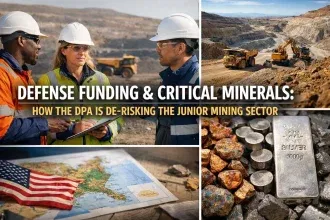
This isn’t traditional project finance. It’s strategic survival. When the Pentagon starts cutting checks for processing facilities, the traditional “is this mine profitable?” calculus changes. The new question is: “Is this mine essential for national security?” If the answer is yes, the floor for that stock is much higher than the market thinks.
5. Canada Is The Only Logical Backup
Canada currently holds over 15 million tonnes of rare earth oxide equivalent in undeveloped resources. It is the second-largest resource base outside of China. More importantly, it’s a “trusted” jurisdiction.
The Canadian government’s $165.2 million Critical Minerals Strategy is finally hitting the ground. In 2026, the smart money is moving toward the Athabasca Basin and the Northwest Territories. We’re seeing a shift from “exploration potential” to “permitted reality.” You can read more about how these jurisdictions are positioning themselves in our latest news coverage.
6. Processing Is The Ultimate Bottleneck
Mining is easy. Chemistry is hard. Rare earth processing is complex, environmentally intensive, and carries massive execution risk. Most juniors will fail not because they don’t have the ore, but because they can’t master the separation of 17 chemically identical elements.

Execution risk is the primary killer of “critical minerals alpha.” In 2026, the market is starting to reward companies that focus on modular, scalable processing technology rather than just “big holes in the ground.” If a company doesn’t have a proven flowsheet, it’s just a lifestyle company with a fancy drill rig.
7. M&A Activity Has Turned Into a Land Grab
US-based companies are moving with a sense of desperation. We are seeing venture-style dealmaking where large-cap industrials are buying minority stakes in early-stage projects just to secure an off-take agreement.
This isn’t just M&A; it’s a structural realignment. Companies like Caterpillar and Fortescue are already showing how deep these partnerships can go. Expect 2026 to be the year of the “strategic investment” where the buyer doesn’t care about the 12-month ROI, but the 10-year supply security.
8. Traceability Is No Longer Optional
Thanks to Section 30D restrictions and “Foreign Entity of Concern” (FEOC) rules, sourcing matters more than price. If your magnets contain Chinese-refined material, you might lose your EV tax credits in the US.
Traceability is becoming a commodity in itself. Supply chains are being optimized for jurisdictional resilience. This increases the value of projects in Norway: like the Fen Project: and other European hubs that can prove their lineage.
9. Heavy Rare Earths (HREE) Are The Real Crisis
While everyone talks about Neodymium, the real “nasty” shortage is in Dysprosium and Terbium. These are the additives that allow magnets to operate at high temperatures without losing their magnetism. Think fighter jets and high-performance EV drivetrains.
China’s grip on HREE is even tighter than on light rare earths. Military and aerospace sectors are facing the most stringent export barriers. In 2026, any project with a significant HREE credit is basically a license to print money.
10. Alpha Lies In Jurisdictional Resilience
The era of the “lowest cost producer” is over. We are now in the era of the “most resilient producer.” The market is finally beginning to price in a “security premium” for non-Chinese supply.
This isn’t a temporary spike. It’s a structural shift. As Bill Peterson from J.P. Morgan noted, the expansion of supply chains outside of China is a multi-year necessity. For investors, the alpha isn’t in finding the highest grade; it’s in finding the project that Western governments cannot afford to let fail.

What Happens Next?
The 2026 rare earths market is a minefield of geopolitical risk and technical hurdles. But for those who understand the “chemistry bottleneck” and the shift toward defense-funded mining, the opportunities are massive.
We are seeing a bifurcated market: those who are part of the “Western Shield” and those who are still waiting for Beijing to grant them an export license. Choose wisely.
Stay Ahead of the Curve
To navigate the complexities of the 2026 mining landscape, you need more than just headlines. Our comprehensive Media Kit provides a deep dive into the demographics and data driving the industry today.

Whether you are tracking the latest exploration breakthroughs or monitoring regulatory shifts in South America, Skillings Mining Review is your primary source for operational intelligence.
For more in-depth analysis of the 2026 mining outlook, check out our recent feature on Mexican mining risk and security policy.