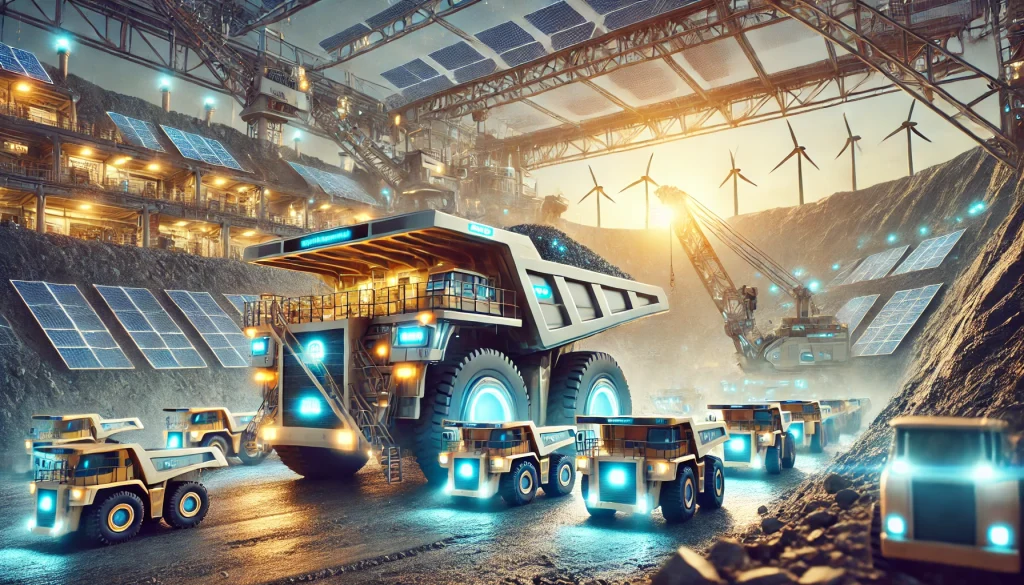
Electrification of Mining Operations Paves the Way for a Greener Future
Mining operators worldwide are racing to decarbonize their operations, and securing a stake in the EV future has become a strategic priority. With electric vehicles (EVs) expected to make up 50% of new mining vehicle sales by 2044, according to IDTechEx, mining companies are exploring ways to integrate EV technology into their fleets while boosting efficiency and profitability.

Related News
- U.S. construction industry Faces Rising Costs Amid New Tariffs
- Tshiamiso Trust Reaches Major Milestone with R2 Billion Payout to Ex-Gold Mineworkers
- Greenland Mining Industry Faces Challenges Despite Vast Potential
- MINEXCHANGE 2025 Conference Highlights Mining’s Shift Toward Sustainability and Innovation
Mining’s Shift Towards an All-Electric Fleet
As mining companies commit to achieving net-zero emissions by 2050—and some setting ambitious goals for 2030—electrifying mining fleets is a logical step. Operators are investing in electric haulier trucks, trains, crushing equipment, and bulldozers, cutting reliance on diesel-powered machinery.
However, some mining giants are taking a more aggressive approach to securing their EV future by pursuing vertical integration strategies. Instead of merely purchasing EVs from third-party manufacturers, operators are acquiring companies that design and produce electric mining vehicles. This strategy not only helps mining companies control supply chains but also unlocks new revenue streams.
The Case for Vertical Integration in Mining EVs
Owning an EV manufacturing capability gives mining companies greater flexibility, cost control, and market competitiveness. By acquiring a supplier of mining EVs, companies can:
- Reduce reliance on external EV manufacturers
- Monetize intellectual property (IP) rights
- Develop aftermarket services for EVs
- Re-purpose batteries for secondary applications
- Implement Battery-as-a-Service (BaaS) models for recurring revenue
One standout example is Fortescue Zero, which aims to become the world’s first net-zero mining operator by 2030. In 2022, the company acquired Williams Advanced Engineering, a specialist in high-performance battery technology. This acquisition is driving Fortescue’s plan to produce scalable batteries for industrial applications, with production set to commence this year.
More Read
Resilience in the EV Supply Chain
A major advantage of vertical integration is supply chain security. The mining industry has been plagued by supply shortages and fluctuating material costs, particularly for EV components such as lithium-ion batteries. By establishing internal EV production, mining operators can:

- Gain greater bargaining power with battery cell providers
- Set up direct partnerships with technology firms
- Adapt battery chemistry to evolving industry needs
- Influence future industry standards
Moreover, companies adopting a Battery-as-a-Service model could maximize returns over a battery’s entire lifecycle, from initial deployment to repurposing for secondary applications.
Challenges of Entering the EV Manufacturing Space
Despite its potential, transitioning from mining operations to EV production is a complex undertaking. Manufacturing electric mining vehicles requires advanced expertise in automotive-grade production, AI-driven digital twins, and automated systems—areas unfamiliar to most mining operators.
Key challenges include:
- The need for a capital-intensive shift from mining operations to industrial manufacturing
- Establishing a new supply chain from scratch
- Ensuring compliance with automotive-grade quality standards
- Managing long lead times before profitability is realized
Additionally, the International Energy Agency (IEA) estimates that the mining industry will need to invest $800 billion by 2040 to achieve full decarbonization. Mining operators must weigh whether they have the financial and operational capacity to make such a transition.
Alternative Approaches to Securing an EV Future
Not all mining operators will be able to transition into EV manufacturing. However, companies can still secure their EV future by adopting digital technologies that optimize efficiency and sustainability.
For instance, in 2024, Hexagon acquired indurad, a company specializing in radar and real-time location systems (RTLS). Such acquisitions allow mining operators to improve automation, reduce operational costs, and enhance safety, ultimately contributing to a cleaner mining ecosystem.
The Race to Electrify Mining: Move Fast or Fall Behind
Mining operators stand at a crossroads: invest early in EV future technologies or risk falling behind in an increasingly competitive landscape. Those that act swiftly, like Fortescue Zero, could set industry benchmarks and establish dominant positions in a greener mining economy.
With demand for electric mining vehicles rising, the opportunity is clear. However, success will depend on strategic decision-making, supply chain control, and technological adaptability. Mining operators must evaluate their capacity for vertical integration, as those who delay risk missing out on one of the most significant industry shifts of the decade.