By Charles Pitts

The global mining landscape in July 2026 is being reshaped by a convergence of high-stakes geopolitical competition and a fundamental shift in how hardware and software interact. As the “AI-Energy Nexus” continues to drive unprecedented demand for copper, lithium, and nickel, the industry has moved beyond the pilot phase of automation. Today, technology is no longer an optional efficiency gain; it is the baseline for operational survival in a market defined by deep-level complexity and unconventional resources.
From the deployment of robotic rod handlers in the Abitibi region to the establishment of marine robotics hubs in the American Rust Belt, the innovations of 2026 are focused on one core objective: removing human exposure from the “active face” while maximizing the velocity of the processing feedback loop.
Autonomous Underground Drilling: Agnico Eagle’s LaRonde Deployment
Agnico Eagle’s LaRonde mine has officially become the first underground operation globally to deploy Epiroc’s Diamec Automated Rod Magazine (ARM) in full-scale production. This milestone marks a significant transition in diamond core drilling, a task traditionally known for its high physical demand and repetitive strain on operators.
The Diamec ARM system, managed at LaRonde by drilling contractor Machines Roger International (MRI), automates the entire rod-loading and retrieval process. A fully loaded magazine can hold 84 N-rods, allowing for up to 252 meters of drilling without manual intervention.
More Read



For operators, the impact is structural. The ARM allows the control station to be moved away from the rotating drill strings and the immediate hazards of the rock face. Internal data from the 2026 rollout suggests a 20% increase in productivity compared to manual diamond drilling, largely due to consistent cycle times and the elimination of downtime related to manual rod handling. This deployment fits into a broader mine-wide automation strategy at LaRonde, which now includes automated mucking and autonomous hauling between depth levels.
The Open Ecosystem: Hitachi and Pronto’s Global Partnership
A long-standing barrier to mine automation has been the “walled garden” approach of major OEMs. Historically, if an operator wanted an autonomous haulage system (AHS), they were forced to standardize their entire fleet around a single manufacturer.
More Read

In a major move toward industry interoperability, Hitachi Construction Machinery and Pronto have entered a global strategic partnership in 2026. This memorandum of understanding focuses on developing an OEM-agnostic, open-architecture AHS. Pronto’s technology, which was recently integrated into the Atoms Mining ecosystem, can be retrofitted onto existing haul trucks regardless of the brand.

This “Open Mine” philosophy allows brownfield operations to introduce autonomy incrementally. By decoupling the control logic from the vehicle hardware, Hitachi and Pronto are enabling operators to maintain mixed fleets while running a single, unified safety and dispatch system. This is particularly relevant for mid-tier miners who cannot afford the capital expenditure of a full fleet replacement but require the safety and throughput benefits of autonomous hauling.
AI-Ready Mineral Processing: The Jameson Cell Feedback Loop
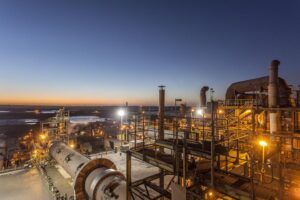
In the processing plant, the narrative has shifted from “bigger is better” to “faster is smarter.” Glencore Technology has positioned its Jameson Cell as the premier hardware for AI-driven advanced process control (APC).
The critical factor is residence time. Conventional mechanical flotation circuits often have residence times measured in hours, creating a massive “dead time” for AI models to account for. If a change in feed chemistry occurs, it may take 60 to 90 minutes for the sensor data to reflect the results of a control adjustment.
The Jameson Cell operates with a residence time of only 5 to 10 minutes. This compressed cycle allows AI models to run dozens of train-and-adjust cycles per shift. By providing near real-time feedback, the AI-integrated Jameson circuits achieve higher recovery rates and more stable concentrate grades, even when dealing with highly variable ore bodies.

Deep-Sea Frontiers: Pittsburgh’s Marine Robotics Hub
The race for critical minerals is also moving toward the abyssal plains. Impossible Metals has announced the establishment of its Advanced Marine Robotics Hub in Pittsburgh, Pennsylvania. The choice of location: historically the heart of American steel: highlights the city’s emergence as a global center for “Physical AI” and robotics.
Unlike traditional deep-sea mining concepts that rely on destructive dredging or scraping of the seabed, Impossible Metals is developing autonomous underwater vehicles (AUVs) that use computer vision and selective “pick-and-place” technology. These robots, such as the “Eureka” platform, are designed to hover above the seafloor and pick up individual polymetallic nodules while leaving those with visible marine life untouched.

The Pittsburgh hub is a strategic move to build a “China-free” supply chain for nickel and cobalt. By utilizing dual-use autonomy: tech that serves both commercial resource collection and naval defense: the project has gained significant traction among investors focused on the AI-energy nexus mining stocks.
Mass Scale Surface Autonomy: The Xinjiang 800-Truck Deal
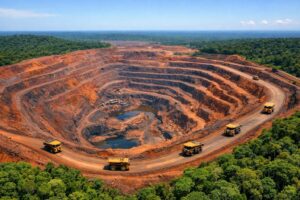
While Western miners focus on precision and interoperability, the scale of deployment in China remains unmatched. Tonly Heavy Industries recently signed a framework agreement with Xinjiang Hanxiang to supply 800 autonomous mining trucks for large open-pit coal and mineral operations in the region.
This deal represents one of the largest single deployments of driverless trucks in history. For mine planners, a fleet of this scale requires a complete redesign of haul road geometry and traffic management standards. The Xinjiang project is being positioned as a “green intelligent mine” benchmark, integrating fully digital dispatching with low-carbon hauling, effectively creating a factory-like environment in a formerly remote mining district.
Unconventional Extraction: Uranium from Seawater
As the nuclear renaissance gains momentum in 2026, the industry is looking beyond traditional hard-rock mining for fuel security. SuperCritical Materials (SuperCritical Technologies Corp) has obtained an exclusive U.S. Department of Energy (DOE) license to commercialize a fiber-adsorption process for extracting uranium from seawater.
The technology uses chemically treated acrylic fibers to bind dissolved uranium ions. SuperCritical plans to deploy this technology on industrial-scale platforms off the Texas coast near Corpus Christi. While the concentration of uranium in seawater is low (approximately 3 parts per billion), the total resource is estimated at 4 billion tons: 500 times larger than known land-based reserves. This move is seen as a long-term play for U.S. energy independence, shifting the nation toward becoming a net exporter of nuclear fuel.
2026 Outlook: The Integrated Reality
The mining technology landscape in 2026 is no longer about isolated “gadgets.” It is about the integration of physical robotics, open-architecture software, and AI-driven processing. The companies that are succeeding are those that have recognized that the mine of the future is a high-velocity data environment where the most valuable asset is no longer just the ore in the ground, but the speed at which it can be safely and intelligently extracted.