PANAMA CITY : The Panamanian government has entered preliminary discussions to establish a state-owned mining framework or public-private partnership to restart the Cobre Panama copper mine, a move aimed at reclaiming economic stability while navigating a tightening global market.

The initiative, spearheaded by the administration of President José Raúl Mulino, represents a strategic pivot after months of operational paralysis. Since its court-ordered closure in late 2023, the US$10 billion asset: formerly operated by First Quantum Minerals: has sat largely idle, leaving a significant void in both the national treasury and global copper concentrate supply. By exploring a state-led partnership, Panama seeks to address the constitutional and environmental concerns that sparked mass protests while securing a larger share of the mine’s revenue to meet aggressive fiscal targets.
The shift comes as industry analysts warn of a severe copper deficit impact 2026, with supply disruptions in Latin America threatening to leave a 330,000-tonne hole in the refined copper market.
The Cobre Panama dilemma: From shutdown to strategic asset
Cobre Panama was once the crown jewel of the country's industrial sector, accounting for roughly 5% of Panama’s Gross Domestic Product (GDP) and 1.5% of the world’s annual copper production. Its sudden closure, triggered by a Supreme Court ruling that declared its contract unconstitutional, removed approximately 350,000 tonnes of annual output from the market overnight.

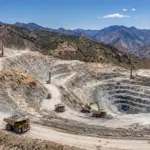
A massive copper ore stockpile at an industrial processing site.
The economic fallout has been immediate. Panama’s public debt now approaches 70% of GDP, and the loss of mine-related revenue has made the government’s deficit targets: capped at 4% for 2025: increasingly difficult to achieve. For more on the initial considerations of this move, see our earlier reporting on how Panama considers a state-owned mining company.

Defining the "State-Owned" model
While initial rhetoric suggested a full nationalization, the current trajectory points toward a more nuanced "partnership" model. Under this framework, the Panamanian state would likely hold a direct equity stake: estimated by market analysts at 5% to 10%: and secure permanent seats on the board of directors. This would grant the government unprecedented oversight into operational safety, environmental compliance, and financial reporting.
Felipe Chapman, Panama’s Minister of Economy and Finance, has emphasized that any new agreement must explicitly recognize the state’s ownership of the mineral resources. This approach mirrors the "Codelco model" used in Chile, where state participation ensures that a higher percentage of mining wealth remains within the country, though the day-to-day operations would likely still involve an experienced international operator.

Global copper deficit impact 2026: A structural shortfall
The timing of Panama’s exploration is dictated by the macro-economic reality of the energy transition. The International Copper Study Group (ICSG) and Wall Street firms like J.P. Morgan have identified 2026 as a critical bottleneck year for the red metal.
| Metric | 2024 (Actual) | 2025 (Forecast) | 2026 (Projected) |
|---|---|---|---|
| Global Refined Copper Balance (Tonnes) | +120,000 | -50,000 | -330,000 |
| Cobre Panama Contribution (Tonnes) | 0 | 70,000 (Stockpiles) | TBD |
| Average LME Copper Price (US$/t) | $9,200 | $10,500 | $12,000+ |
The copper deficit impact 2026 is driven by several factors, including declining ore grades in Chile, operational disruptions in Peru, and the "structural absence" of Cobre Panama’s concentrate. While the Panamanian trade ministry recently authorized the processing of 38 million tonnes of existing ore stockpiles: containing roughly 70,000 tonnes of recoverable copper: this is a "preventive safety action" rather than a full restart. Without a complete reopening, the global supply gap will likely widen, as discussed in the IEA mineral risk report 2026.

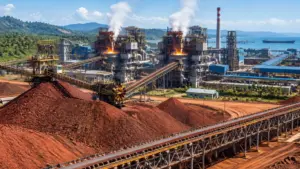
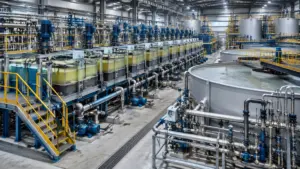
An industrial processing facility at a copper mine illuminated at night.
Fiscal pressure and environmental safeguards
The Mulino administration faces a delicate balancing act. On one hand, the government must restore investor confidence and repair a sovereign credit rating that has come under pressure since the mine’s closure. On the other, it must satisfy a domestic audience that remains skeptical of large-scale extraction.
A government-commissioned audit led by SGS recently found the site to be 88% compliant with environmental commitments. However, the administration has been clear that technical compliance does not automatically trigger a restart. The proposed state partnership is seen as a way to provide "social license" to the project, ensuring that the mine operates under a more rigorous and transparent regulatory regime.

A mining operations control room where staff monitor real-time equipment and maps.
Risks and the path to 2026
Despite the move toward a partnership, significant hurdles remain. Legal challenges regarding the previous contract must be resolved, and a new, constitutionally sound framework must be drafted and approved by the National Assembly. Furthermore, First Quantum Minerals has already initiated international arbitration, seeking billions in damages for the closure.
Investors are watching closely. The resolution of the Cobre Panama standoff is viewed as a bellwether for mining investment across the region. If a state-owned partnership is successful, it could provide a blueprint for other nations looking to balance resource nationalism with the need for foreign capital and technical expertise.
For ongoing analysis of market valuations and commodity shifts, professionals can refer to the latest Skillings Mining Intelligence Investment Edge.

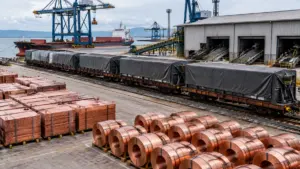
Raw copper concentrate, showing the metallic sheen of the processed mineral.
Conclusion: A race against the clock
As the 2026 deficit looms, Panama’s decision to explore a state-owned mining partnership is more than just a domestic policy shift: it is a critical variable in the global supply chain. The ability to bring Cobre Panama back online under a stable, high-equity framework for the state could stabilize the national economy while providing the copper necessary for the world’s decarbonization goals. However, with the timeline for a full restart still uncertain, the "structural loss" of this tonnage remains a primary driver of bullish price forecasts for the red metal in the coming years.
LinkedIn Snippet
Panama pivots to State-Owned Partnership model for Cobre Panama.
With a projected 330,000-tonne copper deficit looming for 2026, the Panamanian government is exploring a state-led partnership to revive one of the world's largest copper assets. This strategic shift aims to balance fiscal recovery with environmental oversight. Will a state equity stake be enough to secure the "social license" needed to restart?
#Mining #Copper #EnergyTransition #Panama #CriticalMinerals #Commodities