By Penny Langford

The global silver market has entered a transformative period in 2026, transitioning from its traditional role as a store of value to an indispensable industrial commodity. As the world accelerates its energy transition, the metal is facing its sixth consecutive year of structural deficit, creating a supply-demand imbalance that hasn't been seen in decades. Against this backdrop, New Pacific Metals (TSX: NUAG | NYSE: NEWP) has released a Preliminary Economic Assessment (PEA) update for its Carangas project in Bolivia that fundamentally alters the company's valuation floor and strategic importance.
With a post-tax Net Present Value (NPV) of US$2.65 billion, the Carangas project is no longer just an exploration story; it is emerging as a cornerstone asset for the next decade of silver supply.
The 2026 Silver Breakout: Why Now?
The silver price breakout 2026 factors are rooted in a "perfect storm" of dwindling above-ground stocks and relentless industrial consumption. For the last five years, annual demand has outstripped supply, forcing the market to draw down hundreds of millions of ounces from LBMA and COMEX vaults. By mid-2026, these inventories have reached critical levels, removing the "buffer" that previously capped price volatility.
Industrial Demand Drivers: Solar and EVs
Unlike gold, which is largely hoarded, silver is being consumed at record rates. Two sectors are driving this:

- Solar Photovoltaics (PV): The shift to N-type solar cells (TOPCon and HJT), which require significantly more silver per watt than older P-type cells, has pushed solar demand to nearly 30% of total silver consumption.
- Electric Vehicles (EVs): Silver’s superior electrical conductivity makes it vital for the myriad of sensors, power electronics, and charging systems in modern EVs. As the mine electrification trend takes hold, the demand for silver in automotive applications has seen double-digit year-over-year growth.
Current silver price prediction 2026 models from major institutions like J.P. Morgan and HSBC suggest a base case average between US$75/oz and US$85/oz. However, bull-case scenarios: fueled by deep structural deficits: suggest that if solar demand continues to exceed thrifting projections, prices could test the US$100/oz threshold by year-end.


New Pacific Metals: The Carangas Evolution
New Pacific Metals’ updated PEA for the Carangas project (effective July 16, 2026) marks a significant upgrade from its 2024 studies. The most notable change is the integration of a massive gold-rich zone into the mine plan, which starts contributing significantly around year nine of the project life.
This inclusion has transformed Carangas from a silver-dominant "starter pit" into a large-scale, gold-inclusive polymetallic project. The sheer scale of the project now significantly outweighs the company’s current market capitalization, making it one of the premier mining stocks to watch 2026.
Key Economic Highlights of Carangas
The updated economics reflect a robust, high-margin operation capable of weathering cyclical downturns while providing massive leverage to a rising silver price.
| Metric | PEA 2026 Update Value |
|---|---|
| Post-tax NPV (5%) | US$2.65 Billion |
| Internal Rate of Return (IRR) | 35.9% |
| Initial Capital Expenditure (Capex) | US$644.5 Million |
| Payback Period | 2.4 Years |
| Mine Life | 19 Years |
| Life-of-Mine (LOM) Payable Silver | 195.1 Million oz |
| Life-of-Mine (LOM) Payable Gold | 1.1 Million oz |
| Average AISC (AgEq) | ~US$19.16/oz |
The use of US$45/oz silver and US$3,400/oz gold as base-case price assumptions in the PEA may seem aggressive relative to historical averages, but they align with the 2026 reality of structural scarcity and inflationary pressures.
Operational Strategy and Technical Execution
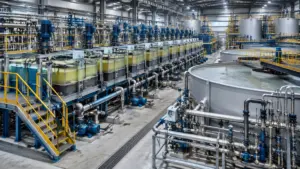
The Carangas project is envisioned as a contract-mining open-pit operation. This approach reduces initial capital intensity and shifts some of the operational risk to specialized mining contractors. The ore will be processed through a conventional crushing, grinding, and flotation circuit to produce high-grade silver-lead and zinc concentrates.

Drilling and Resource Expansion
In 2026, New Pacific has committed to over 30,000 meters of drilling at Carangas. This program serves two purposes:
- Infill Drilling: Upgrading "Inferred" resources to "Indicated" and "Measured" categories to support a formal Feasibility Study.
- Exploration: Testing deeper gold zones and IP (Induced Polarization) anomalies that suggest the deposit may extend well beyond the current pit shell.
The Geopolitical Landscape: Bolivia's Role
Bolivia is a historic mining jurisdiction, but navigating its regulatory framework requires a nuanced approach. New Pacific has been proactive in converting its exploration licenses (EPL) into Administrative Mining Contracts (AMCs). This process involves rigorous "prior consultation" with local communities, a step that the company has prioritized to ensure a long-term "social license" to operate.
As of mid-2026, negotiations to finalize the framework agreement with the Carangas community are ongoing. Once complete, the AMC conversion must be ratified by the Plurinational Legislative Assembly. While this adds a layer of bureaucratic risk, the project's potential to become a major taxpayer and employer in the Oruro Department provides significant incentive for the government to facilitate its progress.
This mirrors broader trends in the region where countries are seeking to secure critical minerals supply chains to participate in the global energy transition.

Silver Deficit: The 46-Million Ounce Shortfall
The Silver Institute’s 2026 World Silver Survey projects a total market deficit of approximately 46 million ounces. This is the narrowest deficit in three years, but it is cumulative. Since 2021, the market has seen a cumulative shortfall of over 760 million ounces.
Industrial users are no longer just buying for immediate needs; they are entering long-term off-take agreements with miners to secure supply. For New Pacific, this creates a favorable environment for project financing. With a 2.4-year payback period and an All-In Sustaining Cost (AISC) of ~US$19.16/oz silver-equivalent, Carangas is positioned at the lower end of the global cost curve, ensuring profitability even if the current "breakout" prices see a temporary correction.
Investment Outlook and Risks
While the $2.65B NPV is a compelling figure, investors must weigh it against the standard risks of project development in South America. The PEA is preliminary and includes "Inferred" resources that may not ultimately be converted into reserves. Furthermore, raising the US$645 million initial capex will require a sophisticated mix of debt, equity, and potentially a strategic partner or silver stream.
However, in the context of mining stocks to watch 2026, New Pacific Metals offers rare exposure to a Tier-1 scale silver asset. Unlike many peers that are struggling with declining grades and aging infrastructure, Carangas represents a "clean sheet" opportunity to build a modern, high-tech mine.
As the industry looks toward the mine of the future, the integration of gold by-products at Carangas provides a unique revenue hedge, making it one of the most resilient development stories in the sector today.
Social Media Snippet (LinkedIn)
? Silver Market Alert 2026: New Pacific Metals has just unveiled a massive PEA update for the Carangas project in Bolivia, boasting a post-tax NPV of US$2.65 Billion and a 35.9% IRR. As silver enters its 6th consecutive year of structural deficit: driven by relentless demand from solar PV and EVs: assets of this scale are becoming strategic necessities. Is Carangas the key to unlocking the next phase of silver supply? Read our deep dive into the 2026 silver price breakout and what it means for mining investors. #MiningNews #SilverPrice #EnergyTransition #NewPacificMetals #MiningInvesting2026